
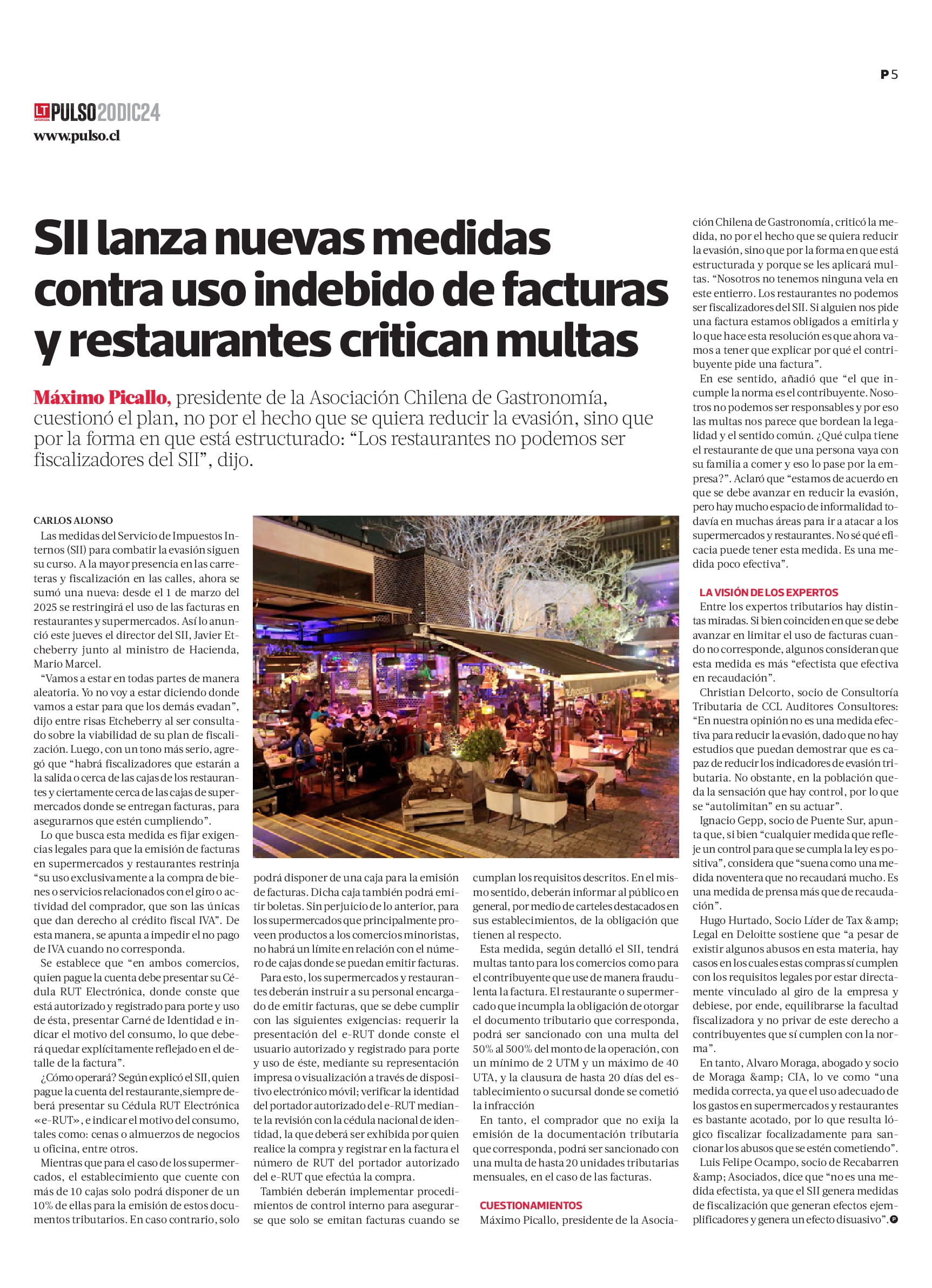
Máximo Picallo, president of the Chilean Gastronomy Association, questioned the plan—not because it seeks to reduce tax evasion, but because of how it is structured: “Restaurants cannot act as auditors for the SII,” he said.
Read the article in La Tercera-Pulso.
The measures of the Internal Revenue Service (SII) to combat tax evasion continue to advance. In addition to increased presence on highways and inspections on the streets, a new measure has been added: starting March 1, 2025, the use of invoices in restaurants and supermarkets will be restricted. This was announced on Thursday by SII Director Javier Etcheberry together with the Minister of Finance, Mario Marcel.
“We will be everywhere at random. I will not say where we will be so that others can evade,” Etcheberry said jokingly when asked about the feasibility of the enforcement plan. He later added more seriously that “there will be inspectors at or near restaurant checkout areas and certainly near supermarket checkout areas where invoices are issued, to ensure compliance.”
The purpose of this measure is to establish legal requirements so that the issuance of invoices in supermarkets and restaurants is restricted “exclusively to the purchase of goods or services related to the buyer’s business or activity, which are the only ones that grant the right to VAT tax credit.” In this way, it aims to prevent the improper non-payment of VAT.
It is established that “in both types of establishments, the person paying must present their Electronic RUT ID (e-RUT), showing they are authorized and registered for its use, present their national identity card, and indicate the reason for the expense, which must be explicitly detailed in the invoice.”
How will it operate? According to the SII, the person paying at the restaurant must always present their Electronic RUT ID (e-RUT) and indicate the reason for the expense, such as business lunches or dinners, among others.
In the case of supermarkets, establishments with more than 10 checkout counters may allocate only 10% of them for issuing these tax documents. Otherwise, only one checkout may be used for issuing invoices, although that checkout may also issue receipts. However, supermarkets primarily supplying goods to retail businesses will not have a limit on the number of checkout counters allowed to issue invoices.
To comply, supermarkets and restaurants must instruct their staff responsible for issuing invoices to meet the following requirements: request the presentation of the e-RUT showing the authorized user through printed format or via a mobile device; verify the identity of the authorized holder using their national ID card; and record in the invoice the RUT number of the authorized holder making the purchase.
They must also implement internal control procedures to ensure invoices are issued only when the requirements are met. Additionally, they must inform the public through visible signage in their establishments about these obligations.
According to the SII, this measure will impose fines on both businesses and taxpayers who misuse invoices. Restaurants or supermarkets that fail to issue the appropriate tax document may face fines ranging from 50% to 500% of the transaction amount, with a minimum of 2 monthly tax units and a maximum of 40 annual tax units, as well as closure of the establishment or branch for up to 20 days.
Meanwhile, buyers who fail to request the appropriate tax documentation may face fines of up to 20 monthly tax units in the case of invoices.
Máximo Picallo, president of the Chilean Gastronomy Association, criticized the measure—not because of its goal to reduce evasion, but due to how it is structured and the imposition of fines. “We have no role in this. Restaurants cannot act as auditors for the SII. If someone requests an invoice, we are obliged to issue it, and now we will have to explain why the taxpayer is requesting it.”
In this regard, he added that “the one who violates the rule is the taxpayer. We cannot be held responsible, and therefore the fines seem to border on legality and common sense. What fault does a restaurant have if someone goes out to eat with their family and charges it to a company?” He clarified that “we agree that efforts should be made to reduce evasion, but there is still significant informality in many areas before targeting supermarkets and restaurants. I am not sure how effective this measure will be. It is not very effective.”
Among tax experts, opinions are divided. While they agree on the need to limit improper use of invoices, some believe this measure is more “symbolic than effective in terms of revenue.”
Christian Delcorto, Tax Consulting Partner at CCL Auditores Consultores: “In our opinion, this is not an effective measure to reduce evasion, as there are no studies demonstrating its ability to reduce tax evasion indicators. However, it creates a perception of control among the public, leading them to self-regulate their behavior.”
Ignacio Gepp, partner at Puente Sur, notes that while “any measure that reinforces compliance is positive,” he believes that “it sounds like a 1990s-style measure that will not generate significant revenue. It is more of a media measure than a fiscal one.”
Hugo Hurtado, Tax & Legal Lead Partner at Deloitte, states that “although there are abuses in this area, there are also cases where such expenses do meet legal requirements because they are directly related to the company’s activity. Therefore, enforcement powers should be balanced so as not to deprive compliant taxpayers of their rights.”
Meanwhile, Álvaro Moraga, lawyer and partner at Moraga & CIA, sees it as “an appropriate measure, since the proper use of expenses in supermarkets and restaurants is quite limited, making targeted enforcement logical to sanction abuses.”
Luis Felipe Ocampo, partner at Recabarren & Asociados, states that “it is not merely symbolic, as SII enforcement measures have demonstrative effects and generate a deterrent impact.”