
In 2023, US$11 million was collected and this year, as of October, US$22 million. When it was approved, the estimate was over US$100 million per year. Experts have divided opinions. Some attribute the low figure to implementation issues, while others argue it has fulfilled its purpose: generating additional revenue for the Treasury.
Read the article in La Tercera-Pulso.
It was part of the funding sources included in the bill that created the Universal Guaranteed Pension (PGU). In January 2022, a luxury tax was approved in the country—an annual levy for fiscal benefit—with a 2% rate applied to the ownership of helicopters, airplanes, yachts, and automobiles with an assessed fiscal value equal to or greater than $40 million as of December 31 of each year. At that time, the projected revenue was 0.05% of GDP annually, around US$119 million ($118,213 million).
Due to how it was structured, the first records of revenue were reported in 2023. According to figures from the General Treasury of the Republic, that year saw effective payments of $10,921 million, approximately US$11 million. Then, between January and October of this year, the amount reached $21,643 million, nearly US$22 million. Thus, since the tax came into effect, total revenue has reached $32,564 million, equivalent to about US$33 million.
What qualifies as a luxury asset? In the case of manned helicopters weighing more than 160 kilos, it refers to vehicles with a market value equal to or greater than 122 UTA, determined based on the value of this unit as of December of the year prior to the tax accrual ($80 million).
The same applies to manned airplanes weighing more than 160 kilos, with a market value equal to or greater than 122 UTA, based on the value as of December of the year prior to the tax accrual ($80 million).
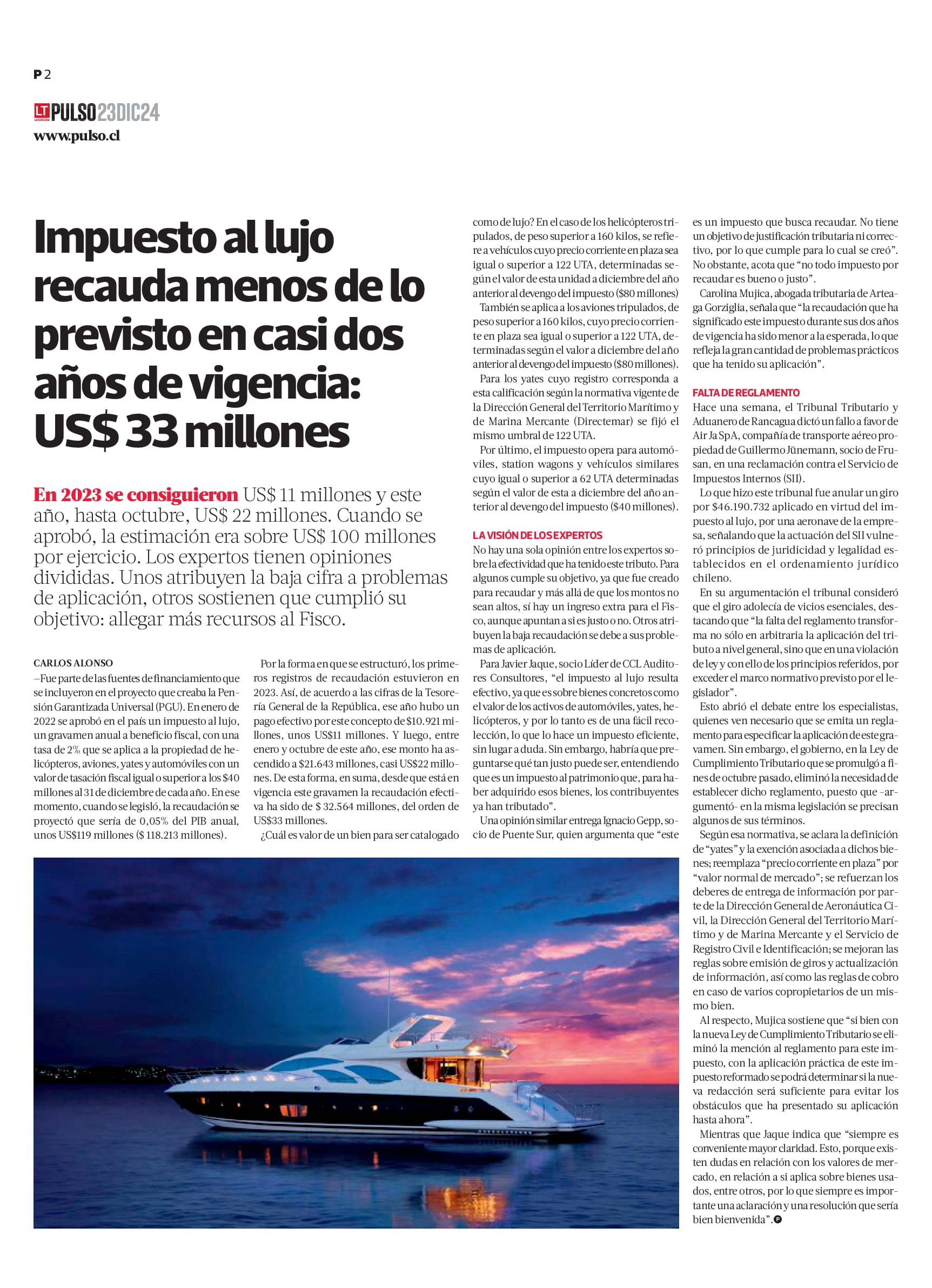
For yachts classified as such under the regulations of the General Directorate of the Maritime Territory and Merchant Marine (Directemar), the same threshold of 122 UTA was established.
Finally, the tax applies to automobiles, station wagons, and similar vehicles with a value equal to or greater than 62 UTA, based on the value of this unit as of December of the year prior to the tax accrual ($40 million).
There is no single view among experts regarding the effectiveness of this tax. For some, it fulfills its purpose, as it was created to generate revenue, and although the amounts are not high, it still provides additional income to the Treasury, though questions remain about its fairness. Others attribute the low revenue to implementation issues.
For Javier Jaque, Lead Partner at CCL Auditores Consultores, “the luxury tax is effective, as it applies to tangible assets such as automobiles, yachts, and helicopters, making it easy to collect and therefore an efficient tax. However, one must question how fair it is, considering it is a wealth tax on assets for which taxpayers have already paid taxes when acquiring them.”
A similar view is shared by Ignacio Gepp, partner at Puente Sur, who argues that “this is a tax designed to generate revenue. It does not have a corrective or redistributive purpose, so it fulfills the role for which it was created.” However, he adds that “not every revenue-generating tax is necessarily good or fair.”
Carolina Mujica, tax attorney at Arteaga Gorziglia, notes that “the revenue generated by this tax during its two years of implementation has been lower than expected, reflecting the numerous practical challenges in its application.”
One week ago, the Tax and Customs Court of Rancagua issued a ruling in favor of Air Ja SpA, an air transport company owned by Guillermo Jünemann, partner at Frusan, in a claim against the Internal Revenue Service (SII).
The court annulled a tax charge of $46,190,732 imposed under the luxury tax for one of the company’s aircraft, stating that the SII’s actions violated principles of legality and due process established under Chilean law.
In its reasoning, the court found that the tax assessment suffered from fundamental flaws, noting that “the absence of a regulation not only makes the application of the tax arbitrary in general, but also constitutes a violation of the law and the principles mentioned, as it exceeds the regulatory framework established by the legislator.”
This has sparked debate among experts, who see it as necessary to issue regulations clarifying how the tax should be applied. However, in the Tax Compliance Law enacted at the end of October, the government eliminated the requirement to issue such regulations, arguing that the legislation itself clarifies key aspects.
According to that regulation, the definition of “yachts” and related exemptions are clarified; “market price” is replaced with “normal market value”; reporting obligations are strengthened for the General Directorate of Civil Aviation, Directemar, and the Civil Registry; and rules on tax assessments, information updates, and collection procedures in cases of multiple co-owners are improved.
Regarding this, Mujica states that “although the new Tax Compliance Law removed the reference to regulations for this tax, practical application will determine whether the new wording is sufficient to overcome the challenges encountered so far.”
Meanwhile, Jaque adds that “greater clarity is always advisable. There are still doubts regarding market values, whether it applies to used assets, among others, so clarification and regulatory guidance would certainly be welcome.”