
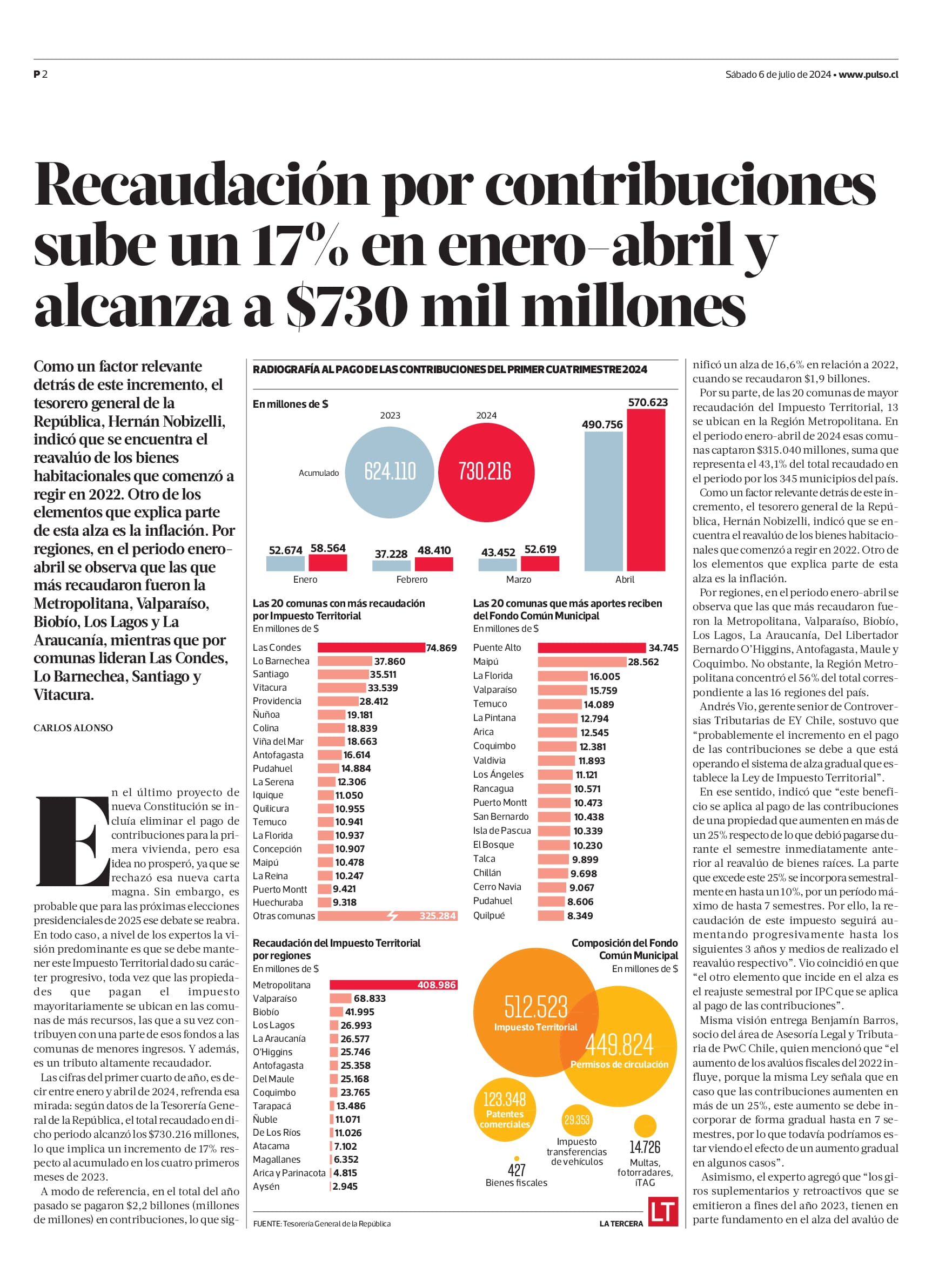
As a relevant factor behind this increase, the General Treasurer of the Republic, Hernán Nobizelli, indicated that the reassessment of residential properties that came into effect in 2022 plays a key role. Another factor explaining part of the increase is inflation. By region, in the January–April period, the highest collections were recorded in the Metropolitan Region, Valparaíso, Biobío, Los Lagos, and La Araucanía, while by municipality, Las Condes, Lo Barnechea, Santiago, and Vitacura led the ranking.
Read the article in La Tercera-Pulso.
The latest draft of the new Constitution included eliminating property tax payments for primary residences, but that proposal did not succeed as the draft Constitution was rejected. However, it is likely that this debate will reopen in the upcoming 2025 presidential elections. In any case, the prevailing view among experts is that this Property Tax should be maintained due to its progressive nature, since properties subject to the tax are mostly located in higher-income municipalities, which in turn contribute part of those funds to lower-income municipalities. Additionally, it is a highly revenue-generating tax.
The figures for the first four months of the year—January to April 2024—support this view: according to data from the General Treasury of the Republic, total revenue collected during this period reached CLP $730.216 billion, representing a 17% increase compared to the same period in 2023.
For reference, in all of last year, CLP $2.2 trillion was collected from property taxes, representing a 16.6% increase compared to 2022, when CLP $1.9 trillion was collected.
Of the 20 municipalities with the highest property tax collection, 13 are located in the Metropolitan Region. During the January–April 2024 period, these municipalities collected CLP $315.040 billion, representing 43.1% of the total collected across the country’s 345 municipalities.
As a key factor behind this increase, the General Treasurer of the Republic, Hernán Nobizelli, indicated that it is due to the reassessment of residential properties that came into effect in 2022. Another contributing factor is inflation.
By region, in the January–April period, the highest collections were recorded in the Metropolitan Region, Valparaíso, Biobío, Los Lagos, La Araucanía, O’Higgins, Antofagasta, Maule, and Coquimbo. However, the Metropolitan Region accounted for 56% of the total across the country’s 16 regions.
Andrés Vio, Senior Manager of Tax Controversies at EY Chile, stated that “the increase in property tax payments is likely due to the gradual increase system established by the Property Tax Law.”
In this regard, he explained that “this benefit applies when property tax payments increase by more than 25% compared to what was payable in the semester immediately prior to the reassessment. The portion exceeding this 25% is incorporated semiannually by up to 10% over a maximum period of seven semesters. Therefore, tax revenue from this source will continue to increase progressively for up to three and a half years after the reassessment.” Vio also agreed that “another factor influencing the increase is the semiannual CPI adjustment applied to property tax payments.”
A similar view is shared by Benjamín Barros, partner in the Legal and Tax Advisory area at PwC Chile, who noted that “the increase in assessed property values in 2022 has had an impact, because the law itself establishes that if property taxes increase by more than 25%, the increase must be incorporated gradually over up to seven semesters, meaning we may still be observing the effects of this gradual adjustment in some cases.”
Additionally, the expert noted that “supplementary and retroactive tax assessments issued at the end of 2023 are partly based on prior increases in property valuations, which has generated controversy regarding their validity, as taxpayers pay property taxes in good faith.”
Javier Jaque, Tax Consulting Partner at CCL Auditores Consultores, also supported this analysis, stating that the increase was influenced by “the reassessment and the CPI adjustments applied semester by semester.” He also noted that delayed payments, which generate interest, had an impact.
The 2022 national reassessment for non-agricultural real estate was 23.4%, increasing from more than CLP $327 trillion to CLP $404 trillion. In the case of residential properties, the increase was 22.1%, rising from more than CLP $191 trillion to CLP $233 trillion.
The Property Tax rates, defined by the Executive in Supreme Decree No. 437, were set at 0.893% for residential properties up to an assessed value of CLP $169,144,585, and 1.042% for the portion exceeding that value. For non-residential properties, such as commercial buildings, warehouses, parking lots, or undeveloped land, among others, the rate was set at 1.042% on the assessed value.
Most of the resources obtained from property tax collection are allocated to the Municipal Common Fund (FCM). In fact, more than half of the revenue is directed to it. Thus, 40% of total collection remains in the municipality where the tax is generated, while 60% goes to the FCM, except in municipalities such as Las Condes, Santiago, Providencia, and Vitacura, which contribute 65% to the FCM and retain 35% of their real estate tax revenue.
According to the General Treasury of the Republic, during the January–April 2024 period, this tax contributed CLP $512.523 billion, while revenues from vehicle circulation permits amounted to CLP $449.824 billion. These figures represented 45.3% and 39.8% of the total, respectively.
In the category of Commercial Licenses, which is the third-largest contributor to the FCM, municipalities such as Santiago contribute 55%, while Las Condes, Providencia, and Vitacura contribute 65% of what they collect through this source.
The municipalities receiving the highest contributions from the FCM are led by Puente Alto, Maipú, La Florida, Valparaíso, and Temuco.
Will the Debate Reopen?
Regarding whether the debate will reopen on exempting certain groups from paying property taxes or eliminating the tax altogether, experts stated that this could be a topic included in proposals by presidential candidates.
“There has always been an effort to benefit specific groups, such as the elderly, or to ease the burden on property owners involved in disputes, affected by occupation, or impacted by disasters such as wildfires, so it will always be a matter of public policy,” stated Barros. However, he added that “the fact that it is a tax that is easy to collect and very difficult to evade makes it highly attractive from a fiscal perspective, so we do not expect a widespread elimination or reduction.”
Vio pointed out that “there has always been debate about applying this tax to elderly homeowners, especially those who do not have sufficient income to reasonably afford the payments.”
While he noted that “there is a benefit allowing for a 100% or 50% reduction depending on income levels, the thresholds set by law may exclude elderly individuals who lack the resources to pay property taxes following reassessment processes.”
This situation, the expert added, “would require a review of the law to ensure that the benefit is effectively applicable to all its intended beneficiaries and to prevent some from being excluded simply because their property values increased beyond the legal thresholds. This issue will likely be addressed by some presidential candidates as a means of providing effective protection for the elderly.”