
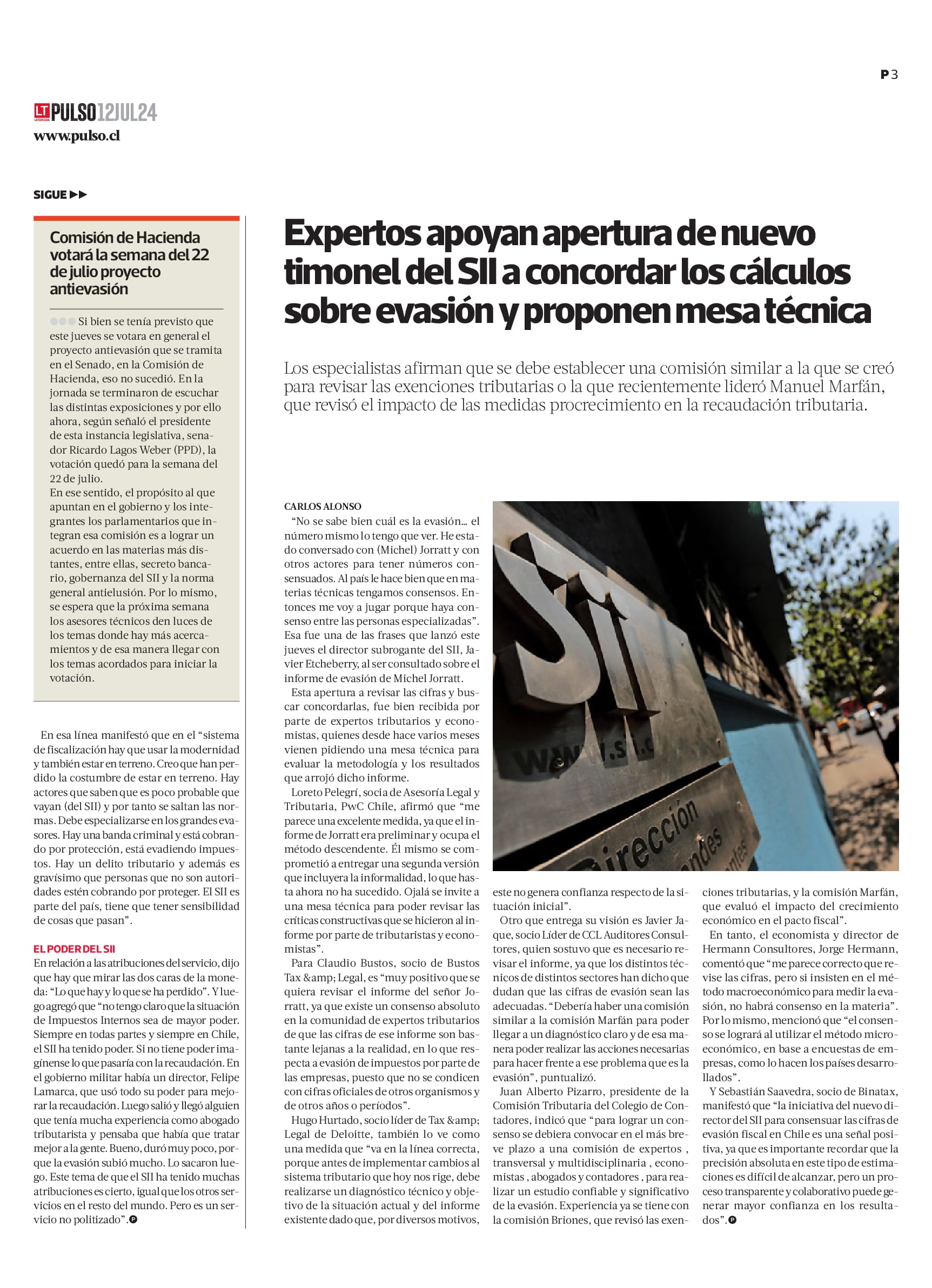
Experts state that a commission similar to the one created to review tax exemptions, or the one recently led by Manuel Marfán that assessed the impact of pro-growth measures on tax revenue, should be established.
Read the news in La Tercera-Pulso.
“It is not entirely clear what the level of evasion is; I need to review the figures myself. I have been speaking with (Michel) Jorratt and other stakeholders to reach consensus on the numbers. It is beneficial for the country to have consensus on technical matters. Therefore, I will push for agreement among specialists.” This was one of the statements made this Thursday by the acting director of the SII, Javier Etcheberry, when asked about Michel Jorratt’s evasion report.
This openness to reviewing the figures and seeking alignment was well received by tax experts and economists, who for several months have been calling for a technical working group to evaluate the methodology and results presented in that report.
Loreto Pelegrí, partner of Legal and Tax Advisory at PwC Chile, stated that “it seems like an excellent measure, since Jorratt’s report was preliminary and uses a top-down methodology. He himself committed to delivering a second version that included informality, which has not yet occurred. Hopefully, a technical working group will be convened to review the constructive criticisms made by tax experts and economists.”
For Claudio Bustos, partner at Bustos Tax & Legal, it is “very positive that the report by Mr. Jorratt is being reviewed, as there is broad consensus within the tax expert community that the figures presented are quite far from reality, particularly regarding corporate tax evasion, as they do not align with official figures from other institutions and from other years or periods.”
Hugo Hurtado, Tax & Legal Leader at Deloitte, also sees this as a measure that “moves in the right direction, because before implementing changes to the current tax system, a technical and objective diagnosis of the current situation and the existing report must be conducted, since, for various reasons, it does not inspire confidence regarding the starting point.”
Another perspective is provided by Javier Jaque, Lead Partner at CCL Auditores Consultores, who stated that it is necessary to review the report, as experts from various sectors have expressed doubts about whether the evasion figures are accurate. “There should be a commission similar to the Marfán Commission to reach a clear diagnosis and, in that way, implement the necessary actions to address the problem of tax evasion,” he emphasized.
Juan Alberto Pizarro, president of the Tax Commission of the Chilean College of Accountants, indicated that “to achieve consensus, a multidisciplinary and cross-sector commission of experts—economists, lawyers, and accountants—should be convened as soon as possible to conduct a reliable and meaningful study of tax evasion. There is already precedent with the Briones Commission, which reviewed tax exemptions, and the Marfán Commission, which evaluated the impact of economic growth on the fiscal pact.”
Meanwhile, economist and director of Hermann Consultores, Jorge Hermann, commented that “it seems appropriate to review the figures, but if the macroeconomic method continues to be used to measure evasion, there will be no consensus on the matter.” Therefore, he noted that “consensus will be achieved by using a microeconomic method based on company surveys, as is done in developed countries.”
Sebastián Saavedra, partner at Binatax, stated that “the initiative of the new SII director to align fiscal evasion figures in Chile is a positive signal, as it is important to remember that absolute precision in this type of estimate is difficult to achieve, but a transparent and collaborative process can generate greater confidence in the results.”