
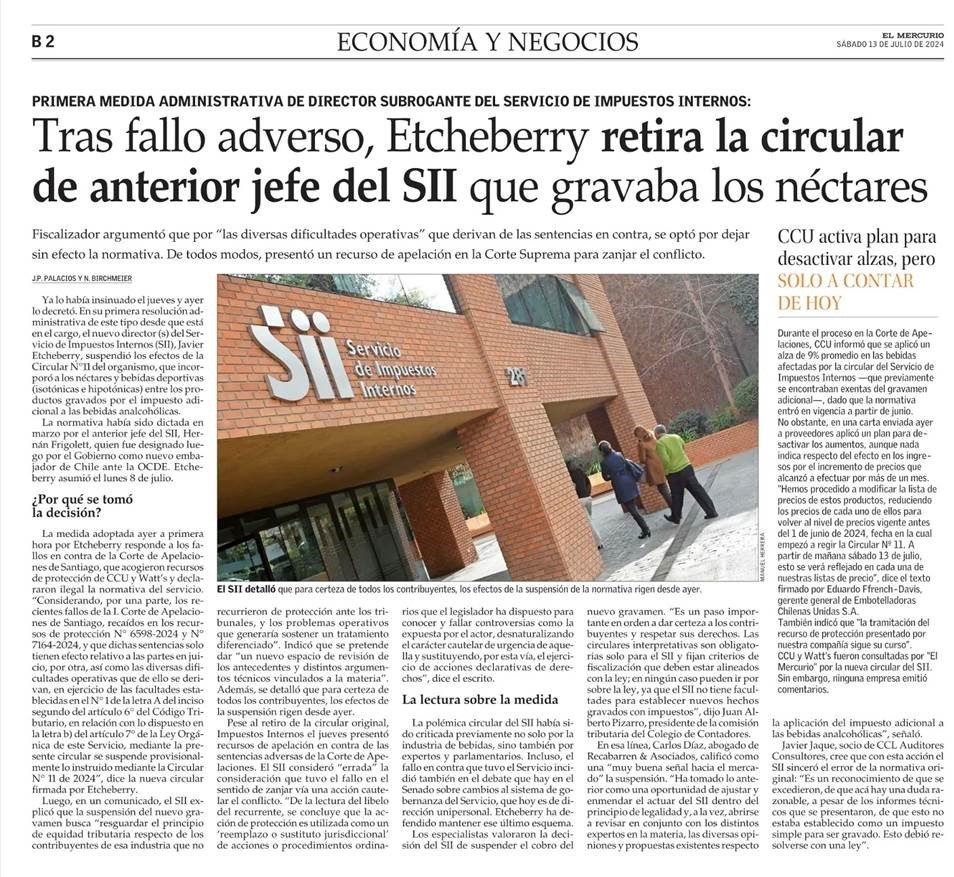
The tax authority argued that due to “various operational difficulties” arising from adverse rulings, it opted to suspend the regulation. Nevertheless, it filed an appeal with the Supreme Court to resolve the dispute.
Read the news in El Mercurio here.
He had already hinted at it on Thursday, and yesterday he formalized it. In his first administrative resolution of this kind since taking office, the new acting director of the Internal Revenue Service (SII), Javier Etcheberry, suspended the effects of Circular No. 11, which had included nectars and sports drinks (isotonic and hypotonic) among the products subject to the additional tax on non-alcoholic beverages.
The regulation had been issued in March by the former head of the SII, Hernán Frigolett, who was later appointed by the government as Chile’s ambassador to the OECD. Etcheberry assumed office on Monday, July 8.
Why was the decision made?
The measure adopted early yesterday by Etcheberry responds to adverse rulings from the Santiago Court of Appeals, which upheld protection appeals filed by CCU and Watt’s and declared the regulation unlawful. “Considering, on the one hand, the recent rulings of the Honorable Santiago Court of Appeals in protection appeals No. 6598-2024 and No. 7164-2024, and that such rulings have only relative effect on the parties involved in the case, and on the other hand, the various operational difficulties arising therefrom, in exercise of the powers established in No. 1 of letter A of the second paragraph of Article 6 of the Tax Code, in relation to the provisions of letter b) of Article 7 of the Organic Law of this Service, the instructions contained in Circular No. 11 of 2024 are hereby provisionally suspended,” states the new circular signed by Etcheberry.
Subsequently, in a statement, the SII explained that the suspension of the new tax aims to “safeguard the principle of tax equity for taxpayers in that industry who did not file protection appeals before the courts, as well as to avoid operational issues that would arise from maintaining differentiated treatment.” It added that the goal is to provide “a new opportunity to review the background and the various technical arguments related to the matter.” It was also specified that, for the sake of certainty, the effects of the suspension apply as of yesterday.
Despite withdrawing the original circular, the Internal Revenue Service filed appeals on Thursday against the adverse rulings of the Court of Appeals. The SII considered the reasoning of the ruling to be “erroneous” in resolving the dispute through a protective action. “From reading the petitioner’s brief, it is concluded that the protection action is being used as a ‘replacement or substitute jurisdictional mechanism’ for ordinary actions or procedures established by the legislator to hear and resolve controversies such as the one presented by the claimant, thus distorting the urgent protective nature of the action and replacing, through this route, the exercise of declaratory actions of rights,” the filing states.
The interpretation of the measure:
The controversial SII circular had previously been criticized not only by the beverage industry but also by experts and lawmakers. The adverse ruling against the Service also influenced the ongoing debate in the Senate regarding changes to the governance system of the SII, which is currently led by a single director. Etcheberry has defended maintaining this structure.
Experts welcomed the SII’s decision to suspend the new tax. “It is an important step toward providing certainty to taxpayers and respecting their rights. Interpretative circulars are binding only on the SII and establish audit criteria that must align with the law; under no circumstances can they go beyond the law, as the SII does not have the authority to create new taxable events,” said Juan Alberto Pizarro, president of the Tax Commission of the Chilean College of Accountants.
In this regard, Carlos Díaz, lawyer at Recabarren & Asociados, described the suspension as a “very positive signal to the market.” “It has taken this as an opportunity to adjust and correct the SII’s actions within the principle of legality, while also opening the door to reviewing, together with experts in the field, the various opinions and proposals regarding the application of the additional tax on non-alcoholic beverages,” he stated.
Javier Jaque, partner at CCL Auditores Consultores, believes that this action reflects an acknowledgment of the error in the original regulation: “It is a recognition that they overstepped, that there is a reasonable doubt here, despite the technical reports presented, that this was not established as a straightforward tax to be imposed. This should have been resolved through legislation.”