
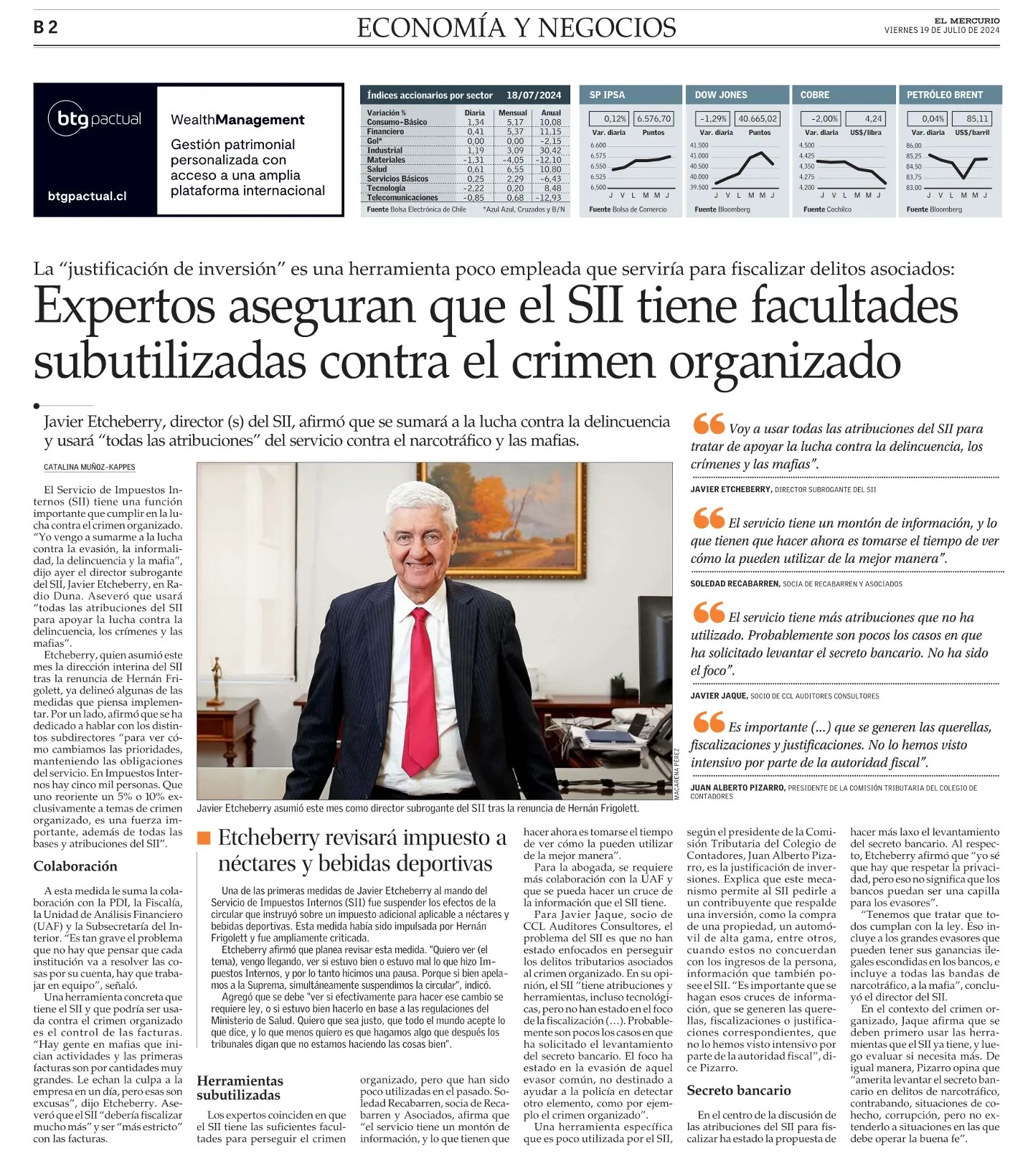
Javier Etcheberry, acting director of the SII, stated that he will join the fight against crime and will use “all the powers” of the service against drug trafficking and organized crime groups.
The Internal Revenue Service (SII) has an important role to play in the fight against organized crime. “I am joining the fight against evasion, informality, crime, and mafias,” said the acting director of the SII, Javier Etcheberry, yesterday on Radio Duna. He stated that he will use “all the powers of the SII to support the fight against crime, criminal activity, and mafias.”
Etcheberry, who assumed interim leadership of the SII this month following the resignation of Hernán Frigolett, has already outlined some of the measures he intends to implement. On the one hand, he stated that he has been speaking with the different sub-directors “to see how we can shift priorities while maintaining the service’s obligations. There are five thousand people in the Internal Revenue Service. Redirecting even 5% or 10% exclusively to organized crime issues is a significant force, in addition to all the SII’s resources and powers.”
Collaboration
To this, he adds collaboration with the Investigations Police (PDI), the Public Prosecutor’s Office, the Financial Analysis Unit (UAF), and the Undersecretariat of the Interior. “The problem is so serious that we cannot think each institution will solve it independently; we must work as a team,” he said.
A specific tool available to the SII that could be used against organized crime is invoice monitoring. “There are people in criminal organizations who start businesses and issue their first invoices for very large amounts. They blame the company in a single day, but those are excuses,” said Etcheberry. He added that the SII “should audit much more” and be “stricter” with invoices.
Underutilized tools
Experts agree that the SII has sufficient powers to pursue organized crime, but that these have been underutilized in the past. Soledad Recabarren, partner at Recabarren y Asociados, states that “the service has a great deal of information, and what they need to do now is take the time to determine how to use it in the best possible way.”
According to the lawyer, greater collaboration with the UAF is needed, along with cross-referencing the information held by the SII.
For Javier Jaque, partner at CCL Auditores Consultores, the issue with the SII is that it has not been focused on pursuing tax crimes associated with organized crime. In his view, the SII “has powers and tools, including technological ones, but they have not been the focus of audits (…). There have likely been few cases where it has requested the lifting of bank secrecy. The focus has been on the evasion of the typical evader, rather than supporting law enforcement in detecting other elements, such as organized crime.”
A specific tool that has been underutilized by the SII, according to the president of the Tax Commission of the Chilean College of Accountants, Juan Alberto Pizarro, is the justification of investments. He explains that this mechanism allows the SII to require a taxpayer to justify an investment—such as the purchase of real estate, a luxury vehicle, among others—when it does not align with the individual’s reported income, information that the SII also holds. “It is important that these data cross-checks are carried out and that complaints, audits, or justifications are generated accordingly, which we have not seen intensively from the tax authority,” says Pizarro.
Bank secrecy
At the center of the discussion regarding the SII’s powers has been the proposal to make it easier to lift bank secrecy. In this regard, Etcheberry stated that “I understand the need to respect privacy, but that does not mean banks can be a sanctuary for evaders.”
“We must ensure that everyone complies with the law. That includes large-scale evaders who may have their illegal profits hidden in banks, as well as drug trafficking groups and mafias,” concluded the SII director.
In the context of organized crime, Jaque states that existing SII tools should first be fully utilized before considering whether additional powers are needed. Similarly, Pizarro believes that “lifting bank secrecy is warranted in cases of drug trafficking, smuggling, bribery, and corruption, but it should not be extended to situations where good faith should prevail.”