
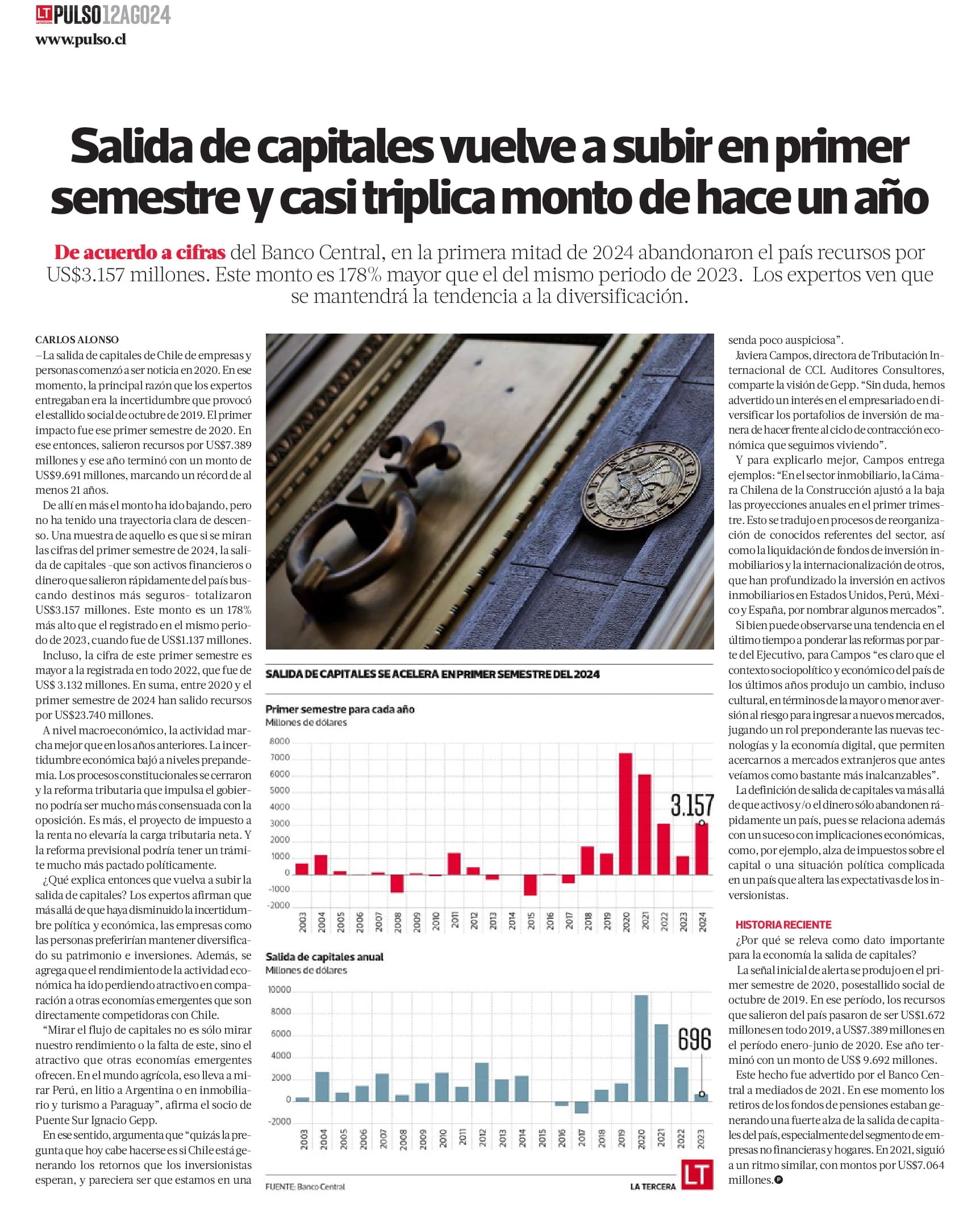
According to figures from the Central Bank, in the first half of 2024, resources totaling US$3.157 billion left the country. This amount is 178% higher than in the same period of 2023. Experts believe the trend toward diversification will continue.
Read the article in La Tercera-Pulso.
Capital outflows from Chile by companies and individuals began to make headlines in 2020. At that time, the main reason identified by experts was the uncertainty caused by the social unrest of October 2019. The first impact was seen in the first half of 2020, when US$7.389 billion left the country, and the year ended with a total of US$9.691 billion, marking a record of at least 21 years.
Since then, the amount has declined, but it has not followed a clear downward trajectory. Evidence of this is that in the first half of 2024, capital outflows—defined as financial assets or money that quickly left the country in search of safer destinations—totaled US$3.157 billion. This figure is 178% higher than that recorded in the same period of 2023, when it amounted to US$1.137 billion.
Moreover, the figure for this first half exceeds that recorded for all of 2022, which was US$3.132 billion. In total, between 2020 and the first half of 2024, US$23.740 billion has left the country.
At a macroeconomic level, economic activity is performing better than in previous years. Economic uncertainty has fallen to pre-pandemic levels. Constitutional processes have concluded, and the tax reform promoted by the government could be more consensual with the opposition. Furthermore, the income tax bill would not increase the net tax burden, and pension reform could proceed with broader political agreement.
What explains, then, the renewed increase in capital outflows? Experts state that, beyond the reduction in political and economic uncertainty, both companies and individuals prefer to keep their assets and investments diversified. Additionally, the performance of economic activity has become less attractive compared to other emerging economies that directly compete with Chile.
“Looking at capital flows is not only about assessing our own performance or lack thereof, but also the attractiveness offered by other emerging economies. In agriculture, that leads us to consider Peru; in lithium, Argentina; and in real estate and tourism, Paraguay,” says Ignacio Gepp, partner at Puente Sur.
In this regard, he argues that “perhaps the question we should be asking today is whether Chile is generating the returns that investors expect, and it seems that we are on a less favorable path.”
Javiera Campos, Director of International Taxation at CCL Auditores Consultores, shares Gepp’s view. “We have clearly observed growing interest among business leaders in diversifying their investment portfolios as a way to face the economic contraction cycle we are still experiencing.”
To explain this further, Campos provides examples: “In the real estate sector, the Chilean Chamber of Construction lowered its annual projections in the first quarter. This resulted in restructuring processes among well-known industry players, as well as the liquidation of real estate investment funds and the internationalization of others, which have increased investments in real estate assets in the United States, Peru, Mexico, and Spain, among other markets.”
Although a recent trend shows greater consideration of reforms by the Executive, for Campos “it is clear that the sociopolitical and economic context of recent years has produced a shift, even cultural, in terms of greater or lesser risk aversion when entering new markets. New technologies and the digital economy play a key role, allowing us to access foreign markets that previously seemed far less attainable.”
The definition of capital outflows goes beyond the mere movement of assets or money leaving a country quickly; it is also associated with events that have economic implications, such as increases in capital taxes or complex political situations that alter investors’ expectations.
Recent history
Why is capital outflow considered an important economic indicator?
The initial warning signal emerged in the first half of 2020, following the social unrest of October 2019. During that period, resources leaving the country increased from US$1.672 billion in all of 2019 to US$7.389 billion between January and June 2020. That year ended with a total of US$9.692 billion.
This situation was highlighted by the Central Bank in mid-2021. At that time, pension fund withdrawals were driving a sharp increase in capital outflows, particularly among non-financial companies and households. In 2021, the trend continued at a similar pace, reaching US$7.064 billion.