
On both issues there is already agreement between the government and the opposition. In the case of bank secrecy, the change that satisfied both sides is that access to information will be granted through judicial means, but within defined timeframes, something that does not currently exist. Meanwhile, for the anonymous whistleblower, the defrauded amount threshold is increased. This Wednesday, it will be voted on in the Senate Finance Committee.
Read the news in La Tercera-Pulso.
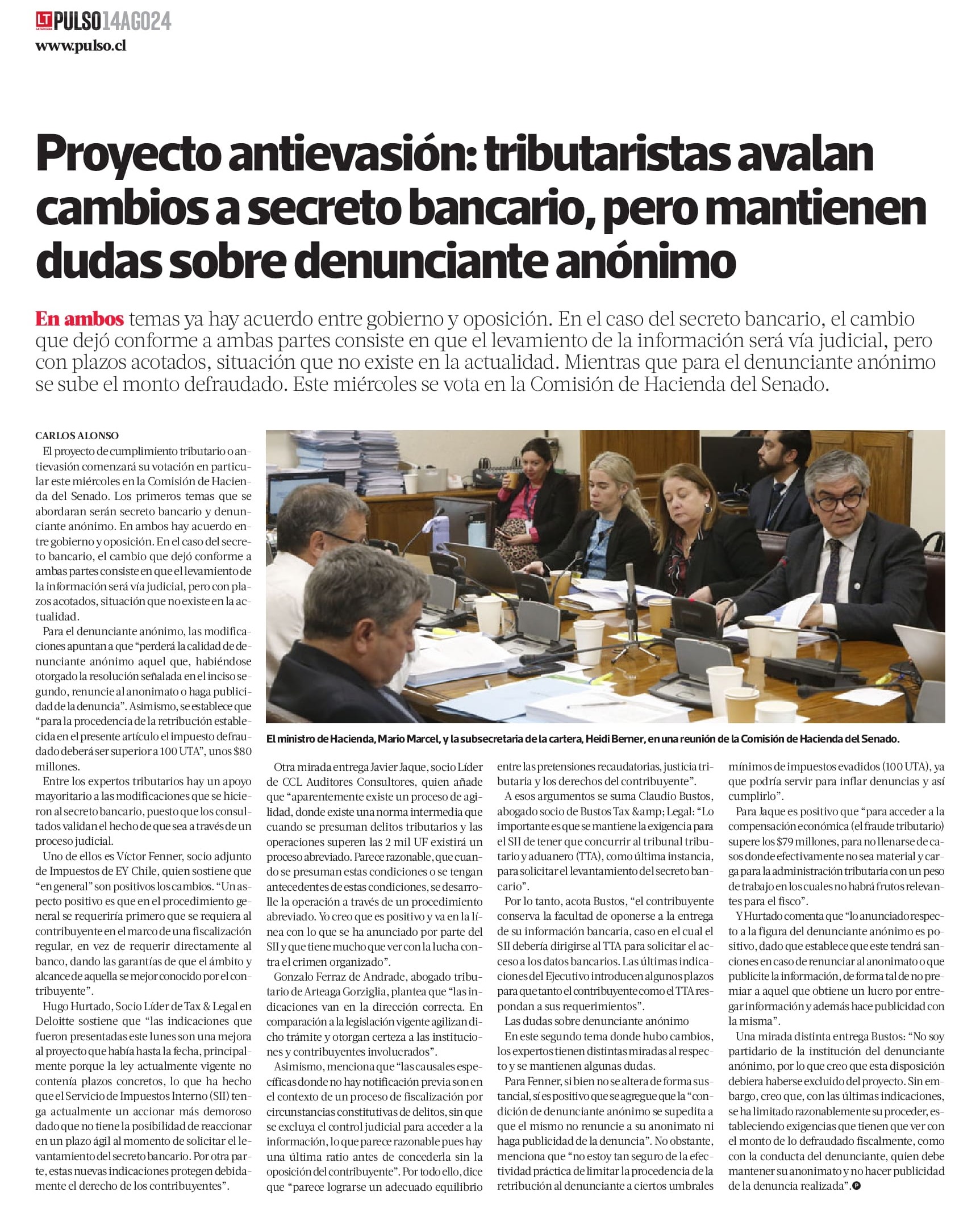
The tax compliance or anti-evasion bill will begin its detailed voting this Wednesday in the Senate Finance Committee. The first issues to be addressed will be bank secrecy and the anonymous whistleblower. On both, there is agreement between the government and the opposition. In the case of bank secrecy, the change that satisfied both parties consists of granting access to information through judicial channels, but with defined timeframes, something that does not currently exist.
Regarding the anonymous whistleblower, the amendments establish that “the status of anonymous whistleblower will be lost by anyone who, after being granted the resolution referred to in the second paragraph, renounces anonymity or publicizes the complaint.” Likewise, it is established that “for the compensation provided for in this article to apply, the defrauded tax must exceed 100 UTA,” approximately CLP $80 million.
Among tax experts, there is broad support for the modifications made to bank secrecy, as those consulted validate the fact that the process is carried out through judicial means.
One of them is Víctor Fenner, Associate Tax Partner at EY Chile, who states that “in general” the changes are positive. “A positive aspect is that under the general procedure, it would first require contacting the taxpayer within the framework of a regular audit, instead of directly approaching the bank, thus providing guarantees that the scope and extent of the process are better understood by the taxpayer.”
Hugo Hurtado, Tax & Legal Leader at Deloitte, states that “the amendments presented this Monday improve the bill compared to its previous version, mainly because the current law did not include specific deadlines, which has resulted in slower action by the Internal Revenue Service (SII), as it lacks the ability to respond swiftly when requesting the lifting of bank secrecy. On the other hand, these new amendments properly protect taxpayers’ rights.”
Another perspective is provided by Javier Jaque, Lead Partner at CCL Auditores Consultores, who adds that “there appears to be a streamlined process, with an intermediate rule whereby, when tax crimes are presumed and transactions exceed 2,000 UF, a simplified procedure will be applied. It seems reasonable that when these conditions are presumed or there is evidence of them, the process is carried out through a simplified procedure. I believe this is positive and aligns with what has been announced by the SII, and is closely related to the fight against organized crime.”
Gonzalo Ferraz de Andrade, tax attorney at Arteaga Gorziglia, states that “the amendments move in the right direction. Compared to current legislation, they streamline the process and provide certainty to both institutions and taxpayers involved.”
He also notes that “the specific cases where there is no prior notification occur in the context of an audit process involving circumstances constituting crimes, without excluding judicial oversight to access the information, which seems reasonable since there is a final step before granting access without the taxpayer’s opposition.” For all these reasons, he concludes that “an appropriate balance seems to be achieved between revenue objectives, tax justice, and taxpayers’ rights.”
Claudio Bustos, partner at Bustos Tax & Legal, adds: “The important point is that the requirement remains for the SII to go before the Tax and Customs Court (TTA), as a last instance, to request the lifting of bank secrecy.”
Therefore, Bustos adds, “the taxpayer retains the right to oppose the disclosure of their banking information, in which case the SII would have to go to the TTA to request access to such data. The latest amendments introduced by the Executive set certain deadlines for both the taxpayer and the TTA to respond to these requests.”
Doubts regarding the anonymous whistleblower
On this second issue where changes were made, experts hold different views and some doubts remain.
For Fenner, although there is no substantial change, it is positive that it is added that “the condition of anonymous whistleblower is subject to the individual not renouncing their anonymity or publicizing the complaint.” However, he notes that “I am not entirely convinced of the practical effectiveness of limiting compensation eligibility to certain minimum thresholds of evaded taxes (100 UTA), as it could incentivize inflating complaints to meet the requirement.”
For Jaque, it is positive that “to access economic compensation, the tax fraud must exceed CLP $79 million, in order to avoid an overload of cases that are not material and that would burden the tax administration with work that yields no significant benefit to the Treasury.”
And Hurtado comments that “what has been announced regarding the anonymous whistleblower is positive, as it establishes sanctions if anonymity is waived or if the information is publicized, thus avoiding rewarding someone who profits from providing information while also making it public.”
Bustos offers a different perspective: “I am not in favor of the anonymous whistleblower mechanism, so I believe this provision should have been excluded from the bill. However, I think that, with the latest amendments, its application has been reasonably limited by establishing requirements related to the amount of tax fraud, as well as the conduct of the whistleblower, who must maintain anonymity and not publicize the complaint.”