
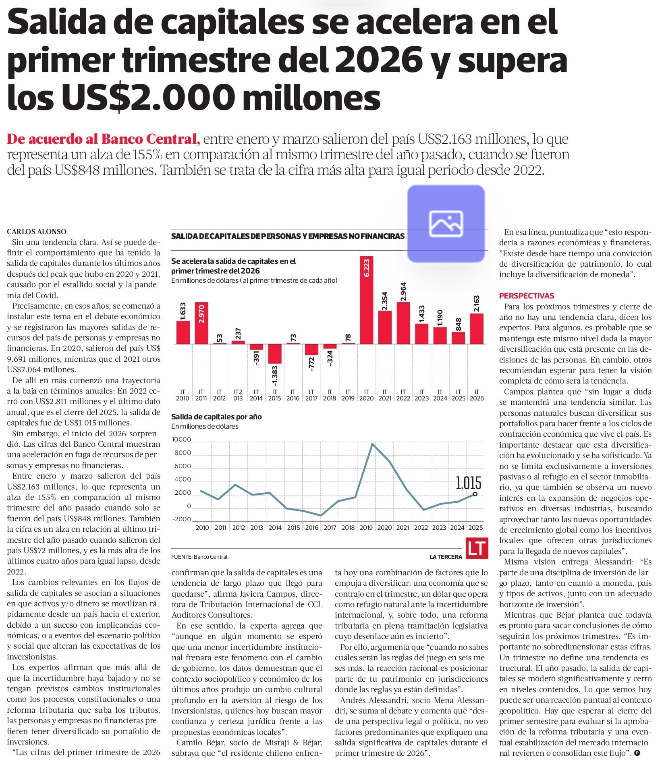
According to the Central Bank, between January and March, US$2.163 billion left the country, representing a 155% increase compared to the same quarter last year, when US$848 million exited the country. It is also the highest figure for the same period since 2022.
Without a clear trend. That is how the behavior of capital outflows over recent years can be described after the peak observed in 2020 and 2021, caused by the social unrest and the Covid-19 pandemic.
Indeed, during those years, the issue became part of the economic debate and the largest outflows of resources from individuals and non-financial companies were recorded. In 2020, US$9.691 billion left the country, while in 2021 another US$7.064 billion exited.
From that point onward, an annual downward trend began: 2022 closed with US$2.811 billion in outflows, and according to the latest annual figure — corresponding to the end of 2025 — capital outflows totaled US$1.015 billion.
However, the beginning of 2026 came as a surprise. Central Bank figures show an acceleration in the outflow of resources from individuals and non-financial companies.
Between January and March, US$2.163 billion left the country, representing a 155% increase compared to the same quarter last year, when only US$848 million exited. The figure also represents an increase compared to the last quarter of the previous year, when US$72 million left the country, and it is the highest level for the same period in the last four years, since 2022.
Significant changes in capital outflow trends are associated with situations in which assets and/or money move rapidly from one country to another due to events with economic implications, or political and social developments that alter investors’ expectations.
Experts state that, beyond the reduction in uncertainty and the absence of expected institutional changes such as constitutional processes or tax reforms that would increase taxes, individuals and non-financial companies still prefer to keep diversified investment portfolios.
“The figures from the first quarter of 2026 confirm that capital outflows are a long-term trend that is here to stay,” says Javiera Campos.
In that regard, the expert adds that “although at one point it was expected that lower institutional uncertainty following the change of government would slow this phenomenon, the data show that the sociopolitical and economic context of recent years has produced a profound cultural shift in investors’ risk aversion. Investors are now seeking greater confidence and legal certainty in response to local economic proposals.”
Camilo Béjar emphasizes that “Chilean residents currently face a combination of factors pushing them toward diversification: an economy that contracted during the quarter, a dollar that acts as a natural safe haven amid international uncertainty, and above all, a tax reform currently under legislative discussion whose outcome remains uncertain.”
Therefore, he argues that “when you do not know what the rules of the game will be six months from now, the rational response is to position part of your wealth in jurisdictions where the rules are already clearly defined.”
Andrés Alessandri also joins the debate, stating that “from a legal or political perspective, I do not see predominant factors explaining a significant capital outflow during the first quarter of 2026.”
Along the same lines, he points out that “this would respond to economic and financial reasons. There has long been a conviction regarding wealth diversification, which also includes currency diversification.”
Outlook
For the coming quarters and year-end, experts say there is still no clear trend. Some believe this same level of capital outflows is likely to continue given the growing emphasis on diversification in investment decisions. Others recommend waiting for a broader view before determining the direction of the trend.
Campos argues that “without a doubt, a similar trend will continue. Individuals seek to diversify their portfolios in order to face the economic contraction cycles affecting the country. It is important to highlight that this diversification has evolved and become more sophisticated. It is no longer limited exclusively to passive investments or real estate safe havens, as there is also growing interest in expanding operating businesses across various industries, seeking to take advantage of new global growth opportunities as well as local incentives offered by other jurisdictions to attract new capital.”
Alessandri shares the same view: “It is part of a long-term investment discipline, both in terms of currency, country, and asset classes, together with an appropriate investment horizon.”
Meanwhile, Béjar argues that it is still too early to draw conclusions about how the coming quarters will evolve. “It is important not to overstate these figures. One quarter does not define a structural trend. Last year, capital outflows moderated significantly and closed at contained levels. What we are seeing today may be a temporary reaction to the geopolitical environment. We must wait until the end of the first half of the year to assess whether the approval of the tax reform and a possible stabilization of international markets will reverse or consolidate this trend”.