
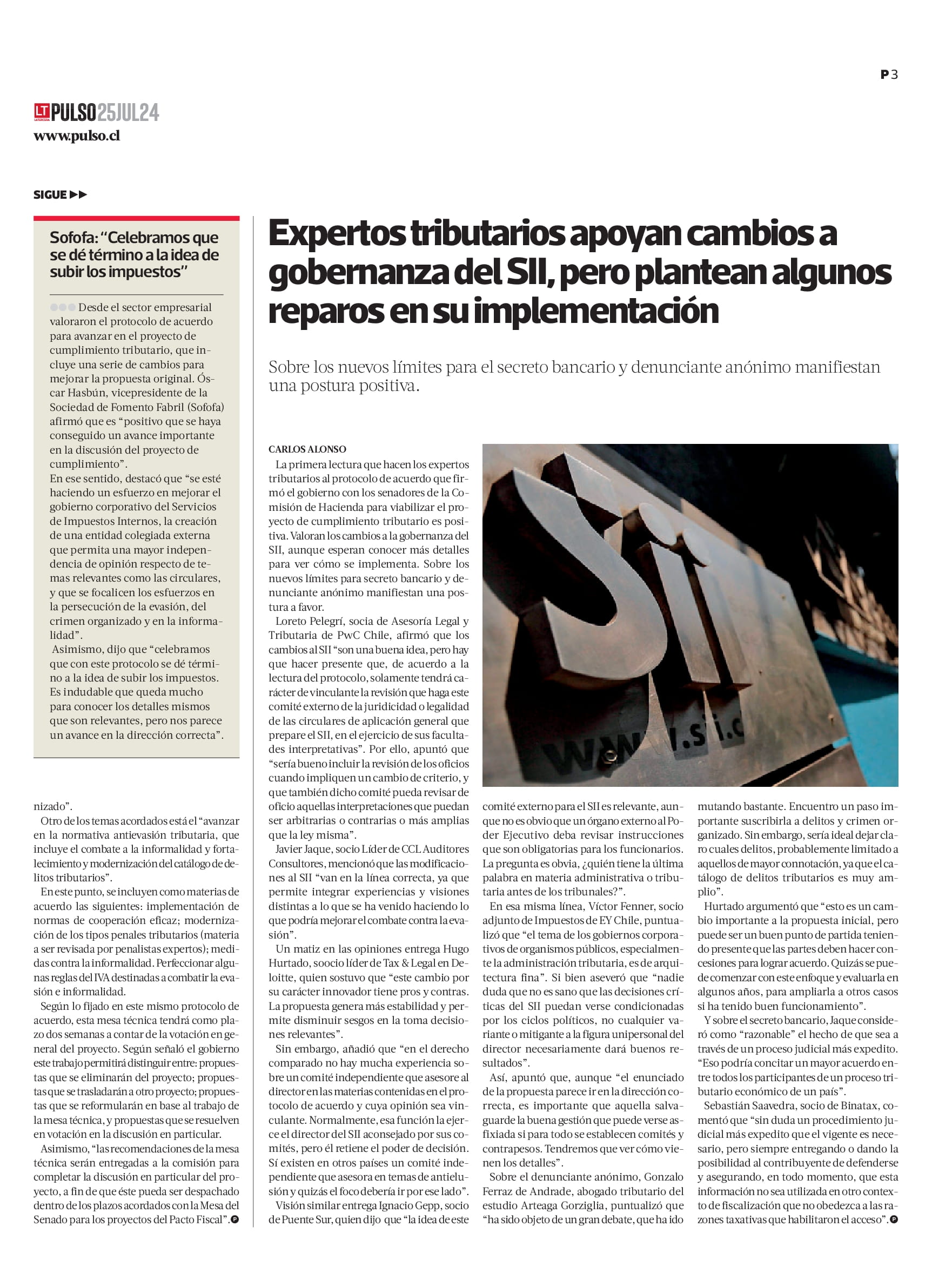
Regarding the new limits on bank secrecy and the anonymous whistleblower, experts express a positive stance.
Read the news in La Tercera-Pulso.
The initial assessment by tax experts of the agreement protocol signed between the government and the senators of the Finance Committee to advance the tax compliance bill is positive. They value the changes to the governance of the SII, although they expect to learn more details regarding its implementation. Regarding the new limits on bank secrecy and the anonymous whistleblower, they express a favorable position.
Loreto Pelegrí, partner of Legal and Tax Advisory at PwC Chile, stated that the changes to the SII “are a good idea, but it should be noted that, according to the protocol, only the external committee’s review of the legality of general application circulars prepared by the SII, in the exercise of its interpretative powers, will be binding.” She added that “it would be beneficial to include the review of official rulings when they imply a change in criteria, and also that the committee be able to review, on its own initiative, interpretations that may be arbitrary, contrary to, or broader than the law itself.”
Javier Jaque, Lead Partner at CCL Auditores Consultores, mentioned that the modifications to the SII “are moving in the right direction, as they allow for the integration of different experiences and perspectives compared to what has been done so far, which could improve the fight against evasion.”
A nuance in the opinions is provided by Hugo Hurtado, Tax & Legal Leader at Deloitte, who stated that “this change, due to its innovative nature, has pros and cons. The proposal generates greater stability and helps reduce bias in decision-making on key matters.”
However, he added that “in comparative law, there is not much experience with an independent committee advising the director on the matters included in the agreement protocol, whose opinion is binding. Normally, this role is carried out by the SII director advised by internal committees, but he retains decision-making authority. There are, however, examples in other countries of independent committees advising on anti-avoidance matters, and perhaps the focus should move in that direction.”
A similar view is shared by Ignacio Gepp, partner at Puente Sur, who stated that “the idea of this external committee for the SII is relevant, although it is not obvious that an entity outside the Executive Branch should review instructions that are mandatory for officials. The question is clear: who has the final say in administrative or tax matters before reaching the courts?”
In the same vein, Víctor Fenner, Associate Tax Partner at EY Chile, pointed out that “the issue of corporate governance in public entities, especially tax administrations, requires a highly refined design.” While he noted that “no one doubts that it is unhealthy for critical SII decisions to be influenced by political cycles, not every alternative or mitigation to the director’s single-person authority will necessarily yield good results.”
Thus, he added that although “the proposal appears to be heading in the right direction, it is important that it safeguards effective management, which could be stifled if committees and counterbalances are introduced for everything. We will need to see the details.”
Regarding the anonymous whistleblower, Gonzalo Ferraz de Andrade, tax attorney at Arteaga Gorziglia, pointed out that “it has been the subject of significant debate and has evolved considerably. I consider it an important step to limit it to crimes and organized crime. However, it would be ideal to clearly define which crimes are included, likely limiting it to those of greater significance, as the catalogue of tax crimes is very broad.”
Hurtado argued that “this is a significant change from the initial proposal, but it could be a good starting point, considering that all parties must make concessions to reach an agreement. Perhaps it can begin with this approach and be evaluated in a few years, to expand it to other cases if it proves effective.”
And regarding bank secrecy, Jaque considered it “reasonable” that it be handled through a more expedited judicial process. “This could generate greater agreement among all participants in a country’s economic tax process.”
Sebastián Saavedra, partner at Binatax, commented that “a more expedited judicial process than the current one is certainly necessary, but always ensuring that taxpayers have the opportunity to defend themselves and guaranteeing, at all times, that this information is not used in other audit contexts beyond the specific reasons that justified access.”