
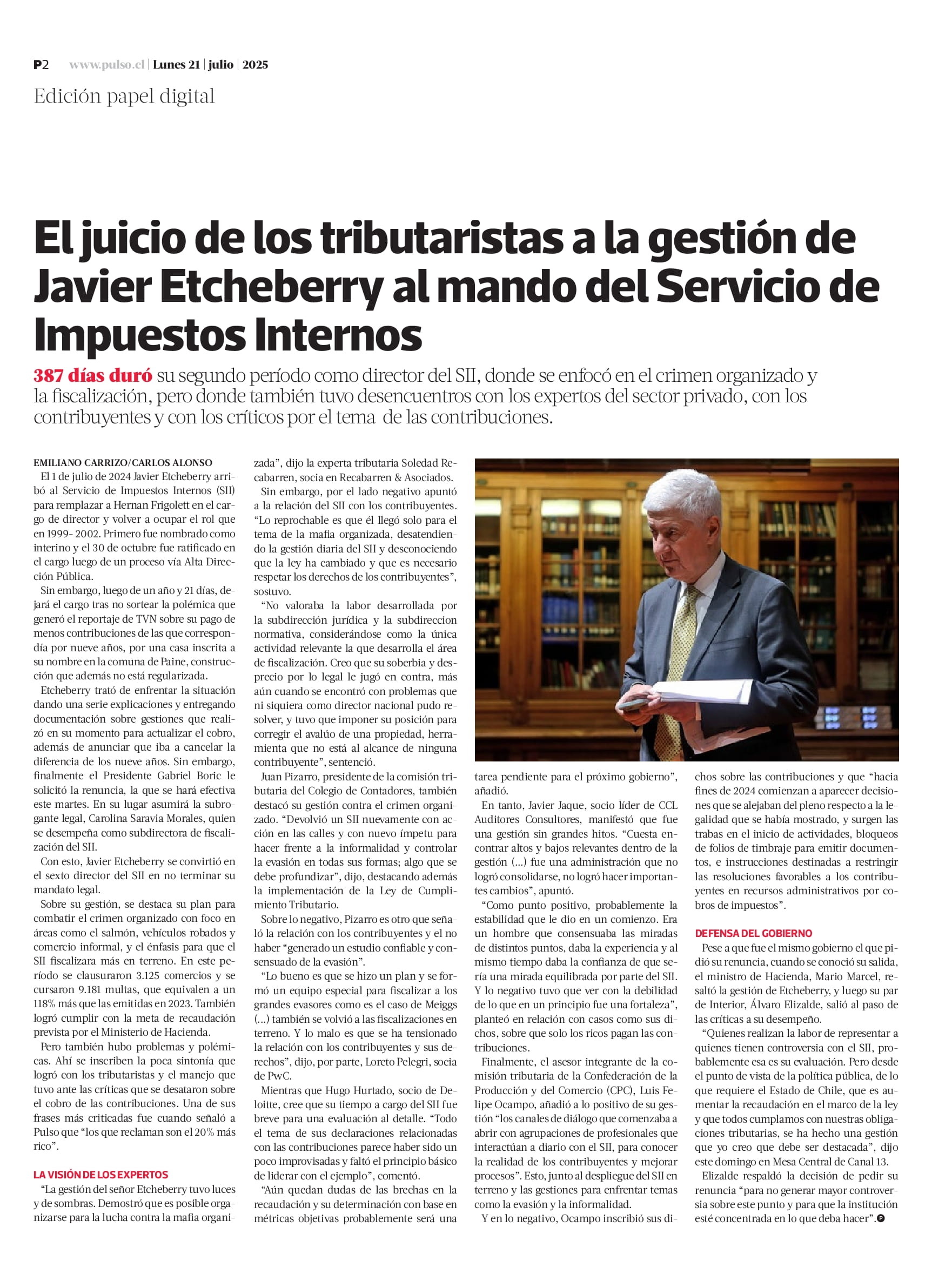
His second term as Director of the SII lasted 387 days, during which he focused on organized crime and enforcement, but also faced disagreements with private-sector experts, taxpayers, and critics over property tax issues.
Read the article in La Tercera-Pulso.
On July 1, 2024, Javier Etcheberry joined the Internal Revenue Service (SII) to replace Hernán Frigolett as Director, returning to a role he had previously held from 1999 to 2002. He was initially appointed on an interim basis and was formally confirmed on October 30 following a public selection process.
However, after one year and 21 days, he will step down after failing to overcome the controversy triggered by a TVN report regarding underpayment of property taxes for nine years on a house registered in his name in the commune of Paine, a property that is also not formally regularized.
Etcheberry attempted to address the situation by providing explanations and documentation of efforts he made to update the tax assessment, and announced that he would pay the outstanding difference for the nine years. Nevertheless, President Gabriel Boric ultimately requested his resignation, which will take effect this Tuesday. His replacement will be acting Director Carolina Saravia Morales, who currently serves as Deputy Director of Enforcement at the SII.
With this, Javier Etcheberry became the sixth SII Director not to complete his legal term.
Regarding his management, his plan to combat organized crime is highlighted, with a focus on areas such as salmon, stolen vehicles, and informal trade, as well as an emphasis on increasing field enforcement. During his tenure, 3,125 businesses were shut down and 9,181 fines were issued, representing a 118% increase compared to 2023. He also met the revenue collection targets set by the Ministry of Finance.
However, there were also challenges and controversies. These included a lack of alignment with tax experts and his handling of criticism regarding property tax charges. One of his most criticized statements was when he told Pulso that “those who complain are the richest 20%.”
Experts’ views
“Mr. Etcheberry’s management had both strengths and weaknesses. He demonstrated that it is possible to organize efforts to combat organized crime,” said tax expert Soledad Recabarren, partner at Recabarren & Asociados.
However, she criticized his relationship with taxpayers. “The issue is that he focused solely on organized crime, neglecting the daily management of the SII and overlooking that the law has evolved and that taxpayers’ rights must be respected,” she stated.
“He did not value the work of the legal and regulatory sub-directorates, considering enforcement as the only relevant activity. I believe his arrogance and disregard for legal aspects worked against him, especially when he encountered issues that even as national director he could not resolve, and had to impose his position to adjust a property valuation—something no ordinary taxpayer could do,” she concluded.
Juan Pizarro, president of the Tax Commission of the Association of Accountants, also highlighted his efforts against organized crime. “He restored an SII with active presence on the streets and renewed momentum to tackle informality and control tax evasion in all its forms—something that should be further strengthened,” he said, also noting the implementation of the Tax Compliance Law.
On the negative side, Pizarro also pointed to the relationship with taxpayers and the failure to “produce a reliable and consensus-based study of tax evasion.”
“The positive aspect is that a plan was implemented and a special team was formed to audit major evaders, such as in the case of Meiggs (…) and field inspections were resumed. The negative aspect is the strain placed on the relationship with taxpayers and their rights,” said Loreto Pelegri, partner at PwC.
Meanwhile, Hugo Hurtado, partner at Deloitte, believes his tenure was too short for a thorough evaluation. “His statements regarding property taxes seemed somewhat improvised, and there was a lack of the basic principle of leading by example,” he noted.
“There are still questions about gaps in tax collection, and determining them based on objective metrics will likely remain a pending task for the next administration,” he added.
Meanwhile, Javier Jaque, Managing Partner of CCL Auditores Consultores, stated that it was a management without major milestones. “It is difficult to identify significant highs or lows in his administration (…) it was a management that failed to consolidate and did not achieve major changes,” he said.
“As a positive aspect, perhaps the stability he initially provided. He was someone who brought together different perspectives, contributed experience, and inspired confidence that the SII would take a balanced approach. The negative aspect was the weakening of what was initially a strength,” he added, referring to controversies such as his statements that only the wealthy pay property taxes.
Finally, Luis Felipe Ocampo, advisor and member of the Tax Commission of the Confederation of Production and Commerce (CPC), added that a positive aspect of his management was “the dialogue channels he began to open with professional groups that interact daily with the SII, to better understand taxpayers’ realities and improve processes,” along with increased field presence and efforts to address issues such as evasion and informality.
On the negative side, Ocampo pointed to his statements on property taxes and that “toward the end of 2024, decisions began to emerge that deviated from the legal rigor previously shown, including obstacles in business registration processes, blocking of invoicing folios, and instructions aimed at restricting favorable administrative rulings for taxpayers regarding tax charges.”
Government’s response
Despite the government itself requesting his resignation, Finance Minister Mario Marcel highlighted Etcheberry’s management upon his departure, and Interior Minister Álvaro Elizalde responded to criticism of his performance.
“Those who represent individuals in disputes with the SII may have that perspective. But from a public policy standpoint—what the Chilean State requires, which is increasing revenue within the law and ensuring that everyone complies with their tax obligations—this has been a management that should be recognized,” he said on Sunday on Mesa Central (Canal 13).
Elizalde also supported the decision to request his resignation “to avoid further controversy on this issue and allow the institution to focus on its responsibilities.”