
Experts warn that the measure could affect economic activity and the formal labor market, and call for exploring alternative ways to offset it.
Read the article in El Mercurio.
One of the innovations included in the tax reform bill presented by the government—and already rejected by the opposition—is the increase in taxes on higher-income individuals.
The proposal seeks to modify the two highest brackets of the Global Complementary Tax, effectively returning to the scheme in place until 2014, which was later changed by the tax reform during Michelle Bachelet’s second administration.
This means that individuals earning monthly income between 120 and 150 UTA (CLP 8.2 million to CLP 10.2 million) will be subject to a marginal tax rate of 38%, replacing the current 35%. Meanwhile, those earning more than CLP 10.2 million per month will face a marginal rate of 40%. Currently, this top rate applies only to those earning more than CLP 20.8 million monthly.
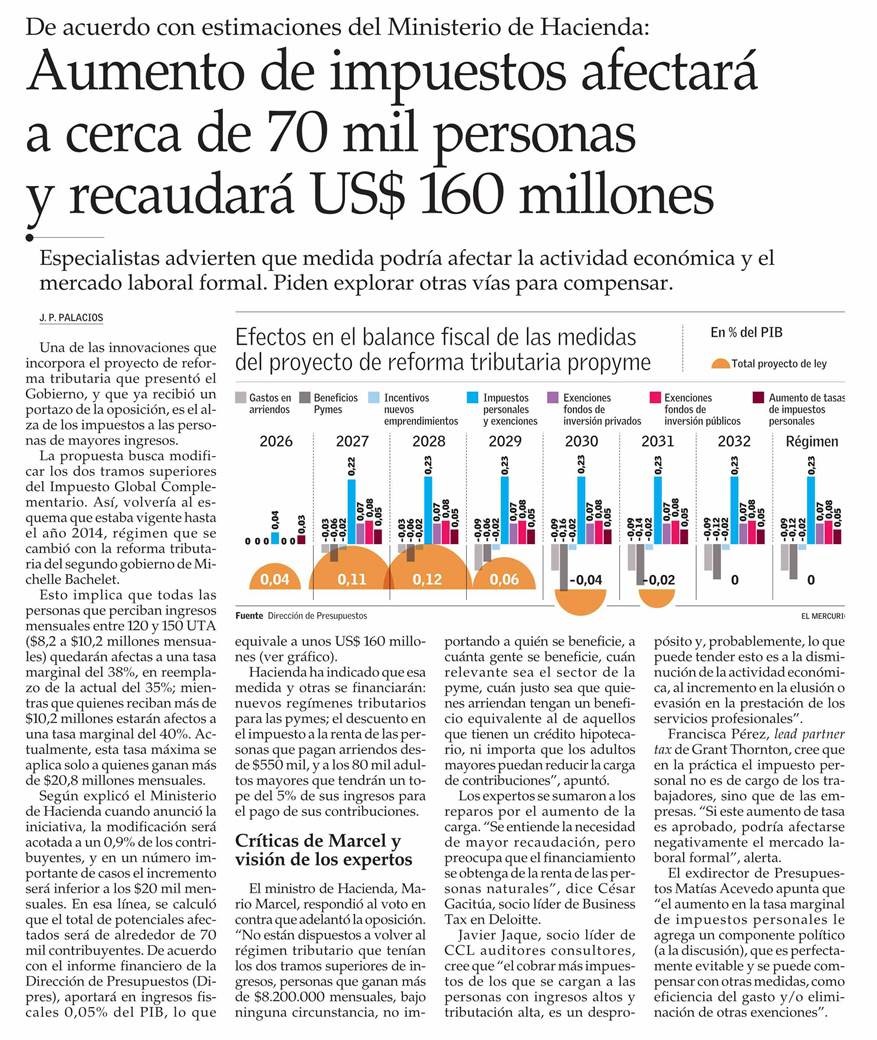
According to the Ministry of Finance, the measure would affect only 0.9% of taxpayers, and in many cases, the increase would be less than CLP 20,000 per month. It is estimated that approximately 70,000 taxpayers would be affected. According to the financial report from the Budget Office (Dipres), the measure would generate fiscal revenue equivalent to 0.05% of GDP, or around US$160 million (see chart).
The Ministry of Finance indicated that this measure, along with others, would be financed through new tax regimes for SMEs, income tax deductions for individuals paying rent above CLP 550,000, and a cap for 80,000 senior citizens limiting property tax payments to 5% of their income.
Marcel’s response and experts’ views
Finance Minister Mario Marcel responded to the opposition’s announced rejection. “They are not willing to return to the previous tax regime for the highest income brackets—those earning more than CLP 8.2 million per month—under any circumstances, regardless of who benefits, how many people benefit, how relevant the SME sector is, how fair it is for renters to receive benefits similar to those with mortgage loans, or that senior citizens could reduce their property tax burden,” he stated.
Experts also expressed concerns about the increased tax burden. “The need for greater revenue is understood, but it is concerning that the financing comes from the income of individuals,” said César Gacitúa, Business Tax Leader at Deloitte.
Javier Jaque, Managing Partner of CCL Auditores Consultores, believes that “imposing higher taxes on individuals who already have high income and tax burdens is misguided and could lead to a reduction in economic activity, as well as an increase in tax avoidance or evasion in professional services.”
Francisca Pérez, Tax Lead Partner at Grant Thornton, argues that in practice, personal income tax is not borne by workers, but by companies. “If this tax increase is approved, it could negatively affect the formal labor market,” she warns.
Former Budget Director Matías Acevedo notes that “the increase in marginal personal tax rates adds a political component to the discussion that is entirely avoidable and could be offset by other measures, such as improving spending efficiency and/or eliminating other tax exemptions.”