
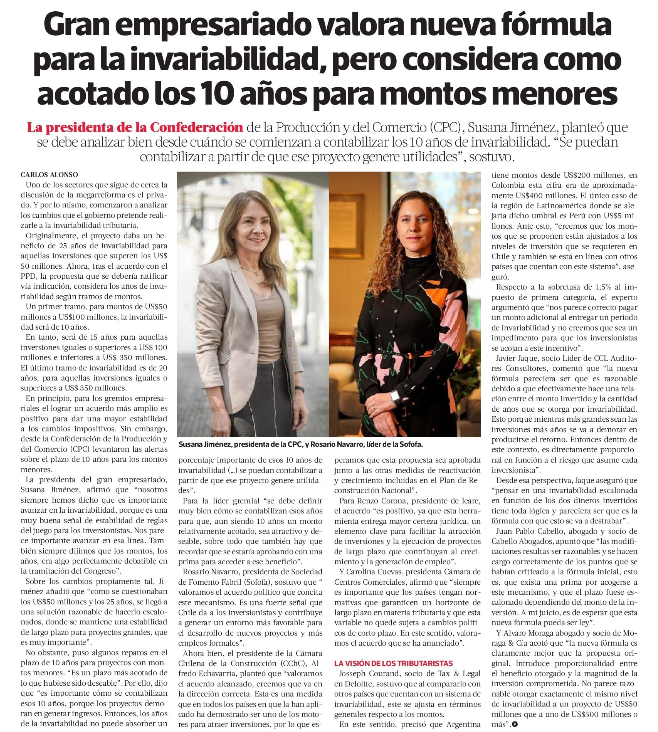
The president of the Confederation of Production and Commerce (CPC), Susana Jiménez, argued that careful consideration should be given to when the 10-year tax stability period begins. “It should be counted from the moment the project starts generating profits,” she stated.
One of the sectors closely following the discussion of the government’s proposed Mega Reform is the business community, which has begun assessing the changes to the tax stability mechanism.
Under the original proposal, investments exceeding US$50 million would receive 25 years of tax stability. Following an agreement with the PPD, the revised proposal introduces a tiered system based on investment size:
- US$50 million to US$100 million: 10 years of tax stability
- US$100 million to US$350 million: 15 years of tax stability
- US$350 million and above: 20 years of tax stability
Business associations generally view the broader political agreement positively, considering it a signal of greater certainty for investors. However, concerns remain regarding the shorter 10-year period for lower investment levels.
CPC President Susana Jiménez noted that tax stability sends an important signal regarding the predictability of the rules governing investments. While she considers the tiered approach reasonable, she emphasized that a 10-year period may be shorter than desirable and that its effectiveness will depend on how the timeframe is calculated, given that large projects often take years before generating revenue.
Other business leaders, including representatives from Sofofa, the Chilean Chamber of Construction (CChC), Icare, and the Chamber of Shopping Centers, also welcomed the agreement, highlighting its potential to strengthen legal certainty, attract investment, promote economic growth, and generate employment.
Tax Experts’ Perspective
Tax specialists generally view the revised formula favorably.
Josseph Courand, Partner at Deloitte Tax & Legal, noted that the proposed investment thresholds are broadly aligned with those used in other countries that offer tax stability regimes. He also stated that the proposed 1.5% surcharge on the corporate income tax rate appears reasonable in exchange for the benefit of tax certainty.
Javier Jaque, Managing Partner of CCL Auditores Consultores, commented that:
“The new formula appears reasonable because it establishes a relationship between the amount invested and the number of years of tax stability granted. Larger investments generally take longer to generate returns, so the duration of tax stability should be proportional to the level of risk assumed by investors.”
He added that a tiered system based on investment size is logical and could be the mechanism that helps unlock broader political support for the initiative.
Other experts, including Juan Pablo Cabello and Álvaro Moraga, also agreed that the revised proposal is an improvement over the original version because it introduces greater proportionality between the benefit granted and the magnitude of the investment committed.