
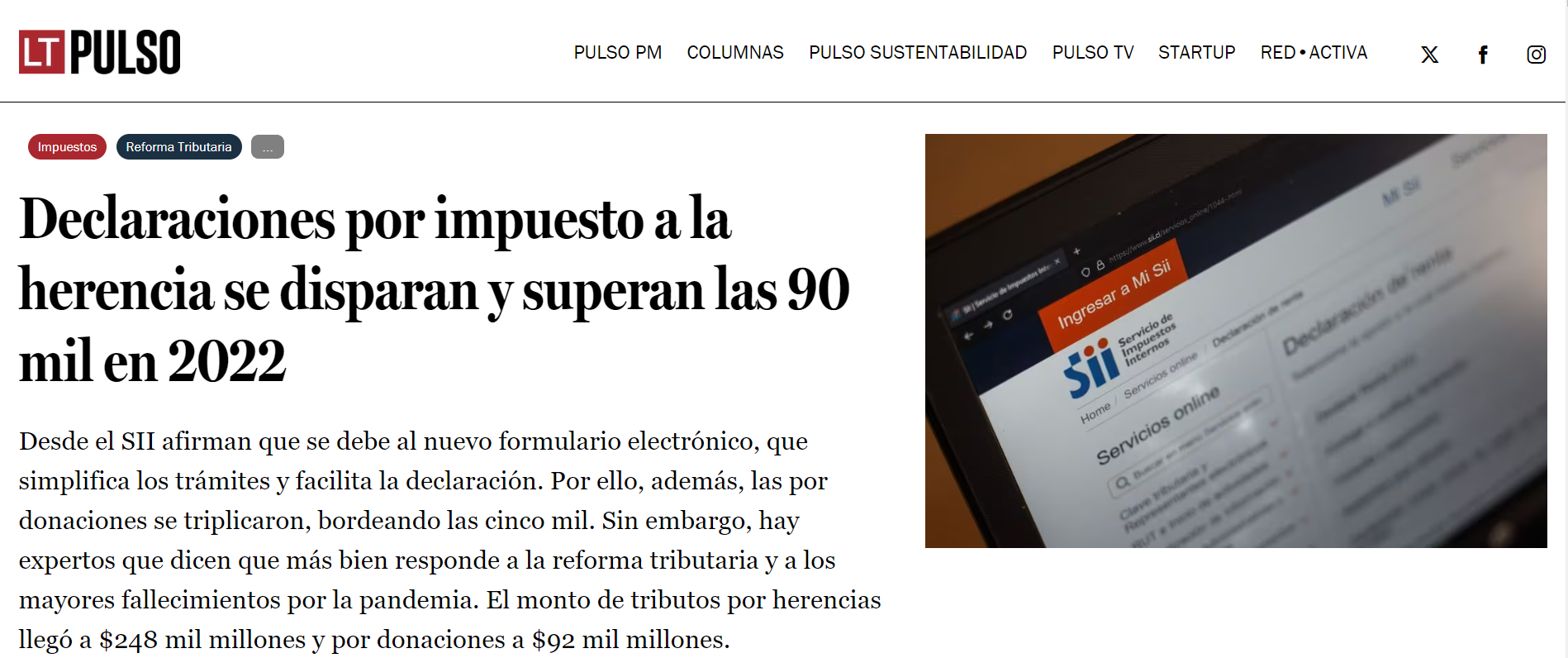
According to the Internal Revenue Service (SII), this is due to the new electronic form, which simplifies procedures and facilitates filing. As a result, donation filings also tripled, reaching close to five thousand. However, some experts argue that it is instead driven by the tax reform and the increased number of deaths due to the pandemic. The amount of taxes collected from inheritances reached CLP 248 billion and from donations CLP 92 billion.
Read the article in La Tercera-Pulso.
The self-imposed goal of the Internal Revenue Service (SII) is to collect an additional 0.4% of GDP beyond what was projected for this year. In this effort, improved control over tax evasion and avoidance among high-net-worth taxpayers will play a fundamental role, with a special focus on their tax behavior regarding the declaration and payment of inheritance and donation taxes.
This was defined as a priority by the SII in its 2023 Tax Compliance Management Plan.
Who are considered high-net-worth individuals? To be classified as such, a person must meet the following conditions: having income over the last three tax periods exceeding US$150,000 (approximately CLP 120 million), or personal wealth exceeding US$1 million (CLP 800 million), or family wealth exceeding US$2 million.
The SII estimates that there are 92,226 high-net-worth individuals in Chile, according to its current registry. During 2023, the SII’s analysis of this segment is focused on controlling compliance risks in two areas: intergenerational wealth transfers (inheritances and donations), and the declaration and payment of the global complementary income tax.
Intergenerational transfer
In the case of intergenerational wealth transfer, the tax applicable to a taxpayer will depend on the form and timing in which it is carried out, according to the SII. Thus, such transfers may be subject to donation tax when assets are transferred free of charge through acts between living persons. Meanwhile, inheritance tax applies to transfers of assets upon death, and income tax applies to transfers for consideration between living persons.
According to the SII, in cases of donation, the law establishes a progressive tax rate, with the highest bracket reaching 25%. In terms of income tax and its final taxation, the rate may reach 40%, which could apply in cases of transfers for consideration (where there is a cost or obligation).
Regarding inheritance tax, the SII states that “it must be considered that transfers made free of charge (benefit for the recipient) previously carried out between the deceased and the heir must be included in determining the taxable base, although the tax already paid at the time may be deducted. In this context, inheritance tax may be understood as a final tax.”
The law on donations, allocations, and inheritance specifies that if a person makes a donation to a relative, it is not taxed under donation tax, but rather under inheritance tax rules.
Javier Jaque, Tax Consulting Partner at CCL AC Auditores Consultores, explains that “inheritance applies when a person passes away, and it is processed through probate. Heirs are appointed, and they are awarded the assets.” However, Jaque emphasizes that “through donation, assets can be transferred to family members before death, but in this case, inheritance tax still applies as established by law.”
Expert opinions
Among experts, there are differing views regarding this increase. Some agree with the SII that it is due to the simplification of procedures, while others argue that it is driven by the tax reform currently under discussion in Congress.
Among the former is Sebastián Benedetti, lawyer and partner at CBC Abogados, who states that “the increase in filings and revenue is mainly due to the fact that the new process is much faster and more efficient, allowing procedures that previously took months to now be completed in minutes.” He also adds that “regarding donations, it is likely that prior to this more streamlined enforcement model, some taxpayers did not report small donations due to the lengthy process and the relatively low risk of enforcement and sanctions.”
On the other hand, Jaque argues that “while simplifications are always positive, the increase in inheritance and donation filings is not necessarily due to process simplification, but rather because the market prepared for the wealth tax and inheritance tax. As a result, asset transfers and donations began to increase. The use of donations and inheritances intensified, which may better explain this rise than the simplification itself.”