
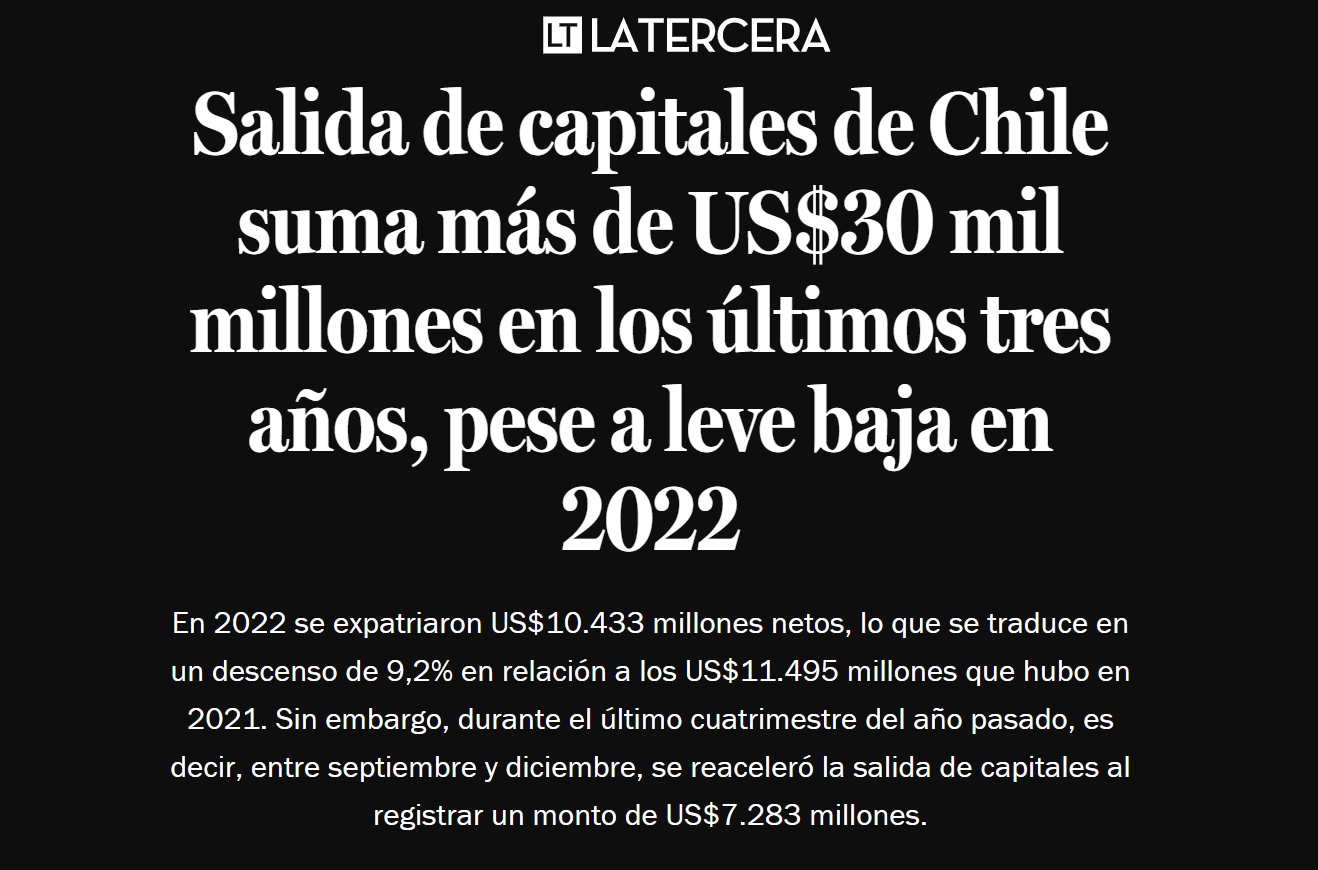
In 2022, a net total of US$10.433 billion was expatriated, representing a 9.2% decrease compared to the US$11.495 billion recorded in 2021. However, during the last four months of the year—that is, between September and December—capital outflows accelerated again, reaching US$7.283 billion.
Read the full article in La Tercera-Pulso.
In mid-2021, the Central Bank warned that withdrawals of pension funds were generating a significant increase in capital outflows from the country, particularly from non-financial companies and households. In 2022, this trend moderated slightly compared to the previous period, but still remained well above levels seen before the social unrest.
The Minister of Finance, Mario Marcel, has stated that the level of capital outflows was lower than in previous years. This view is partially supported by Central Bank data: in 2022, net capital outflows reached US$10.432 billion, representing a 9.2% decrease compared to US$11.495 billion in 2021. However, this figure is still 6.2% higher than in 2020, when US$9.812 billion left the country, and significantly higher than in 2019, when outflows totaled US$1.693 billion. In 2017, there was even a net capital inflow of US$1.073 billion.
Looking at the evolution of 2022, it is observed that up to August, the difference compared to 2021 was 72.7% lower for the same period. However, during the last four months of the year, capital outflows accelerated again, reaching US$7.283 billion, compared to US$687 million in the same period of 2021.
In the breakdown of the final part of 2022, it is noted that in November there was a significant spike in capital expatriation, reaching US$5.838 billion.
What explains this?
There is no single explanation among analysts. Some point to the progress of the tax reform, others to changes in tax domicile or diversification of investment portfolios among high-net-worth individuals. Another possible factor is the distribution of profits by some companies in November.
Among tax experts, the explanation is similar: reduced uncertainty following the constitutional process.
Javier Jaque, Tax Consulting Partner at CCL AC Auditores Consultores, states that “in 2021 the constitutional process was underway, and under that context of uncertainty, resources began to leave the country. Subsequently, what happened was the rejection of the Constitution, which provided greater political and economic certainty to the country.”
Downward trend?
Although economic prospects for this year are less negative than previously expected and uncertainty has decreased—which could suggest a slowdown in capital outflows from households and non-financial companies—experts remain cautious and do not necessarily expect the trend to continue downward.
“This year could present a complex scenario, as the approval of a wealth tax could create challenges for high-net-worth taxpayers, so it is not clear that the downward trend will continue,” Jaque indicates.