
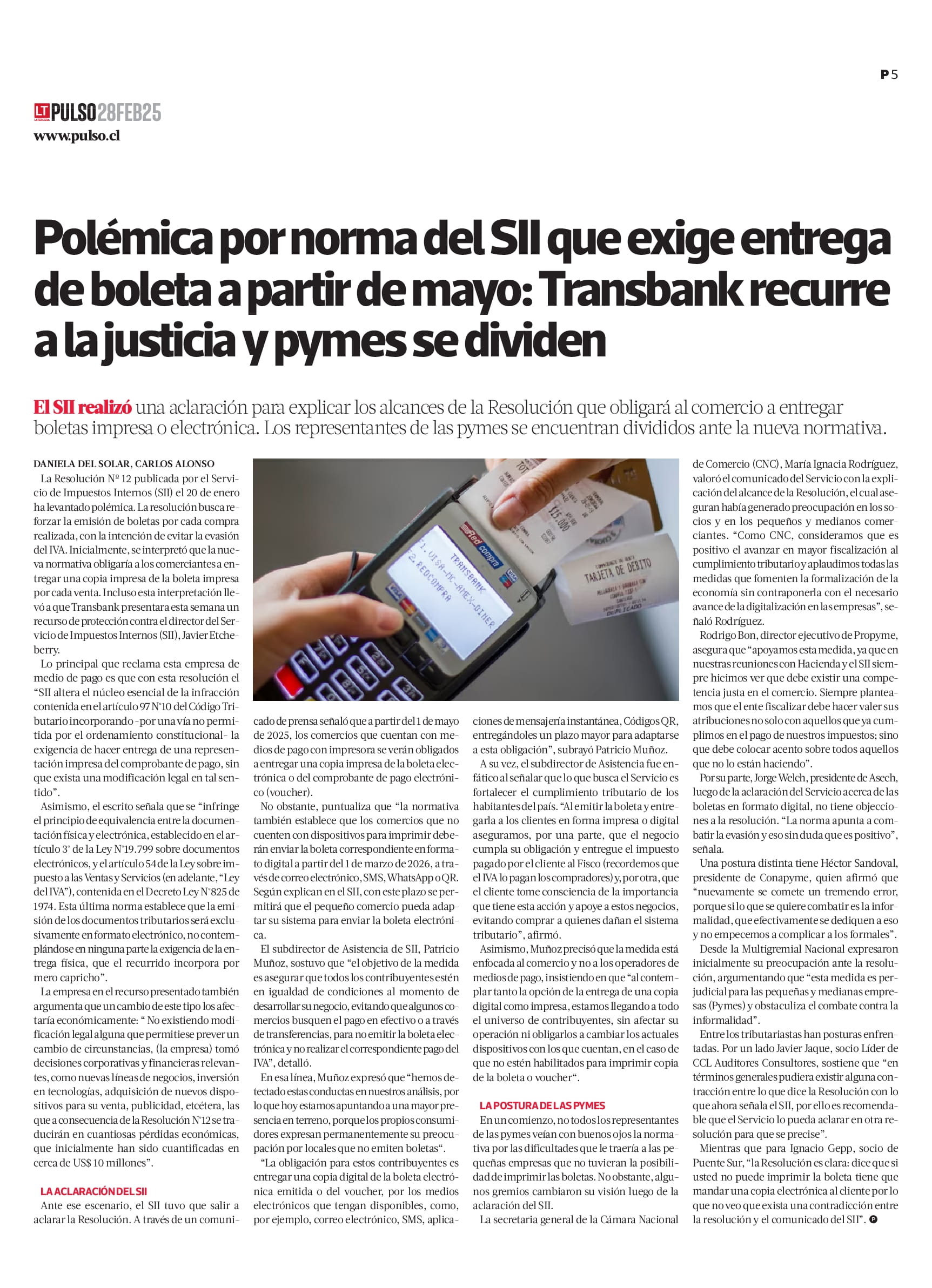
The Internal Revenue Service (SII) issued a clarification to explain the scope of the resolution that will require businesses to provide printed or electronic receipts. SME representatives are divided over the new regulation.
Read the article in La Tercera-Pulso.
Resolution No. 12, published by the Internal Revenue Service (SII) on January 20, has sparked controversy. The resolution seeks to reinforce the issuance of receipts for every purchase made, with the aim of preventing VAT evasion. Initially, it was interpreted that the new regulation would require merchants to provide a printed copy of the receipt for every sale. This interpretation even led Transbank to file a legal protection appeal this week against the Director of the SII, Javier Etcheberry.
The main complaint from this payment processing company is that the resolution “alters the essential nature of the infringement described in Article 97 No. 10 of the Tax Code by introducing—through a mechanism not permitted by the constitutional framework—the requirement to provide a printed representation of the payment receipt, without any legal amendment to that effect.”
The filing also argues that it “violates the principle of equivalence between physical and electronic documentation, established in Article 3 of Law No. 19.799 on electronic documents, and Article 54 of the VAT Law (Decree Law No. 825 of 1974). The latter establishes that tax documents must be issued exclusively in electronic format, with no requirement for physical delivery, which the respondent has introduced arbitrarily.”
The company further argues that such a change would have economic consequences: “In the absence of any legal modification that would allow for anticipating such a change, (the company) made significant corporate and financial decisions, such as launching new business lines, investing in technology, acquiring new devices for sale, advertising, etc., which, as a result of Resolution No. 12, will lead to substantial financial losses, initially estimated at around US$10 million.”
In response, the SII issued a clarification. Through a press release, it stated that starting May 1, 2025, businesses equipped with payment devices that include printers will be required to provide a printed copy of the electronic receipt or payment voucher.
However, it also specified that “businesses without printing devices must send the corresponding receipt in digital format starting March 1, 2026, via email, SMS, WhatsApp, or QR code.” According to the SII, this timeline allows small businesses to adapt their systems to comply with the electronic receipt requirement.
The SII’s Deputy Director of Assistance, Patricio Muñoz, stated that “the goal of the measure is to ensure that all taxpayers operate under equal conditions when conducting their business, preventing some merchants from favoring cash payments or transfers to avoid issuing electronic receipts and paying the corresponding VAT.”
In that regard, Muñoz added that “we have detected these practices in our analyses, and therefore we are increasing our field presence, as consumers consistently express concern about businesses that do not issue receipts.”
“The obligation for these taxpayers is to provide a digital copy of the electronic receipt issued or the voucher through available electronic means, such as email, SMS, instant messaging apps, or QR codes, granting them a longer period to adapt to this requirement,” Muñoz emphasized.
He also stressed that the measure is aimed at businesses rather than payment operators, stating that “by including both digital and printed delivery options, we are reaching all taxpayers without affecting their operations or requiring them to change their existing devices if they are not equipped to print receipts or vouchers.”
Initially, not all SME representatives viewed the regulation favorably due to the challenges it posed for small businesses unable to print receipts. However, some associations revised their stance following the SII’s clarification.
The Secretary General of the National Chamber of Commerce (CNC), María Ignacia Rodríguez, welcomed the clarification, noting that it addressed concerns among members and small and medium-sized businesses. “As CNC, we believe it is positive to move toward stronger tax compliance enforcement, and we support measures that promote economic formalization without hindering digitalization in businesses,” she stated.
Rodrigo Bon, Executive Director of Propyme, stated that “we support this measure, as in our meetings with the Ministry of Finance and the SII we have always emphasized the need for fair competition in commerce. We have consistently argued that the authority must enforce compliance not only among those who already pay taxes, but also focus on those who do not.”
For his part, Jorge Welch, President of Asech, after the clarification regarding digital receipts, expressed no objections to the resolution. “The regulation aims to combat evasion, which is undoubtedly positive,” he said.
A different view was expressed by Héctor Sandoval, President of Conapyme, who stated that “once again, a major mistake is being made, because if the goal is to combat informality, then efforts should be focused on that instead of complicating compliance for formal businesses.”
The National Multigremial initially expressed concern over the resolution, arguing that “this measure is harmful to small and medium-sized enterprises (SMEs) and hinders efforts to combat informality.”
Tax experts are also divided. On one hand, Javier Jaque, Managing Partner of CCL Auditores Consultores, stated that “in general terms, there may be some contradiction between what the Resolution states and what the SII has now clarified. Therefore, it would be advisable for the Service to issue another resolution to provide further precision.”
Meanwhile, Ignacio Gepp, partner at Puente Sur, argued that “the Resolution is clear: it states that if you cannot print the receipt, you must send an electronic copy to the customer. Therefore, I do not see any contradiction between the resolution and the SII’s statement.”