
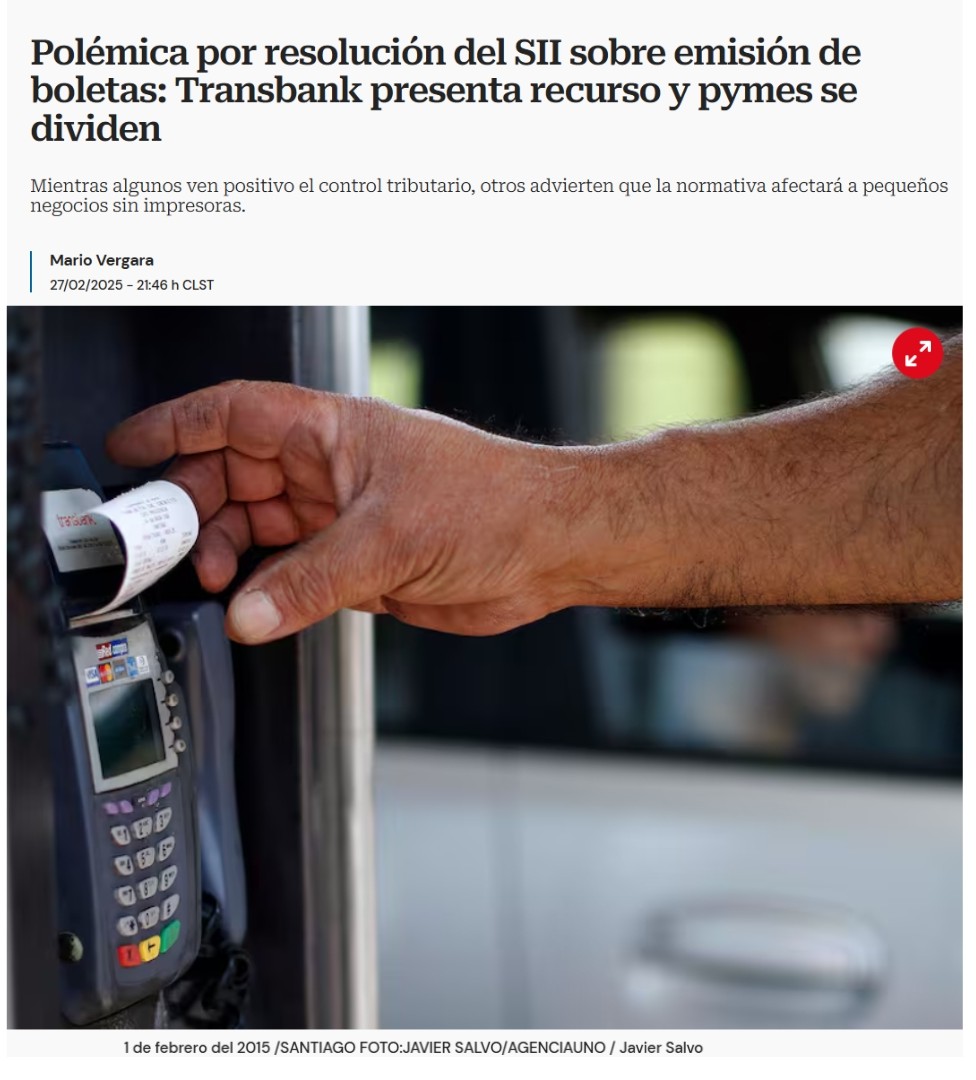
While some view the measure as a positive step toward tax enforcement, others warn that it could affect small businesses that lack printing devices.
Read the full article on ADN Radio.
Resolution No. 12, published by the Internal Revenue Service (SII) on January 20, has sparked debate within the commercial sector. The measure reinforces the obligation to issue receipts for every purchase in order to reduce VAT evasion. However, its initial interpretation created confusion, leading Transbank to file a legal protection appeal against the Director of the SII, Javier Etcheberry.
The payment processing company argued that the resolution mandates the delivery of a printed copy of the payment receipt, which, according to its interpretation, exceeds the SII’s authority and violates the current legal framework. In its filing, Transbank warned that the measure could result in financial losses of approximately US$10 million due to prior investments made under the existing regulations.
SII Clarifications on the Measure
In response to the controversy, the SII issued a statement clarifying the scope of the resolution. According to the authority, starting May 1, 2025, only businesses equipped with payment devices that include printers will be required to provide a printed copy of the electronic receipt or voucher.
For establishments without printing devices, the obligation to send digital receipts will come into effect on March 1, 2026. In such cases, businesses must send the document to customers via email, SMS, messaging applications, or QR codes.
The SII’s Deputy Director of Assistance, Patricio Muñoz, explained that the measure aims to ensure tax fairness in commerce. “We are increasing our field presence because consumers consistently express concern about businesses that do not issue receipts. With this resolution, we ensure that all taxpayers operate under equal conditions when conducting their business,” he stated, as reported by La Tercera.
Muñoz also emphasized that the regulation is aimed at businesses, not payment service providers. “By including both digital and printed delivery options, we are covering all taxpayers without affecting their operations or forcing them to change their current devices,” he clarified.
Reactions from the SME Sector
Small and medium-sized enterprises initially expressed concern over the resolution, arguing that it would create challenges for those without printing capabilities. However, following the SII’s clarification, some industry associations adjusted their stance.
The Secretary General of the National Chamber of Commerce (CNC), María Ignacia Rodríguez, noted that “it is positive to advance toward greater tax enforcement, as long as it does not hinder the digitalization process of businesses.”
Divided Opinions Among Tax Experts
The resolution has also sparked debate among tax specialists. Some, such as Javier Jaque of CCL Auditores Consultores, believe the SII should issue a new resolution to clarify any inconsistencies between the original document and the subsequent statement.
On the other hand, Ignacio Gepp of Puente Sur considers the regulation to be clear and sees no conflict between the two texts. “If a business cannot print the receipt, it must send it digitally to the customer, which is explicitly stated in the resolution,” he explained.
Despite the SII’s clarification, the discussion surrounding the regulation remains ongoing, with divided opinions in both the commercial and legal sectors. While the authority seeks to strengthen tax compliance, the private sector continues to assess the impact that implementing the measure will have on its operations.