
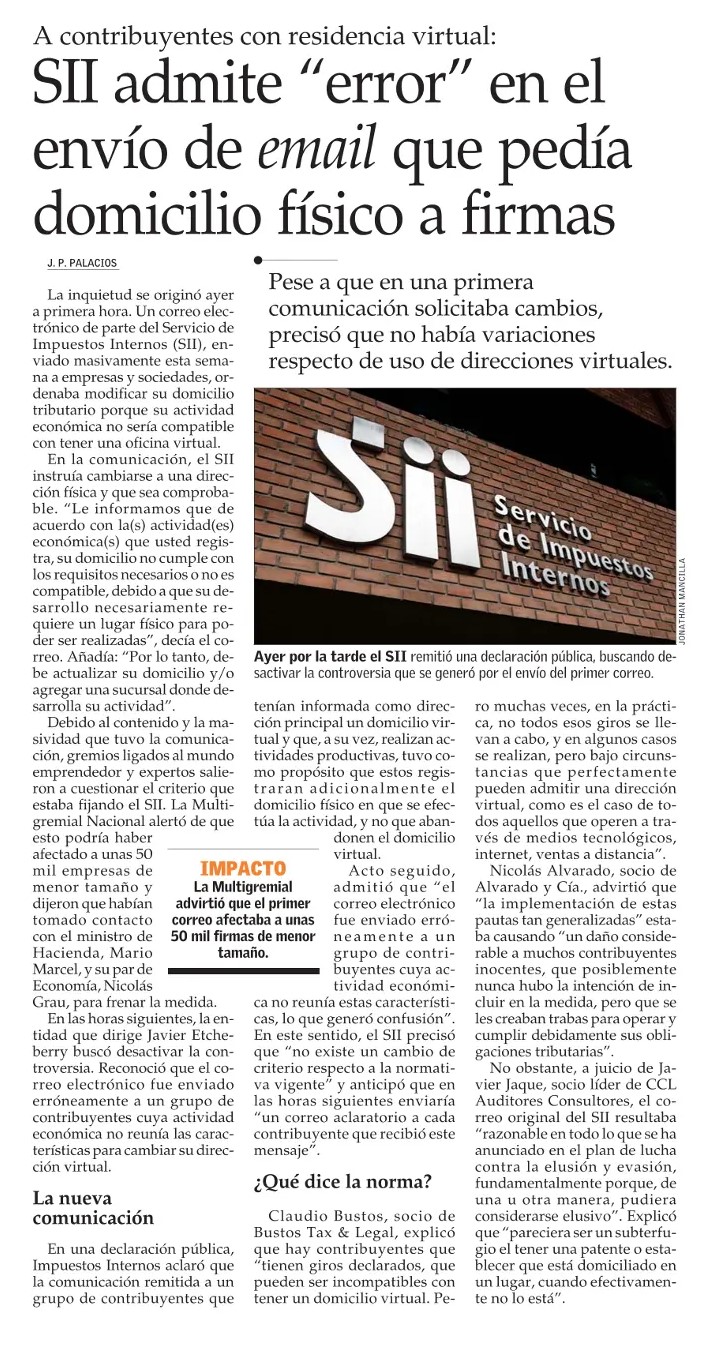
Although an initial communication requested changes, it clarified that there were no variations regarding the use of virtual addresses.
The concern arose early yesterday morning. An email from the Internal Revenue Service (SII), sent massively this week to companies and corporations, instructed them to modify their tax address because their economic activity would not be compatible with having a virtual office.
In the communication, the SII instructed them to change to a physical address that can be verified. “We inform you that, according to the economic activity(ies) you have registered, your address does not meet the necessary requirements or is not compatible, since its execution necessarily requires a physical location,” the email stated. It added: “Therefore, you must update your address and/or add a branch where you carry out your activity.”
Due to the content and mass distribution of the communication, business associations linked to the entrepreneurial sector and experts questioned the criteria being set by the SII. The National Multiguild warned that this could have affected around 50,000 smaller companies and stated that they had contacted the Minister of Finance, Mario Marcel, and the Minister of Economy, Nicolás Grau, to halt the measure.
In the following hours, the entity led by Javier Etcheberry sought to defuse the controversy. It acknowledged that the email had been mistakenly sent to a group of taxpayers whose economic activity did not meet the characteristics requiring a change from a virtual address.
The new communication
In a public statement, the Internal Revenue Service clarified that the communication sent to a group of taxpayers who had reported a virtual address as their main address and who also carry out productive activities was intended for them to additionally register the physical address where the activity is performed, not to abandon the virtual address.
It then admitted that “the email was mistakenly sent to a group of taxpayers whose economic activity did not meet these characteristics, which caused confusion.” In this regard, the SII clarified that “there has been no change in criteria regarding current regulations” and announced that in the following hours it would send “a clarification email to each taxpayer who received this message.”
What does the regulation say?
Claudio Bustos, partner at Bustos Tax & Legal, explained that there are taxpayers who “have declared business activities that may be incompatible with having a virtual address. However, in practice, not all of those activities are carried out, and in some cases they are, but under circumstances that can perfectly allow a virtual address, such as those operating through technological means, the internet, or remote sales.”
Nicolás Alvarado, partner at Alvarado y Cía., warned that “the implementation of such generalized guidelines” was causing “considerable harm to many innocent taxpayers, who were likely never intended to be included in the measure, but were facing obstacles to operate and properly comply with their tax obligations.”
However, in the opinion of Javier Jaque, lead partner at CCL Auditores Consultores, the original SII email was “reasonable in light of everything that has been announced in the plan to combat avoidance and evasion, mainly because, in one way or another, it could be considered evasive.” He explained that “it may appear to be a loophole to hold a business license or claim to be domiciled in a place when in fact it is not.”