
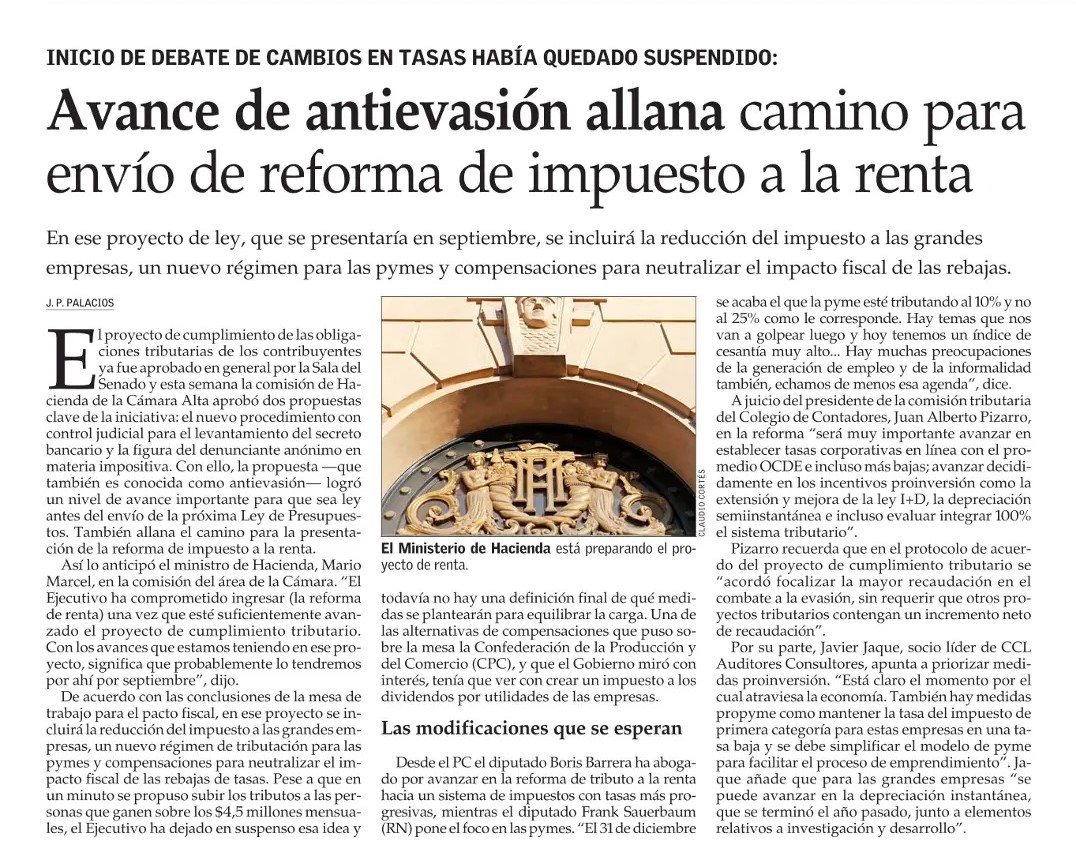
In that bill, which would be submitted in September, the reduction of taxes for large companies, a new regime for SMEs, and compensations to neutralize the fiscal impact of the rate cuts will be included.
The bill on compliance with taxpayers’ tax obligations has already been approved in general by the Senate Chamber, and this week the Senate Finance Committee approved two key proposals of the initiative: the new procedure with judicial oversight for lifting bank secrecy and the introduction of the anonymous whistleblower in tax matters. With this, the proposal—also known as the anti-evasion initiative—has reached an important level of progress, aiming to become law before the submission of the next Budget Law. It also paves the way for the presentation of the income tax reform.
This was anticipated by the Minister of Finance, Mario Marcel, in the committee session. “The Executive has committed to submitting (the income tax reform) once the tax compliance bill is sufficiently advanced. With the progress we are making on that project, it likely means we will have it around September,” he said.
According to the conclusions of the working group for the fiscal pact, the bill will include a reduction in taxes for large companies, a new tax regime for SMEs, and compensations to offset the fiscal impact of rate reductions. Although there was initially a proposal to increase taxes for individuals earning over CLP $4.5 million per month, the Executive has put that idea on hold, and there is still no final definition of the measures that will be proposed to balance the fiscal burden. One of the compensation alternatives proposed by the Confederation of Production and Commerce (CPC), and viewed with interest by the Government, involved creating a tax on dividends from corporate profits.
Expected Modifications
From the Communist Party, Congressman Boris Barrera has advocated for advancing the income tax reform toward a system with more progressive tax rates, while Congressman Frank Sauerbaum (RN) has focused on SMEs. “On December 31, the current situation ends where SMEs are taxed at 10% instead of the 25% that applies to them. There are issues that will affect us soon, and today we have a very high unemployment rate… There are many concerns about job creation and informality as well; we miss that agenda,” he said.
According to the president of the Tax Commission of the Chilean College of Accountants, Juan Alberto Pizarro, in the reform “it will be very important to move forward in establishing corporate tax rates in line with the OECD average or even lower; to decisively advance pro-investment incentives such as extending and improving the R&D law, semi-instant depreciation, and even evaluating full integration of the tax system.”
Pizarro recalls that in the agreement protocol of the tax compliance bill it was “agreed to focus increased revenue on combating evasion, without requiring other tax projects to include a net increase in revenue.”
For his part, Javier Jaque, lead partner at CCL Auditores Consultores, points to prioritizing pro-investment measures. “The moment the economy is going through is clear. There are also pro-SME measures such as maintaining the first-category tax rate for these companies at a low level, and the SME model should be simplified to facilitate entrepreneurship.” Jaque adds that for large companies, “progress can be made in reinstating instant depreciation, which ended last year, along with elements related to research and development.”