
The incentive, which in its most conservative estimate would raise 0.21% of GDP, contributed to the update of projections for new revenues. Experts point to a greater temporary fiscal effect.
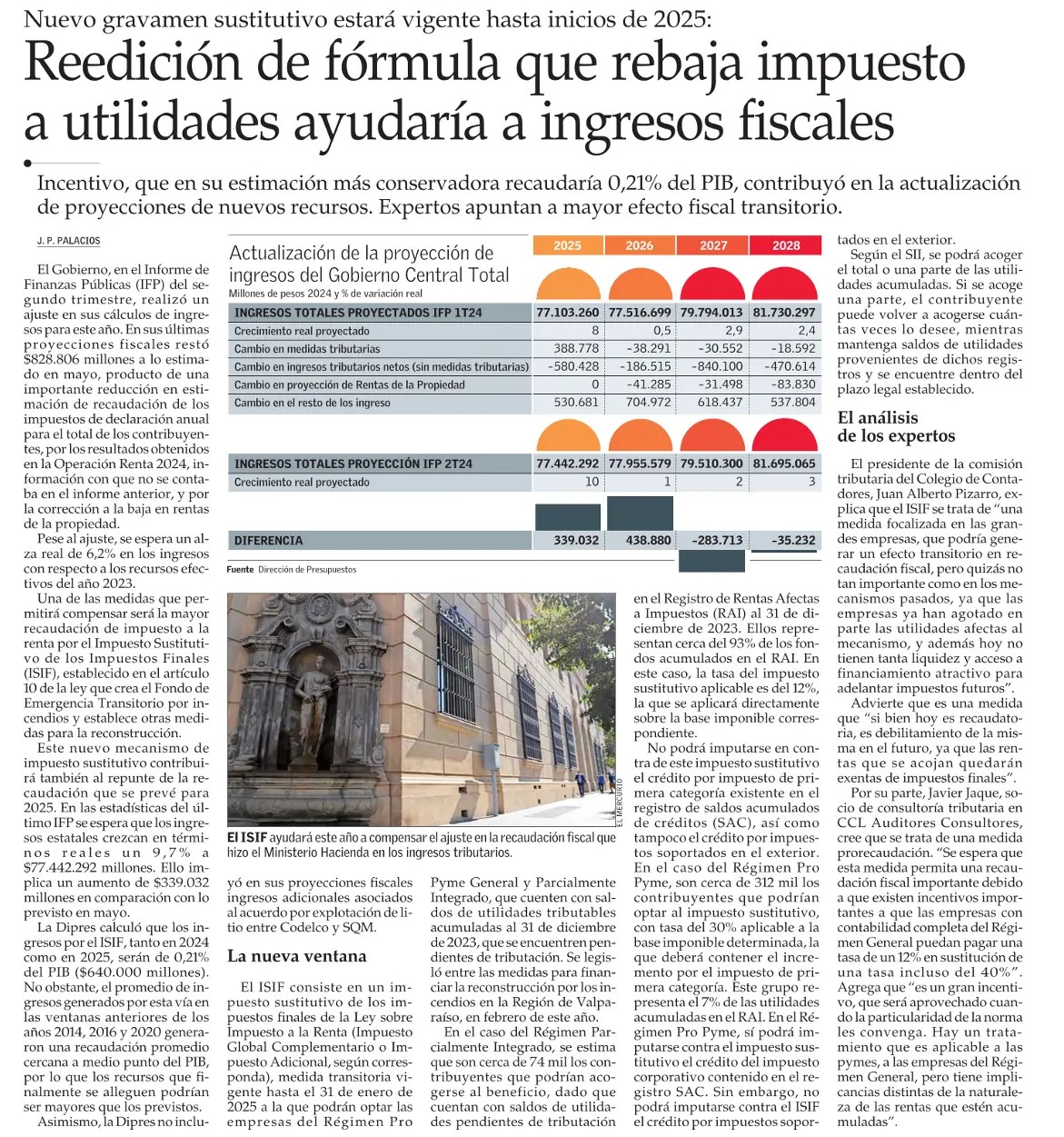
The Government, in the Public Finance Report (IFP) for the second quarter, made an adjustment to its revenue estimates for this year. In its latest fiscal projections, it reduced by CLP $828,806 million what had been estimated in May, due to a significant downward revision in expected revenue from annual tax filings for all taxpayers, based on the results of the 2024 Income Tax Operation, information that was not available in the previous report, as well as a downward correction in property income.
Despite the adjustment, a real increase of 6.2% in revenues is expected compared to the actual resources of 2023.
One of the measures that will help offset this will be increased income tax collection through the Substitute Tax on Final Taxes (ISIF), established in Article 10 of the law that creates the Temporary Emergency Fund for fires and establishes other reconstruction measures.
This new substitute tax mechanism will also contribute to the recovery in revenue expected for 2025. According to the latest IFP statistics, state revenues are projected to grow in real terms by 9.7% to CLP $77,442,292 million. This implies an increase of CLP $339,032 million compared to what was projected in May.
The Budget Office (Dipres) estimated that revenues from the ISIF, both in 2024 and 2025, will amount to 0.21% of GDP (CLP $640,000 million). However, the average revenue generated through this mechanism in previous windows in 2014, 2016, and 2020 was close to half a percentage point of GDP, meaning that the actual resources collected could be higher than currently projected.
Additionally, Dipres did not include in its fiscal projections additional revenues associated with the lithium exploitation agreement between Codelco and SQM.
The new window
The ISIF consists of a substitute tax for the final taxes under the Income Tax Law (Global Complementary Tax or Additional Tax, as applicable), a temporary measure in force until January 31, 2025, which may be applied by companies under the General Pro SME Regime and the Partially Integrated Regime that have accumulated taxable profit balances as of December 31, 2023, pending taxation. This was legislated as part of the measures to finance reconstruction following the fires in the Valparaíso Region earlier this year.
In the case of the Partially Integrated Regime, it is estimated that around 74,000 taxpayers could benefit from this measure, as they have pending taxable profit balances in the Taxable Income Registry (RAI) as of December 31, 2023. These represent approximately 93% of the accumulated funds in the RAI. In this case, the applicable substitute tax rate is 12%, applied directly to the corresponding taxable base.
The corporate income tax credit recorded in the accumulated credit balances registry (SAC), as well as credits for taxes paid abroad, may not be offset against this substitute tax. In the case of the Pro SME Regime, around 312,000 taxpayers could opt for the substitute tax, with a 30% rate applied to the determined taxable base, which must include the gross-up for corporate income tax. This group represents 7% of the accumulated profits in the RAI. Under the Pro SME Regime, the corporate tax credit recorded in the SAC may be offset against the substitute tax; however, foreign tax credits may not be offset against the ISIF.
According to the SII, taxpayers may opt to apply the substitute tax to all or part of their accumulated profits. If only part is chosen, the taxpayer may opt in again as many times as desired, provided they maintain balances of profits from these registries and remain within the legally established timeframe.
Expert analysis
The president of the Tax Commission of the Chilean College of Accountants, Juan Alberto Pizarro, explains that the ISIF is “a measure focused on large companies, which could generate a temporary effect on fiscal revenue, but perhaps not as significant as in previous mechanisms, since companies have already partially exhausted the profits subject to this mechanism, and currently do not have as much liquidity or access to attractive financing to advance future taxes.”
He warns that it is a measure that “while it increases revenue today, it weakens it in the future, since the income subject to it will be exempt from final taxes.”
For his part, Javier Jaque, Tax Consulting Partner at CCL Auditores Consultores, believes it is a pro-revenue measure. “This measure is expected to generate significant fiscal revenue due to the strong incentives for companies with full accounting under the General Regime to pay a 12% rate instead of rates that can reach up to 40%.” He adds that “it is a strong incentive that will be used when the specific conditions of the rule are favorable. There is a treatment applicable to SMEs and to companies under the General Regime, but it has different implications depending on the nature of the accumulated income.”