
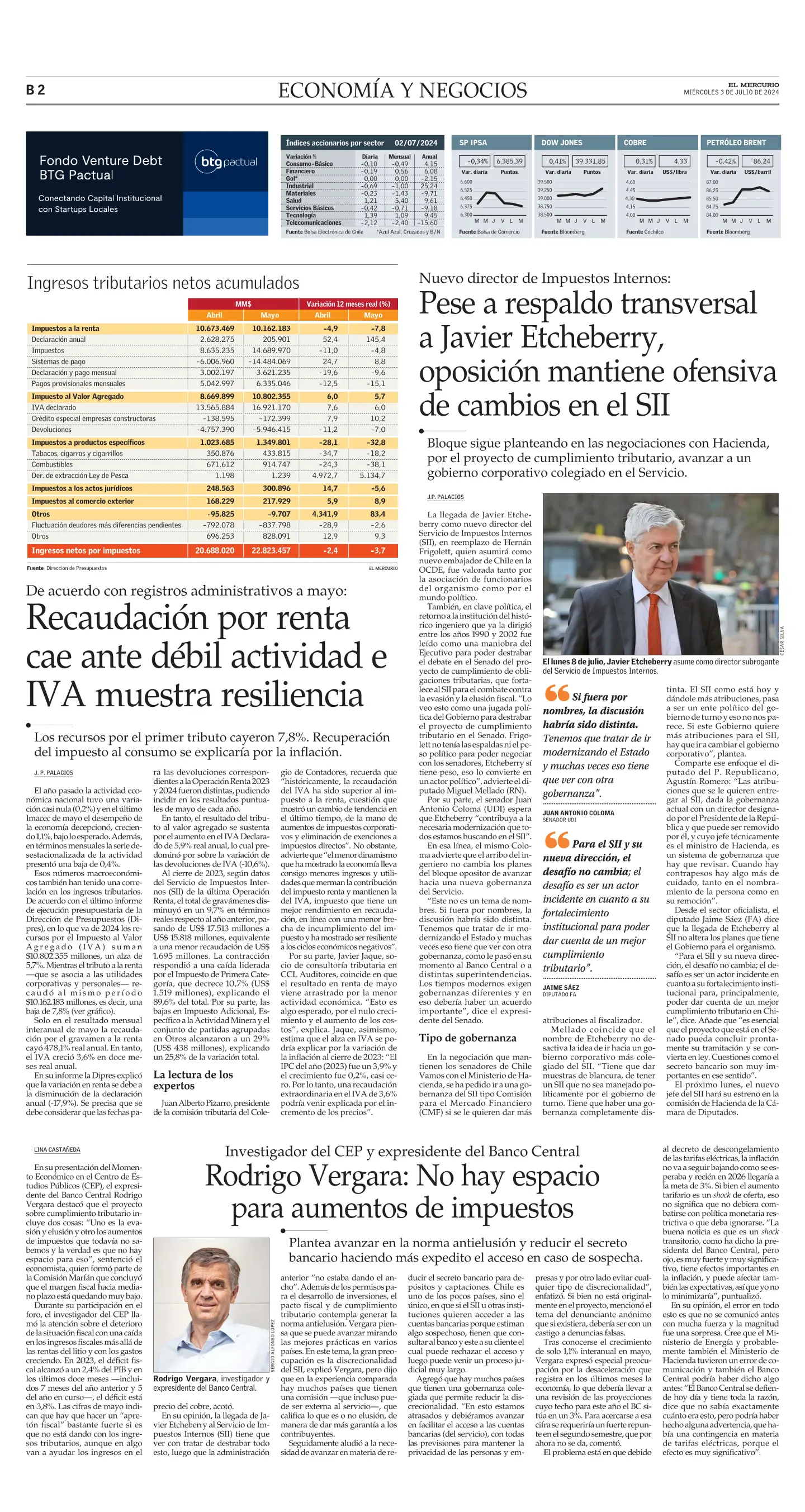
Revenue from the first tax fell by 7.8%. The recovery of the consumption tax would be explained by inflation.
Read the article in El Mercurio.
Last year, national economic activity showed almost no variation (0.2%), and in the latest May IMACEC, economic performance disappointed, growing by 1.1%, below expectations. Additionally, on a monthly basis, the seasonally adjusted activity series recorded a decline of 0.4%.
These macroeconomic figures have also been reflected in tax revenues. According to the latest budget execution report from the Budget Office (Dipres), so far in 2024, revenues from Value Added Tax (VAT) amount to CLP $10,802,355 million, an increase of 5.7%. Meanwhile, income tax—which is associated with corporate and personal profits—collected CLP $10,162,183 million over the same period, representing a decrease of 7.8% (see chart).
In the year-on-year monthly result for May alone, revenue from income tax fell by 478.1% in real annual terms. Meanwhile, VAT increased by 3.6% in real annual terms over twelve months.
In its report, Dipres explained that the variation in income tax is due to a decrease in annual filings (-17.9%). It noted that the dates for refunds corresponding to the 2023 and 2024 Income Tax Operations differed, which may have influenced the specific results for May of each year.
Meanwhile, the result of VAT is supported by a 5.9% real annual increase in declared VAT, which outweighed the variation in VAT refunds (-10.6%).
At the close of 2023, according to data from the Internal Revenue Service (SII) from the latest Income Tax Operation, total tax revenues decreased by 9.7% in real terms compared to the previous year, falling from US$17.513 billion to US$15.818 billion, equivalent to a reduction of US$1.695 billion. This contraction was driven by a decline in Corporate Income Tax, which fell by 10.7% (US$1.519 billion), accounting for 89.6% of the total decrease. Meanwhile, declines in Additional Tax, the Specific Mining Tax, and other grouped items amounted to 29% (US$438 million), explaining 25.8% of the total variation.
Experts’ interpretation
Juan Alberto Pizarro, president of the Tax Commission of the Chilean College of Accountants, noted that “historically, VAT collection has been higher than income tax, a trend that shifted recently due to increases in corporate taxes and the elimination of exemptions on direct taxes.” However, he warned that “the lower economic dynamism leads to reduced income and profits, which diminishes income tax contributions while maintaining VAT revenues. VAT tends to perform better in terms of collection, with a smaller compliance gap, and has proven to be resilient during negative economic cycles.”
For his part, Javier Jaque, Tax Consulting Partner at CCL Auditores Consultores, agrees that the May income tax results are driven by lower economic activity. “This is expected, given the lack of growth and rising costs,” he explained. Jaque also estimates that the increase in VAT could be explained by inflation at the end of 2023: “The CPI for the year (2023) was 3.9% and growth was 0.2%, nearly zero. Therefore, an extraordinary VAT increase of 3.6% could be explained by rising prices.”