
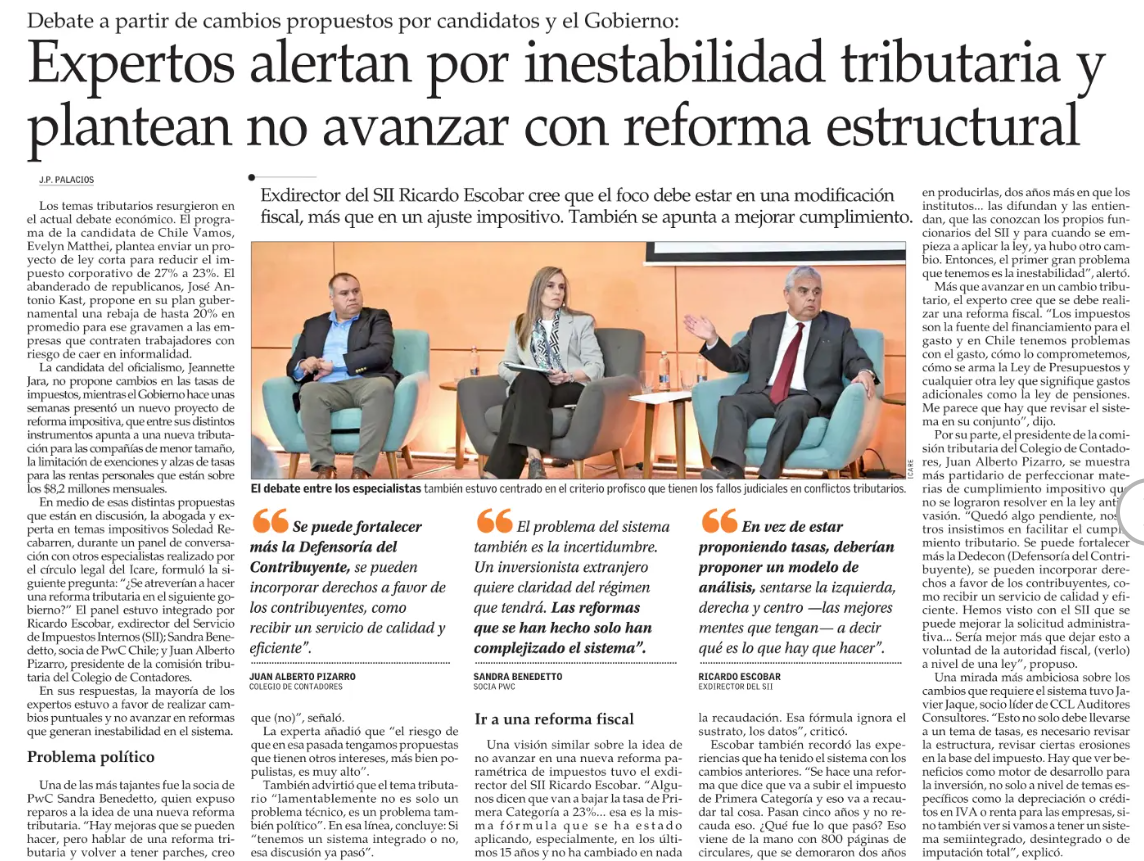
Former SII Director Ricardo Escobar believes the focus should be on a fiscal reform rather than a tax adjustment. There is also an emphasis on improving compliance.
Read the full article in El Mercurio.
Tax issues have resurfaced in the current economic debate. The program of Chile Vamos candidate Evelyn Matthei proposes submitting a short bill to reduce the corporate tax rate from 27% to 23%. The Republican candidate, José Antonio Kast, proposes in his government plan a reduction of up to 20% on average for companies that hire workers at risk of falling into informality.
The ruling coalition’s candidate, Jeannette Jara, does not propose changes to tax rates, while the government recently introduced a new tax reform bill that, among other measures, includes a new tax regime for smaller companies, limits on exemptions, and higher rates for personal income above CLP 8.2 million per month.
Amid these proposals under discussion, tax expert and attorney Soledad Recabarren, during a panel discussion with other specialists organized by ICARE’s legal circle, raised the following question: “Would you dare to implement a tax reform in the next government?” The panel included Ricardo Escobar, former Director of the Internal Revenue Service (SII); Sandra Benedetto, partner at PwC Chile; and Juan Alberto Pizarro, president of the Tax Commission of the Association of Accountants.
In their responses, most experts favored making targeted changes rather than moving forward with reforms that create instability in the system.
Political issue
One of the most decisive voices was PwC partner Sandra Benedetto, who expressed reservations about the idea of a new tax reform. “There are improvements that can be made, but talking about another tax reform and adding more patches, I don’t think so,” she said.
The expert added that “the risk that such a process could include proposals driven by other, more populist interests is very high.”
She also warned that tax issues are “unfortunately not only a technical problem but also a political one.” In that sense, she concluded: “Whether we have an integrated system or not—that discussion is already behind us.”
Move toward a fiscal reform
A similar view was expressed by former SII Director Ricardo Escobar, who opposed advancing a new parametric tax reform. “Some say they will reduce the First Category tax rate to 23%… that is the same formula that has been applied over the past 15 years and it has not changed revenue at all. That formula ignores the underlying data,” he criticized.
Escobar also recalled previous reform experiences. “A reform is introduced claiming it will increase First Category tax revenue. Five years later, it does not. What happened? It comes with 800 pages of circulars that take two years to produce, two more years for institutions to understand and disseminate, and by the time the law is applied, another reform has already been introduced. The main problem we face is instability,” he warned.
Rather than advancing tax changes, the expert believes a fiscal reform is needed. “Taxes are the source of funding for public spending, and in Chile we have issues with spending—how it is committed, how the Budget Law is structured, and other laws that involve additional expenditures, such as pension reform. We need to review the system as a whole,” he stated.
Meanwhile, Juan Alberto Pizarro, president of the Tax Commission of the Association of Accountants, is more inclined toward improving tax compliance issues that were not fully resolved in the anti-evasion law. “Something was left pending; we insisted on facilitating tax compliance. The Taxpayer Ombudsman (Dedecon) can be strengthened, and rights for taxpayers can be incorporated, such as receiving efficient and high-quality service. We have seen that administrative processes within the SII can be improved… It would be better to establish this through law rather than leaving it to the discretion of the tax authority,” he proposed.
A more ambitious perspective on the changes required by the system was expressed by Javier Jaque, Managing Partner of CCL Auditores Consultores. “This should not be limited to tax rates; it is necessary to review the structure and address certain erosions in the tax base. We must consider incentives as drivers of investment, not only in specific areas such as depreciation or VAT/income tax credits for companies, but also whether we will have a semi-integrated, disintegrated, or fully integrated tax system,” he explained.