
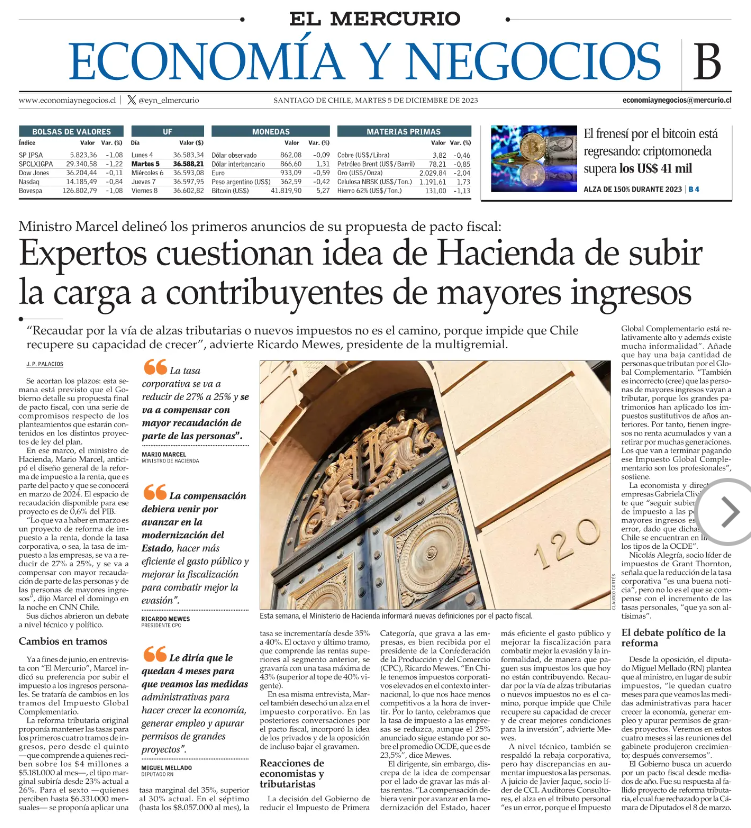
“Raising revenue through tax increases or new taxes is not the way, because it prevents Chile from regaining its capacity to grow,” warns Ricardo Mewes, president of the multi-industry association.
Read the full article in El Mercurio here.
Deadlines are shortening: this week the Government is expected to detail its final fiscal pact proposal, including a series of commitments regarding the measures contained in the various legislative projects of the plan.
In this context, Finance Minister Mario Marcel previewed the general design of the income tax reform, which is part of the pact and will be announced in March 2024. The available revenue space for this project is 0.6% of GDP.
“What will be presented in March is an income tax reform project, where the corporate rate – that is, the company tax rate – will be reduced from 27% to 25%, and this will be offset by higher collection from individuals, particularly high-income earners,” Marcel said Sunday night on CNN Chile.
His statements have sparked debate at both technical and political levels.
Reactions from economists and tax experts:
From a technical standpoint, the corporate tax reduction was also supported, but there are disagreements about increasing taxes on individuals. According to Javier Jaque, Lead Partner at CCL Auditores Consultores, “the increase in personal tax is a mistake, because the Complementary Global Tax is already relatively high and there is also a lot of informality.” He adds that a small number of people actually pay the Complementary Global Tax. “It is also incorrect (he believes) that high-income earners will pay it, because large fortunes have applied substitute taxes from previous years. Therefore, they have non-income revenues and will withdraw them over many generations. Those who will end up paying this Complementary Global Tax are the professionals,” he argues.