
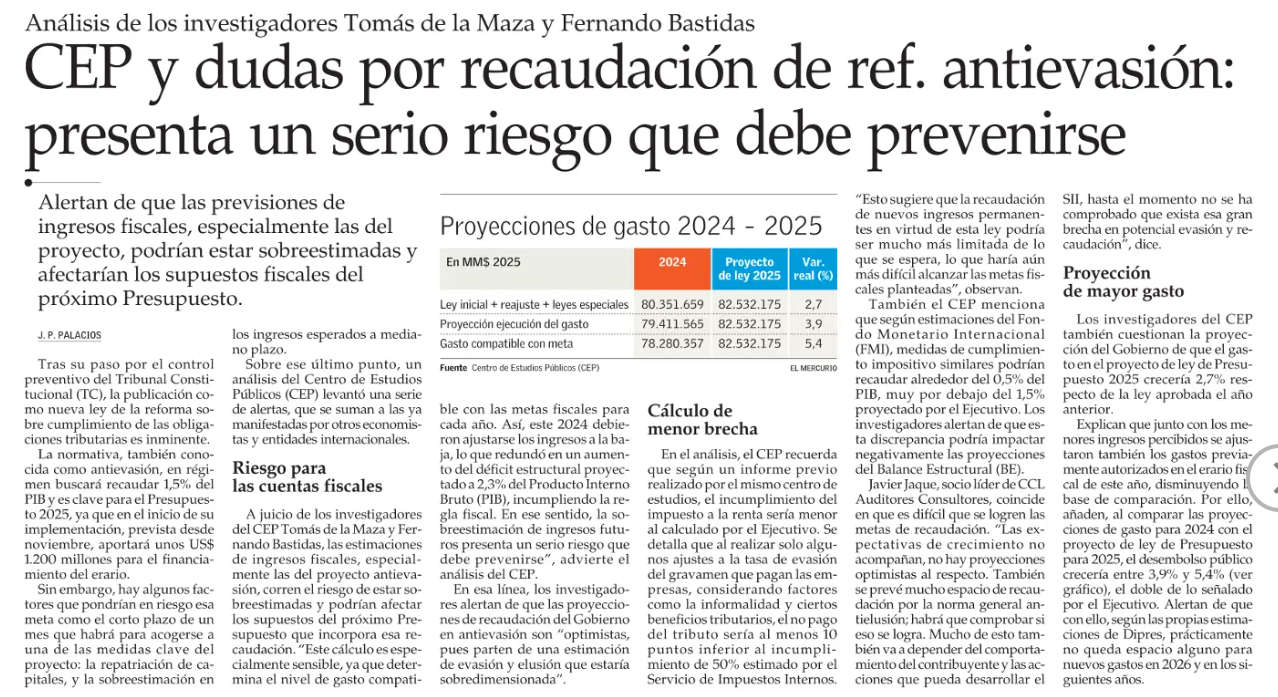
They warn that fiscal revenue projections, especially those of the bill, may be overestimated and could affect the fiscal assumptions of the upcoming Budget.
Read the full article in El Mercurio.
Following its review under preventive control by the Constitutional Court (TC), the publication of the tax compliance reform as a new law is imminent.
The regulation, also known as the anti-evasion reform, aims to raise 1.5% of GDP in its full implementation and is key to the 2025 Budget, as in its initial phase—expected to begin in November—it will contribute around US$1.2 billion to finance the public treasury.
However, there are some factors that could put that target at risk, such as the short one-month window to opt into one of the key measures of the bill—capital repatriation—and the overestimation of expected revenues in the medium term.
On this latter point, an analysis by the Center for Public Studies (CEP) raised a series of warnings, adding to those already expressed by other economists and international organizations.
Risks to fiscal accounts
According to CEP researchers Tomás de la Maza and Fernando Bastidas, fiscal revenue estimates—especially those related to the anti-evasion bill—risk being overestimated and could affect the assumptions of the upcoming Budget that incorporates such revenue. “This calculation is particularly sensitive, as it determines the level of spending compatible with fiscal targets each year. Thus, in 2024, revenues had to be adjusted downward, resulting in an increase in the projected structural deficit to 2.3% of Gross Domestic Product (GDP), breaching the fiscal rule. In this sense, the overestimation of future revenues poses a serious risk that must be prevented,” the CEP analysis warns.
In this regard, the researchers warn that the Government’s revenue projections from anti-evasion measures are “optimistic, as they are based on an estimate of evasion and avoidance that may be overstated.”
Lower gap estimation
Javier Jaque, Lead Partner at CCL Auditores Consultores, agrees that it will be difficult to achieve the revenue targets. “Growth expectations are not supportive; there are no optimistic projections in that regard. There is also an expectation of significant revenue from the general anti-avoidance rule, which remains to be seen. Much of this will also depend on taxpayer behavior and the actions that the SII can take. So far, it has not been proven that such a large gap in potential evasion and revenue exists,” he states.