
The measure would have a cost of 1.3% of GDP. Experts call for offsetting its fiscal impact through spending adjustments and expanding the personal income tax base.
Read the article in El Mercurio.
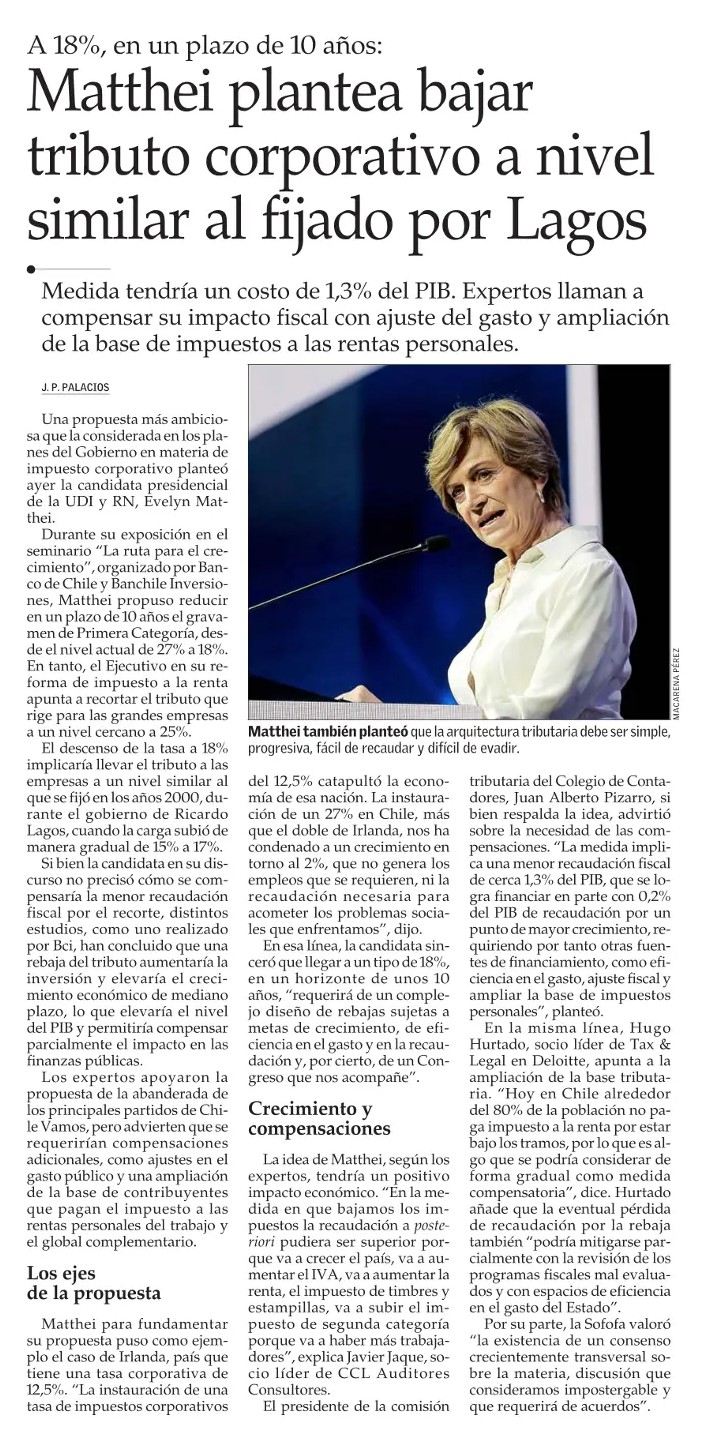
A more ambitious proposal than the one currently considered by the government regarding corporate taxation was presented yesterday by the presidential candidate of UDI and RN, Evelyn Matthei.
During her presentation at the seminar “The Path to Growth,” organized by Banco de Chile and Banchile Inversiones, Matthei proposed reducing the First Category tax over a 10-year period, from the current 27% to 18%. Meanwhile, the government’s income tax reform aims to lower the rate for large companies to around 25%.
The reduction to 18% would bring corporate taxation to a level similar to that set in the 2000s during the government of Ricardo Lagos, when the rate gradually increased from 15% to 17%.
Although the candidate did not specify how the loss in fiscal revenue would be offset, various studies—such as one conducted by Bci—have concluded that lowering the tax rate would boost investment and medium-term economic growth, increasing GDP levels and partially compensating for the impact on public finances.
Experts supported the proposal from the candidate of Chile Vamos’ main parties, but warned that additional compensatory measures would be required, such as adjustments in public spending and an expansion of the base of taxpayers paying personal income tax and the global complementary tax.
Main pillars of the proposal
To support her proposal, Matthei cited Ireland as an example, a country with a 12.5% corporate tax rate. “The introduction of a 12.5% corporate tax rate propelled that country’s economy. The implementation of a 27% rate in Chile—more than double Ireland’s—has condemned us to growth of around 2%, which does not generate the jobs required nor the revenue needed to address the social challenges we face,” she said.
In this context, the candidate acknowledged that reaching an 18% rate within a 10-year horizon “will require a complex design of reductions tied to growth targets, efficiency in spending and revenue collection, and, of course, a Congress willing to support it.”
Growth and compensations
According to experts, Matthei’s proposal would have a positive economic impact. “As taxes decrease, revenue could later increase because the country will grow, VAT will rise, income tax will increase, stamp taxes will rise, and second-category tax will also increase due to higher employment,” explained Javier Jaque, Managing Partner of CCL Auditores Consultores.
Juan Alberto Pizarro, president of the Tax Commission of the Association of Accountants, while supporting the idea, warned about the need for compensations. “The measure implies a fiscal revenue loss of around 1.3% of GDP, which could be partially financed by 0.2% of GDP from higher growth, thus requiring other funding sources such as spending efficiency, fiscal adjustments, and expanding the personal income tax base,” he stated.
Similarly, Hugo Hurtado, Tax & Legal Managing Partner at Deloitte, pointed to expanding the tax base. “Currently in Chile, around 80% of the population does not pay income tax because they fall below the taxable brackets, so this is something that could be gradually considered as a compensatory measure,” he said. Hurtado added that the potential loss in revenue “could also be partially mitigated by reviewing poorly evaluated fiscal programs and identifying efficiency gains in government spending.”
For its part, Sofofa valued “the existence of a growing cross-sector consensus on this matter, a discussion that we consider unavoidable and that will require agreements.”