
Some experts see it as the right path, while others believe it is necessary to consider a range of factors—such as public spending structure and debt—to determine whether this measure is appropriate. Business representatives consider it a topic for long-term analysis.
Read the article in La Tercera-Pulso.
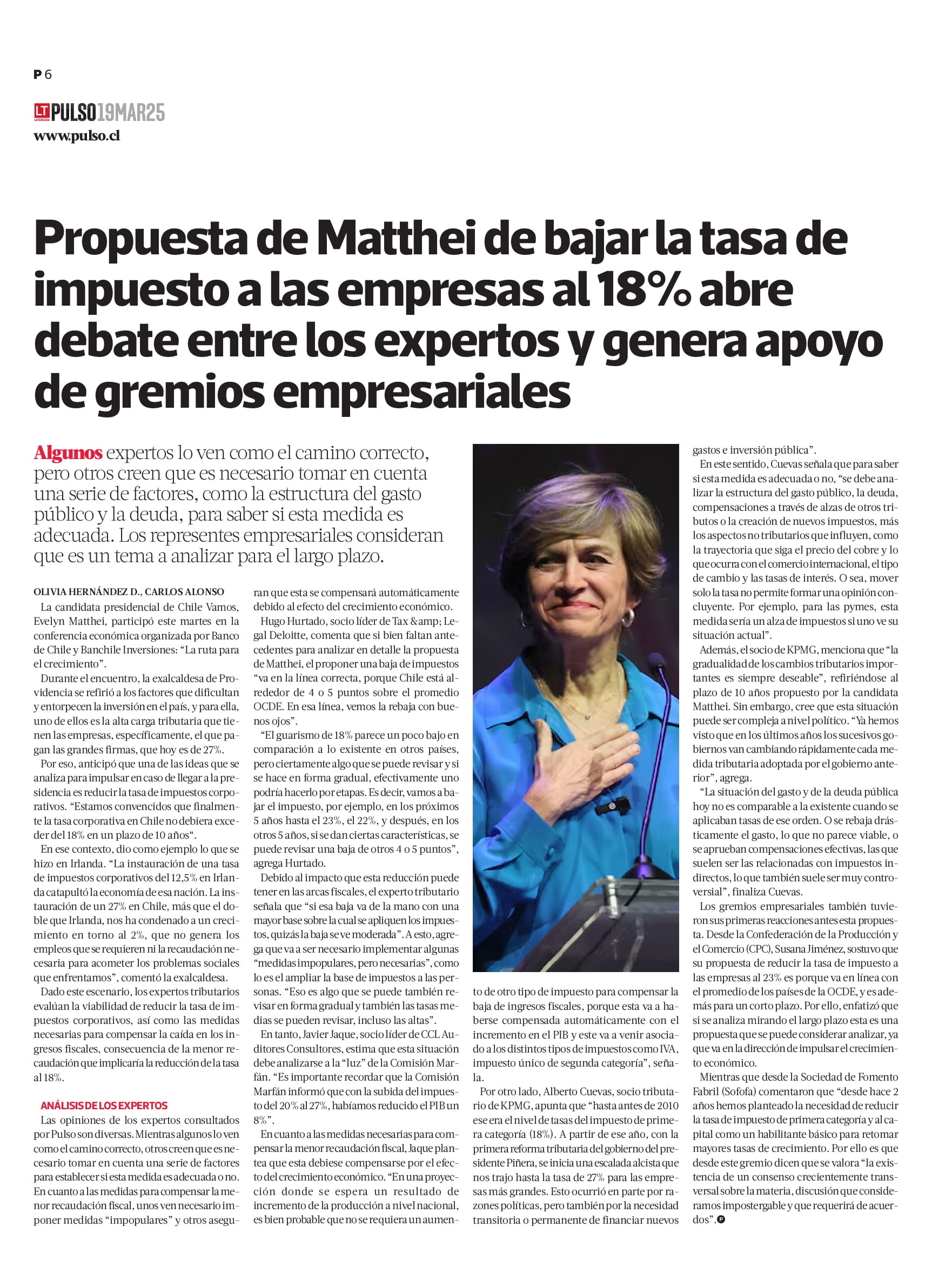
The Chile Vamos presidential candidate, Evelyn Matthei, participated this Tuesday in the economic conference organized by Banco de Chile and Banchile Inversiones: “The Path to Growth.”
During the event, the former mayor of Providencia referred to the factors that hinder investment in the country. In her view, one of them is the high tax burden on companies, specifically the rate paid by large firms, which currently stands at 27%.
For this reason, she indicated that one of the ideas being considered, should she reach the presidency, is to reduce the corporate tax rate. “We are convinced that the corporate tax rate in Chile should not exceed 18% within a 10-year period.”
In that context, she cited Ireland as an example. “The establishment of a 12.5% corporate tax rate in Ireland propelled that country’s economy. In contrast, the 27% rate in Chile—more than double that of Ireland—has condemned us to growth of around 2%, which does not generate the jobs required nor the revenue needed to address the social challenges we face,” she stated.
Given this scenario, tax experts are assessing the feasibility of reducing the corporate tax rate, as well as the measures needed to offset the decline in fiscal revenue that such a reduction to 18% would entail.
The opinions of experts consulted by Pulso are mixed. While some see it as the right path, others believe it is necessary to consider multiple factors to determine whether the measure is appropriate. Regarding how to offset lower fiscal revenues, some argue that “unpopular” measures would be required, while others believe the loss would be automatically compensated by economic growth.
Hugo Hurtado, Tax & Legal Managing Partner at Deloitte, commented that although more details are needed to fully assess Matthei’s proposal, suggesting a tax reduction “is moving in the right direction, as Chile is about 4 to 5 percentage points above the OECD average. In that sense, we view the reduction positively.”
“An 18% rate seems somewhat low compared to other countries, but it is certainly something that can be evaluated. If implemented gradually, it could be done in stages—for example, lowering the tax over the next five years to 23% or 22%, and then, in the following five years, if conditions allow, reviewing a further reduction of 4 to 5 percentage points,” Hurtado added.
Given the fiscal impact such a reduction could have, the tax expert noted that “if the reduction is accompanied by a broader tax base, the effect could be moderated.” He added that it would likely require implementing some “unpopular but necessary” measures, such as expanding the personal income tax base. “This could also be implemented gradually, and even average and higher tax rates could be reviewed.”
Meanwhile, Javier Jaque, Managing Partner of CCL Auditores Consultores, believes the issue should be analyzed “in light of the Marfán Commission. It is important to remember that the Marfán Commission reported that increasing the tax rate from 20% to 27% reduced GDP by 8%.”
Regarding the measures needed to offset lower fiscal revenue, Jaque suggests that this could be compensated through economic growth. “In a scenario where increased national production is expected, it is quite likely that no additional taxes would be needed to offset the loss in fiscal revenue, as it would be automatically compensated by GDP growth, which in turn would be reflected in various taxes such as VAT and second-category income tax,” he stated.
On the other hand, Alberto Cuevas, Tax Partner at KPMG, noted that “prior to 2010, that was the level of the First Category tax rate (18%). From that year onward, with the first tax reform under President Piñera’s administration, a gradual increase began, leading to the current 27% rate for large companies. This occurred partly for political reasons, but also due to the need—temporary or permanent—to finance new public spending and investment.”
In this regard, Cuevas stated that to determine whether the measure is appropriate, “it is necessary to analyze the structure of public spending, debt levels, compensatory measures such as increases in other taxes or the creation of new ones, as well as non-tax factors such as copper prices, international trade conditions, exchange rates, and interest rates. Simply adjusting the rate alone is not enough to form a definitive opinion. For example, for SMEs, this measure could actually represent a tax increase given their current situation.”
Additionally, the KPMG partner emphasized that “gradual implementation of major tax changes is always desirable,” referring to the 10-year timeframe proposed by Matthei. However, he acknowledged that this could be politically challenging, noting that “in recent years, successive governments have quickly reversed tax measures adopted by previous administrations.”
“The current situation of public spending and debt is not comparable to when such rates were in place. Either spending must be drastically reduced—which seems unfeasible—or effective compensatory measures must be approved, which are often related to indirect taxes and tend to be highly controversial,” Cuevas concluded.
Business associations also reacted to the proposal. Susana Jiménez, president of the Confederation of Production and Commerce (CPC), stated that her proposal to reduce the corporate tax rate to 23% aligns with the OECD average and is intended for the short term. She emphasized that, from a long-term perspective, Matthei’s proposal is worth considering, as it moves in the direction of promoting economic growth.
Meanwhile, the Society of Industrial Development (Sofofa) commented that “for the past two years, we have highlighted the need to reduce the First Category tax rate and capital taxation as a key enabler for returning to higher growth rates. Therefore, we value the emergence of a growing cross-sector consensus on this matter, a discussion that we consider unavoidable and that will require agreements.”