
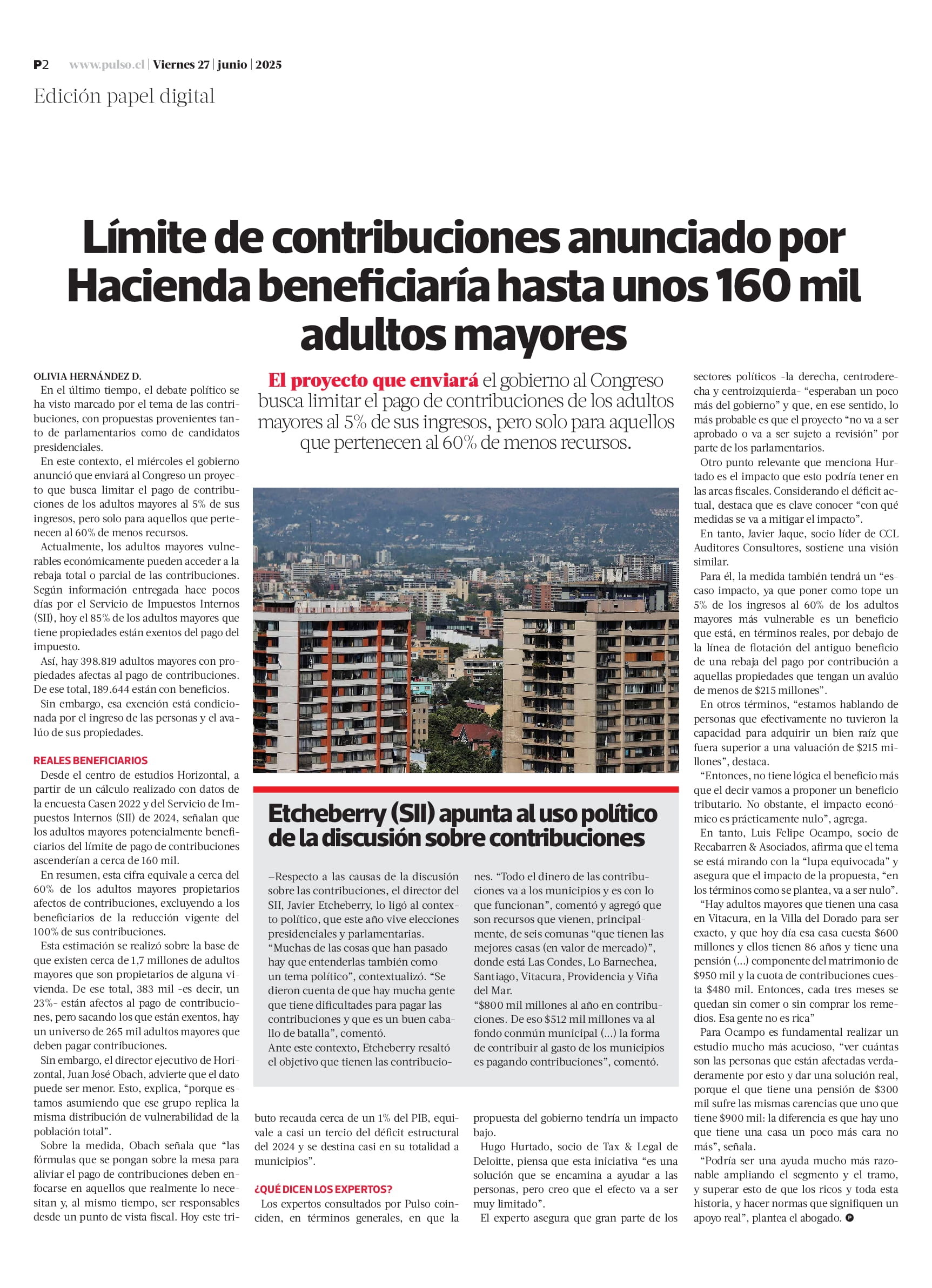
The bill the government will send to Congress seeks to limit property tax payments for seniors to 5% of their income, but only for those within the lowest 60% income bracket.
Read the article in La Tercera-Pulso.
In recent times, the political debate has been strongly influenced by the issue of property taxes, with proposals coming from both lawmakers and presidential candidates.
In this context, on Wednesday the government announced that it will submit to Congress a bill aimed at limiting property tax payments for seniors to 5% of their income, but only for those within the lowest 60% income group.
Currently, economically vulnerable seniors can access full or partial exemptions from property taxes. According to recent information from the Internal Revenue Service (SII), 85% of seniors who own property are currently exempt from paying this tax.
Thus, there are 398,819 seniors with properties subject to property tax payments. Of that total, 189,644 already receive benefits.
However, this exemption is conditional upon both the individual’s income and the assessed value of their property.
Actual beneficiaries
According to the Horizontal think tank, based on calculations using data from the 2022 Casen survey and the SII (2024), the number of seniors who could potentially benefit from the property tax cap would be around 160,000.
In summary, this figure represents approximately 60% of senior property owners subject to property taxes, excluding those already benefiting from a 100% exemption.
This estimate is based on the existence of approximately 1.7 million seniors who own at least one property. Of that total, 383,000—around 23%—are subject to property taxes, but excluding those already exempt, there are about 265,000 seniors who must pay property taxes.
However, the executive director of Horizontal, Juan José Obach, warns that the figure could be lower. This is because, he explains, “we are assuming that this group reflects the same distribution of vulnerability as the overall population.”
Regarding the measure, Obach states that “any proposals aimed at easing property tax payments must focus on those who truly need it, while also being fiscally responsible. Today, this tax generates around 1% of GDP, equivalent to nearly one-third of the structural deficit for 2024, and is allocated almost entirely to municipalities.”
What do experts say?
Experts consulted by Pulso generally agree that the government’s proposal would have a limited impact.
Hugo Hurtado, partner at Deloitte Tax & Legal, believes that this initiative “is a solution aimed at helping people, but I think the effect will be very limited.”
The expert notes that much of the political spectrum—right, center-right, and center-left—“expected more from the government,” and therefore it is likely that the bill “will not be approved or will be subject to revision” by lawmakers.
Another key point highlighted by Hurtado is the potential fiscal impact. Given the current deficit, he emphasizes that it is essential to determine “what measures will be used to offset the impact.”
Meanwhile, Javier Jaque, Managing Partner of CCL Auditores Consultores, holds a similar view.
In his opinion, the measure will also have “limited impact, since setting a cap of 5% of income for the most vulnerable 60% of seniors is, in real terms, a benefit that falls below the threshold of the previous benefit, which reduced property tax payments for properties valued under CLP 215 million.”
In other words, “we are referring to individuals who, in practice, did not have the capacity to acquire real estate valued above CLP 215 million,” he explains.
“Therefore, the benefit lacks logic beyond the intention of proposing a tax relief measure. However, its economic impact is practically negligible,” he adds.
Similarly, Luis Felipe Ocampo, partner at Recabarren & Asociados, argues that the issue is being viewed through the “wrong lens” and states that the impact of the proposal, “as currently structured, will be null.”
“There are seniors who own a house in Vitacura, specifically in Villa del Dorado, which today is worth CLP 600 million, and they are 86 years old with a combined pension of CLP 950,000. Their property tax payment is CLP 480,000. So every three months, they must choose between food and medication. These people are not wealthy.”
For Ocampo, it is essential to conduct a more thorough analysis, “to determine how many people are truly affected and provide a real solution. Someone with a pension of CLP 300,000 faces the same hardships as someone with CLP 900,000—the only difference is that one owns a slightly more valuable home,” he explains.
“A more reasonable solution would be to expand the eligible segment and thresholds, moving beyond the narrative of ‘the wealthy’ and implementing measures that provide real support,” the attorney concludes.