
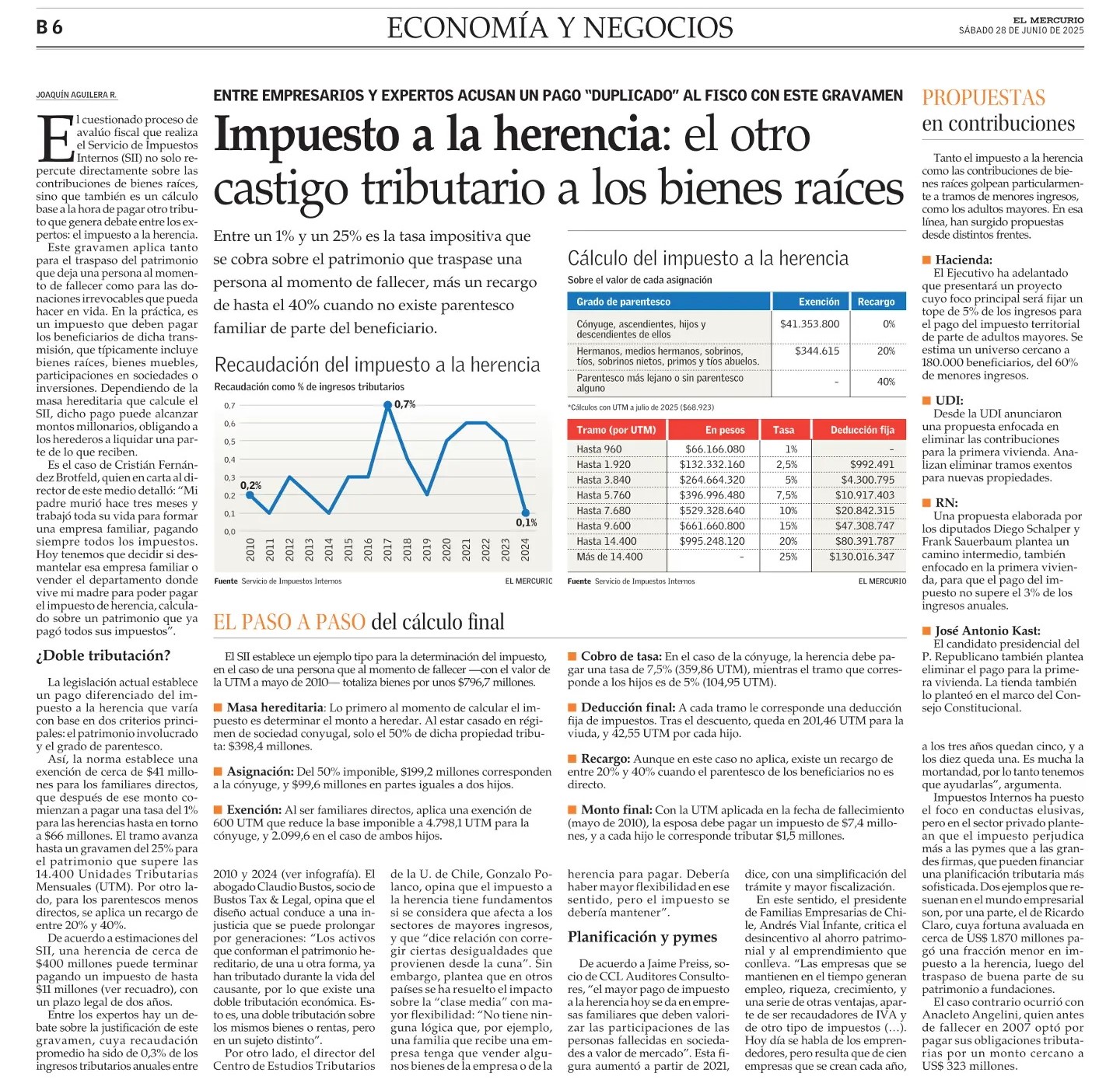
The tax rate applied to assets transferred upon a person’s death ranges from 1% to 25%, with an additional surcharge of up to 40% when there is no familial relationship with the beneficiary.
Read the article in El Mercurio.
The controversial property valuation process carried out by the Internal Revenue Service (SII) not only directly impacts property taxes, but also serves as the base calculation for another debated levy among experts: inheritance tax.
This tax applies both to the transfer of assets upon a person’s death and to irrevocable gifts made during their lifetime. In practice, it is paid by the beneficiaries of such transfers, typically including real estate, movable assets, company shares, or investments. Depending on the estate value determined by the SII, the tax can reach significant amounts, forcing heirs to liquidate part of what they inherit.
This is the case of Cristián Fernández Brotfeld, who, in a letter to the editor of this newspaper, stated: “My father passed away three months ago and worked his entire life to build a family business, always paying all taxes. Today we must decide whether to dismantle that family business or sell the apartment where my mother lives in order to pay the inheritance tax, calculated on assets that have already been fully taxed.”
Double taxation?
Current legislation establishes a differentiated inheritance tax based on two main criteria: the size of the estate and the degree of kinship.
Thus, the law provides an exemption of approximately CLP 41 million for direct relatives. Beyond that amount, a 1% rate applies to inheritances up to approximately CLP 66 million, increasing progressively to a 25% tax on estates exceeding 14,400 Monthly Tax Units (UTM). For more distant relationships, an additional surcharge of between 20% and 40% applies.
According to SII estimates, an inheritance of approximately CLP 400 million could result in a tax payment of up to CLP 11 million (see chart), with a legal payment deadline of two years.
Among experts, there is ongoing debate regarding the justification of this tax, whose average revenue has represented around 0.3% of total annual tax income between 2010 and 2024 (see infographic). Attorney Claudio Bustos, partner at Bustos Tax & Legal, argues that the current design leads to an injustice that can persist across generations: “The assets that make up an estate have, in one way or another, already been taxed during the lifetime of the deceased, resulting in economic double taxation—that is, the same assets or income being taxed twice, albeit in different taxpayers.”
On the other hand, Gonzalo Polanco, Director of the Center for Tax Studies at the University of Chile, believes that inheritance tax has a valid foundation, as it primarily affects higher-income groups and “is intended to correct certain inequalities that originate at birth.” However, he notes that in other countries the impact on the middle class has been addressed with greater flexibility: “It makes no sense, for example, that a family receiving a business must sell part of it or other inherited assets to pay the tax. There should be greater flexibility in that regard, although the tax itself should remain.”
Planning and SMEs
According to Jaime Preiss, partner at CCL Auditores Consultores, “the highest inheritance tax payments today occur in family businesses, where the shares of the deceased must be valued at market value.” He notes that this trend has increased since 2021 due to simplified procedures and enhanced enforcement.
In this regard, Andrés Vial Infante, president of Familias Empresarias de Chile, criticizes the disincentive this tax creates for wealth accumulation and entrepreneurship. “Companies that endure over time generate employment, wealth, growth, and many other benefits, in addition to being VAT collectors and taxpayers in general (…). Today we talk about entrepreneurs, but out of every hundred companies created each year, only five remain after three years, and just one after ten. The mortality rate is very high, so we must support them,” he argued.
The Internal Revenue Service has focused on tax avoidance practices, but the private sector argues that the tax affects SMEs more than large corporations, which can afford more sophisticated tax planning. Two examples often cited in the business community are, on one hand, Ricardo Claro, whose estate valued at approximately US$1.87 billion paid a relatively small inheritance tax after transferring much of his wealth to foundations.
The opposite case occurred with Anacleto Angelini, who before his death in 2007 chose to fulfill his tax obligations, paying close to US$323 million.