
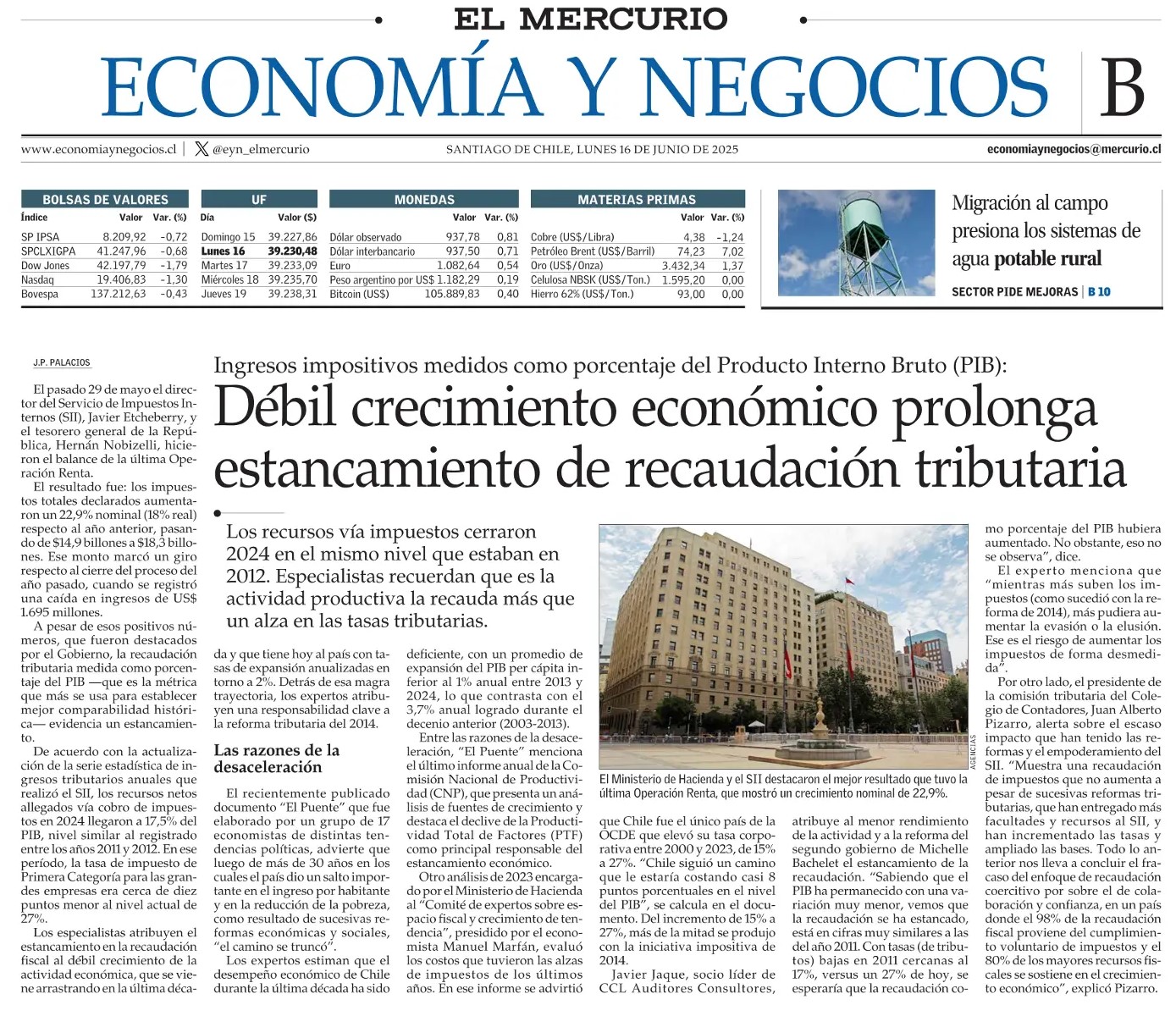
Tax revenues closed 2024 at the same level as in 2012. Experts note that productive activity generates more revenue than increases in tax rates.
Read the article in El Mercurio
On May 29, the Director of the Internal Revenue Service (SII), Javier Etcheberry, and the General Treasurer of the Republic, Hernán Nobizelli, presented the results of the latest tax filing process (Operación Renta).
The outcome was that total declared taxes increased by 22.9% in nominal terms (18% in real terms) compared to the previous year, rising from CLP 14.9 trillion to CLP 18.3 trillion. This marked a turnaround compared to the previous year’s process, which had recorded a decline in revenue of US$1.695 billion.
Despite these positive figures, highlighted by the government, tax revenue as a percentage of GDP—which is the most commonly used metric for historical comparison—shows signs of stagnation.
According to the updated statistical series of annual tax revenues published by the SII, net tax revenues in 2024 reached 17.5% of GDP, a level similar to that recorded between 2011 and 2012. During that period, the First Category tax rate for large companies was approximately ten percentage points lower than the current 27%.
Experts attribute the stagnation in tax collection to weak economic growth, which has persisted over the past decade and currently places the country’s annual growth rate at around 2%. Behind this weak trajectory, experts assign significant responsibility to the 2014 tax reform.
Reasons for the slowdown
The recently published document “El Puente,” prepared by a group of 17 economists from different political backgrounds, warns that after more than 30 years of significant progress in per capita income and poverty reduction—driven by successive economic and social reforms—“the path has stalled.”
Experts estimate that Chile’s economic performance over the past decade has been poor, with average per capita GDP growth below 1% annually between 2013 and 2024, compared to 3.7% per year during the previous decade (2003–2013).
Among the causes of the slowdown, “El Puente” highlights findings from the latest annual report of the National Productivity Commission (CNP), which identifies the decline in Total Factor Productivity (TFP) as the main driver of economic stagnation.
Another analysis commissioned in 2023 by the Ministry of Finance to the “Committee of Experts on Fiscal Space and Trend Growth,” chaired by economist Manuel Marfán, assessed the costs of recent tax increases. The report noted that Chile was the only OECD country to raise its corporate tax rate between 2000 and 2023, from 15% to 27%. “Chile followed a path that may be costing it nearly 8 percentage points of GDP,” the document states. More than half of this increase occurred as part of the 2014 tax reform.
Javier Jaque, Managing Partner of CCL Auditores Consultores, attributes the stagnation in tax revenue to lower economic performance and the tax reform of Michelle Bachelet’s second administration. “Knowing that GDP has shown very limited variation, we see that tax revenue has stagnated and remains at levels very similar to those of 2011. With lower tax rates in 2011—around 17%—compared to today’s 27%, one would expect tax revenue as a percentage of GDP to have increased. However, this has not been observed,” he explains.
The expert adds that “as taxes increase (as occurred with the 2014 reform), tax evasion or avoidance may also rise. That is the risk of excessively increasing taxes.”
Meanwhile, Juan Alberto Pizarro, president of the Tax Commission of the Association of Accountants, warns about the limited impact of reforms and the expanded authority of the SII. “It shows tax revenue that does not increase despite successive tax reforms that have granted more powers and resources to the SII, while also raising rates and broadening tax bases. All of this leads us to conclude the failure of a coercive revenue approach over one based on collaboration and trust, in a country where 98% of fiscal revenue comes from voluntary tax compliance and 80% of additional fiscal resources depends on economic growth,” he explained.