
Criticism from tax experts adds to the concerns already expressed by opposition lawmakers.
Read the article in La Tercera-Pulso.
A complex legislative process is expected for the bill recently submitted by the government to Congress, which focuses on reformulating the tax system for SMEs. This has been anticipated by opposition lawmakers, who criticize the timing of its presentation—toward the end of the government’s term—and the inclusion of too many different topics.
The fundamental change is that these smaller companies will no longer pay the First Category tax, as it will instead be reflected in the owners’ Global Complementary Tax.
It was explained that for companies that do not wish to be part of the transparent regime, the current integrated system will remain, with a modification to the First Category tax rate (IDPC), which will be set at 20%.
The initiative also includes tax increases to compensate for the lower revenues that the Treasury will receive, considering the tax relief measures provided in education and rent, along with the changes affecting SMEs. This set of measures, combined with benefits for the middle class, has an annual cost of approximately US$1 billion.
However, concerns about this initiative are not limited to the political sphere, but are also shared by tax experts and economists.
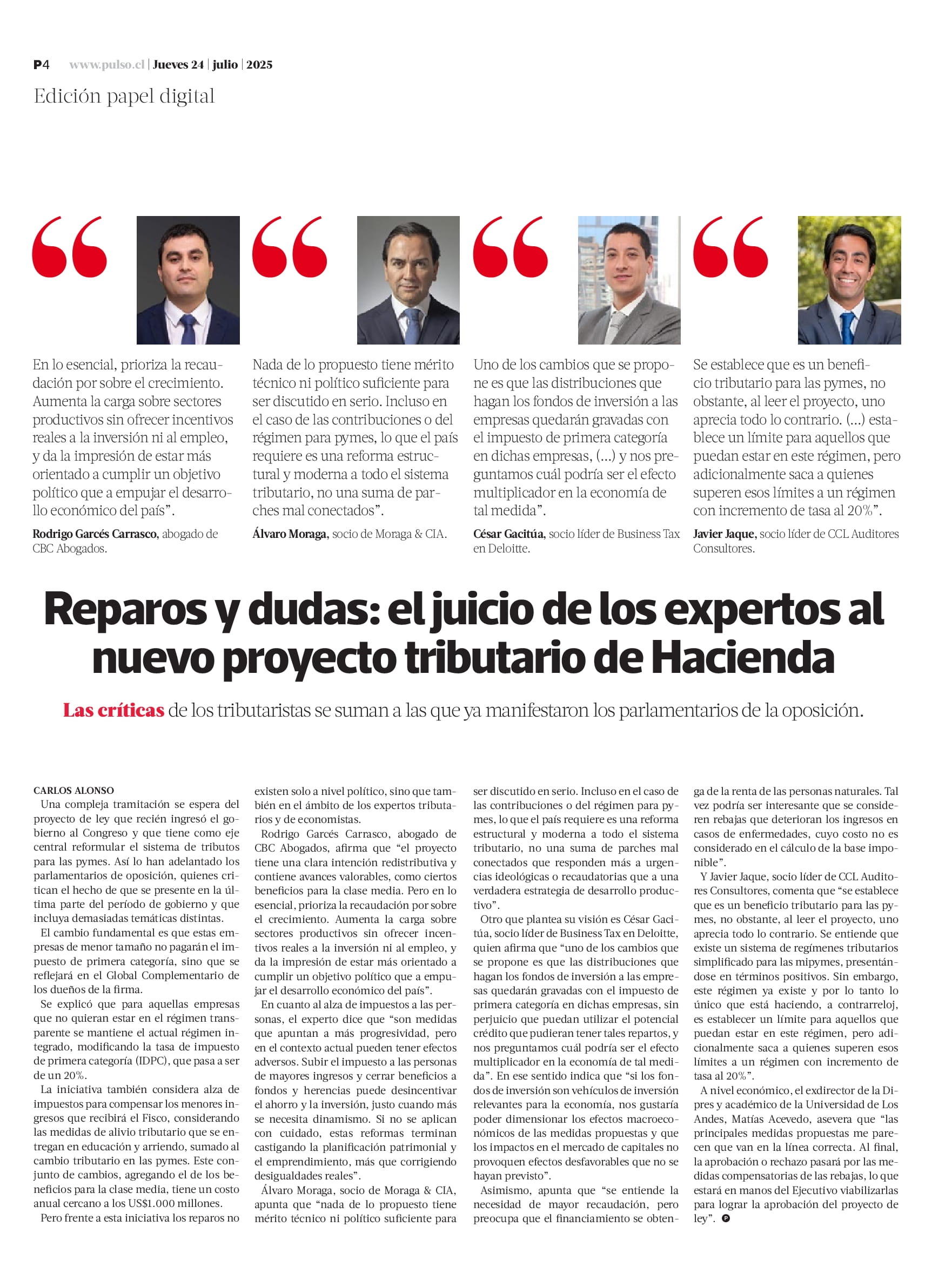
Rodrigo Garcés Carrasco, attorney at CBC Abogados, states that “the bill has a clear redistributive intent and includes some valuable advances, such as certain benefits for the middle class. However, at its core, it prioritizes revenue collection over growth. It increases the burden on productive sectors without offering real incentives for investment or employment, and appears more focused on achieving a political objective than on promoting the country’s economic development.”
Regarding higher taxes on individuals, the expert notes that “these measures aim for greater progressivity, but in the current context they may have adverse effects. Increasing taxes on higher-income individuals and eliminating benefits related to funds and inheritances could discourage savings and investment, precisely when economic dynamism is most needed. If not applied carefully, these reforms may end up penalizing wealth planning and entrepreneurship rather than correcting real inequalities.”
Álvaro Moraga, partner at Moraga & CIA, argues that “none of the proposed measures has sufficient technical or political merit to be seriously discussed. Even in the case of property taxes or the SME regime, what the country needs is a structural and modern reform of the entire tax system, not a set of poorly connected patches driven more by ideological or revenue-raising urgencies than by a genuine strategy for productive development.”
Another perspective is offered by César Gacitúa, Business Tax Leader at Deloitte, who states that “one of the proposed changes is that distributions made by investment funds to companies will be subject to the First Category tax at the company level, regardless of any potential tax credits associated with such distributions. This raises questions about the potential multiplier effect of such a measure on the economy.” In this regard, he adds that “if investment funds are key vehicles for economic activity, it would be important to assess the macroeconomic impact of these measures and ensure that their effects on capital markets do not generate unforeseen negative consequences.”
He also points out that “while the need for greater revenue is understood, there is concern that funding will come from the income of individuals. It may be worth considering tax reductions that address income erosion in cases such as illness, where costs are not currently reflected in the taxable base.”
And Javier Jaque, Managing Partner of CCL Auditores Consultores, comments that “it is presented as a tax benefit for SMEs; however, upon reviewing the bill, one sees quite the opposite. While a simplified tax regime for MSMEs is presented positively, this regime already exists. Therefore, what is being done at the last minute is to set a limit for those who can remain in it, while additionally moving those who exceed these thresholds into a regime with an increased tax rate of 20%.”
From an economic standpoint, former Director of Budget and academic at Universidad de Los Andes, Matías Acevedo, states that “the main measures proposed seem to be in the right direction. Ultimately, approval or rejection will depend on the compensatory measures for the tax reductions, which will be up to the Executive to implement in order to secure the bill’s approval.”