
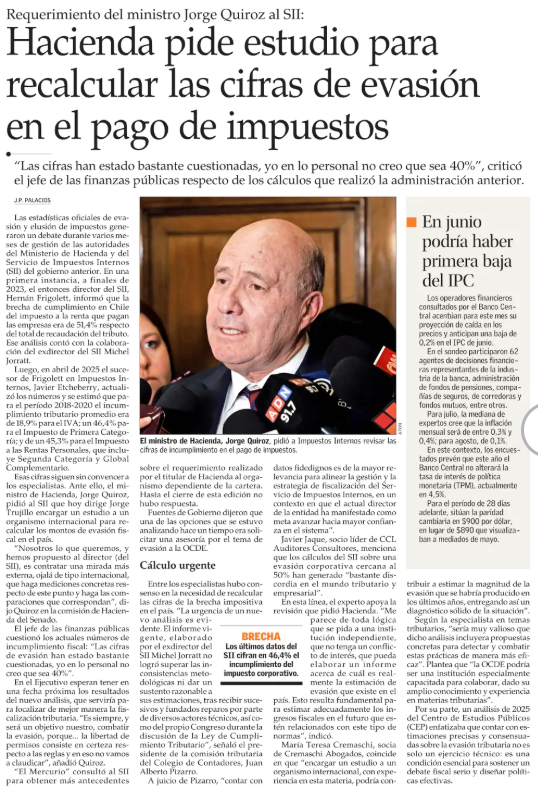
“The figures have been heavily questioned, and personally, I do not believe the rate is 40%,” criticized the head of Chile’s public finances regarding the calculations made by the previous administration.
Official tax evasion and avoidance statistics sparked debate throughout several months under the previous administration of the Ministry of Finance and the Chilean Internal Revenue Service (SII). Initially, at the end of 2023, then-SII Director Hernán Frigolett reported that the tax gap in Chile’s corporate income tax collection amounted to 51.4% of total revenue from that tax. The analysis was conducted with the collaboration of former SII Director Michel Jorratt.
Later, in April 2025, Frigolett’s successor at the SII, Javier Etcheberry, updated the figures and estimated that, for the 2018–2020 period, average tax non-compliance reached 18.9% for VAT, 46.4% for First Category Tax (corporate income tax), and 45.3% for Personal Income Tax, including Second Category Tax and the Global Complementary Tax.
These figures continue to raise doubts among specialists. As a result, Finance Minister Jorge Quiroz requested that the SII, now headed by Jorge Etcheberry, commission an international organization to recalculate the country’s tax evasion estimates.
“What we want, and what we have proposed to the Director of the SII, is to obtain a more external perspective—ideally from an international organization—that can provide concrete measurements on this issue and make the necessary comparisons,” Quiroz said before the Senate Finance Committee.
Urgent Reassessment
Among tax experts, there was broad consensus on the need to recalculate the country’s tax gap figures. “The urgency of a new analysis is evident. The current report, prepared by former SII Director Michel Jorratt, failed to overcome methodological inconsistencies or provide a reasonable basis for its estimates, after receiving repeated and well-founded criticism from various technical experts, as well as from Congress itself during the discussion of the Tax Compliance Law,” said Juan Alberto Pizarro, President of the Tax Committee of the Chilean Association of Accountants.
According to Pizarro, one option that had been considered for some time was to request technical assistance from the OECD regarding tax evasion estimates.
Javier Jaque, Managing Partner of CCL Auditores Consultores, noted that the SII’s estimates of corporate tax evasion, which approach 50%, have generated “considerable disagreement within the tax and business communities.”
In this regard, Jaque supports the review requested by the Ministry of Finance. “It seems entirely reasonable to ask an independent institution, free from conflicts of interest, to prepare a report on what the actual level of tax evasion in the country is. This is essential for accurately estimating future tax revenues associated with this type of legislation,” he stated.
María Teresa Cremaschi, partner at Cremaschi Abogados, agrees that “commissioning a study from an international organization with expertise in this field could help estimate the magnitude of tax evasion over recent years, thereby providing a solid diagnosis of the situation.”
According to the tax specialist, “it would be highly valuable for such an analysis to include concrete proposals to detect and combat these practices more effectively.” She further suggested that “the OECD could be particularly well suited to collaborate, given its extensive knowledge and experience in tax matters.”
Meanwhile, a 2025 study by the Center for Public Studies (CEP) emphasized that having accurate and broadly accepted estimates of tax evasion is not merely a technical exercise; it is an essential condition for sustaining a serious fiscal debate and designing effective public policies.