
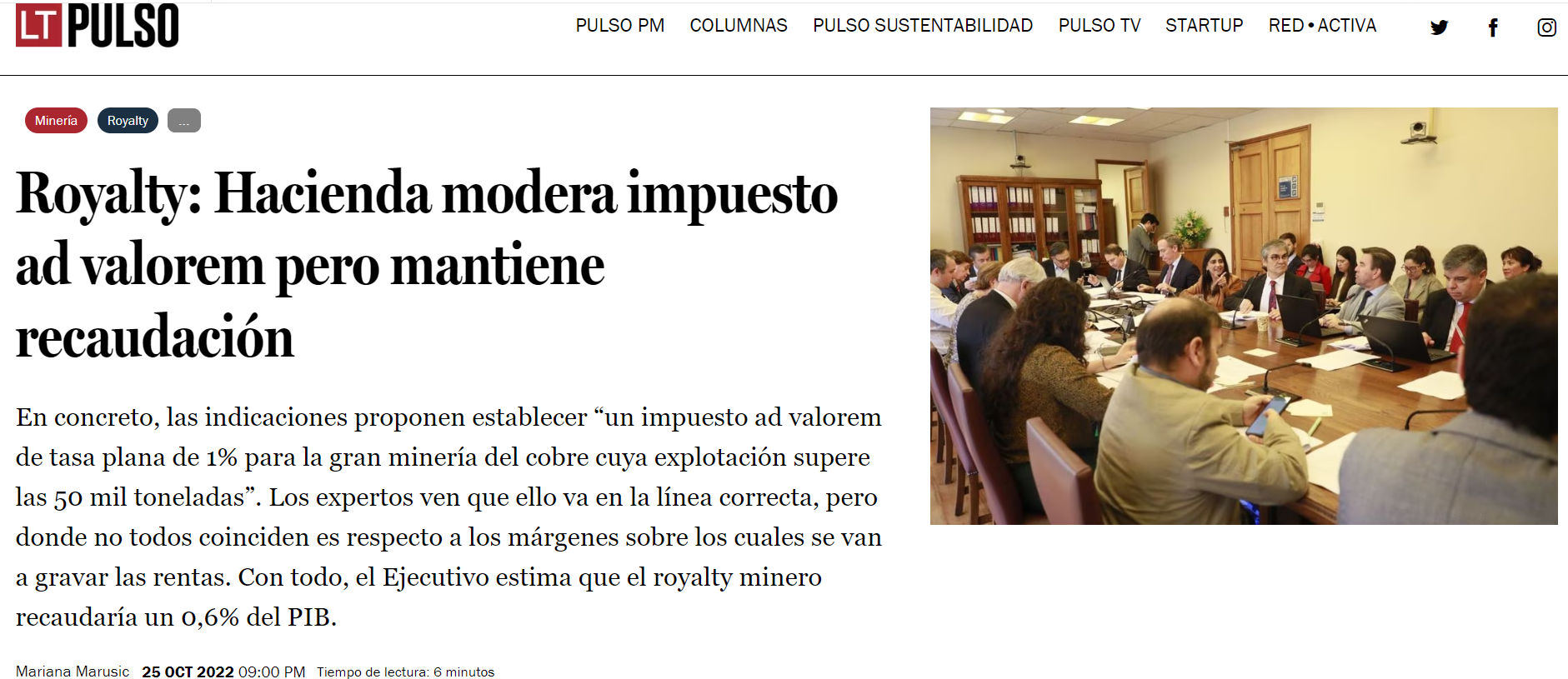
Specifically, the amendments propose establishing “a flat-rate ad valorem tax of 1% for large copper mining whose production exceeds 50,000 tons.” Experts see this as heading in the right direction, but where not everyone agrees is regarding the margins on which income will be taxed. Nevertheless, the Executive estimates that the mining royalty would raise 0.6% of GDP.
After several weeks of discussions with parliamentarians and representatives of the mining industry, the government presented this Tuesday to the Senate Mining and Energy Commission a set of amendments that reformulate the mining royalty project.
According to a statement sent by the Treasury, these amendments take “into account the proposals made by specialists and academics during hearings on the project.” It also states that “they involve a simplification and reduction of the ad valorem component; a change of the base of the variable component, which will be determined based on mining operational margin ranges instead of copper prices; a reduction or elimination of the ad valorem component for companies that could face operational losses as a result of its application; and the inclusion of depreciation as part of the calculation of the mining operational margin.”
Specifically, the amendments propose establishing “a flat-rate ad valorem tax of 1% for large copper mining whose production exceeds 50,000 tons,” thereby excluding medium-sized mining,” the Treasury stated in the press release. And if the operational margin is negative, “this tax will not apply. The rate scale is also modified to apply the tax based on the operational margin of mining companies, which will fluctuate between 8% and 26%. For the calculation of operational margin, the expenses of the productive site, inputs, and depreciation may be deducted.”
Considering these changes, the government estimates that the mining royalty would raise an additional 0.6% of GDP. The Treasury detailed that of this total, 0.46% of GDP would come from the new structure, and the remaining 0.15% results from production growth and costs.
Regarding revenue, the Treasury also stated that “new recipients are incorporated, distributing a significant portion of resources to local and regional governments, with special priority to those in mining areas. To compensate for the negative externalities of mineral extraction, a total of USD 20 million will be distributed among the 25 mining municipalities that host mining operations subject to royalty payment.”
Additionally, they specified that “a contribution of USD 60 million to the Municipal Common Fund is planned, doubling the amount currently provided by the Treasury, fulfilling one of the commitments of President Gabriel Boric’s government program. USD 280 million will also be allocated to the Regional Productivity and Development Fund, managed by regional governments to finance plans and programs promoting investment projects, regional development, and scientific and technological research. The per capita contribution will be double for mining regions, and another USD 50 million will be designated for investment in research and development in the regions.”
The Minister of Finance, Mario Marcel, stated that “we are grateful for the discussions held in recent weeks, which have allowed us to find an alternative that better balances revenue objectives with industry growth and development.”
The experts
The amendments are heading in the right direction. That is the first thing experts say when quickly evaluating the government’s proposed amendments.
The Tax & Legal Leader partner at Deloitte, Hugo Hurtado, comments that “there is a willingness from the government to engage in discussion; there was an ad valorem that was very high, and now it is at 1%, which seems reasonable, also considering our competitors, such as Peru and other countries, which also have this ad valorem. However, the margins on which income will be taxed seem a bit high, as does the revenue. With revenue of 0.6% of GDP, they are probably assuming that in some cases rates will exceed 50% (…) This would leave us in a disadvantaged position compared to other competing mining investment countries.” He adds that he will study the issue further and run models to determine the real impact.
The partner at Cabello Abogados Tributarios, Juan Pablo Cabello, mentions that “the modifications would be on the right track since they address the fact that mining companies operate under different realities. It was necessary to reduce the ad valorem component, as it put the viability of several companies at risk, and similarly, it is positive to focus more on operational margin than copper prices. The principle at stake is to tax companies mainly based on operational results and set an ad valorem that does not affect the viability of several companies in the sector, and for future projects.”
The partner of the tax consulting firm CCL Auditores Consultores, Javier Jaque, says that “the changes to the mining royalty project would go in the right direction. The simplification was expected along with determining the base according to operational margin ranges instead of copper prices. Considering companies that could face operational losses and including depreciation in the calculation of the operational margin were considered essential elements of any project to discuss. This makes it expected that the final tax rates on margin or profit will fall within what is expected to be collected from the sector with minimal impact on investment and industry development.”