
Casinos have argued that the approach adopted by the Chilean Internal Revenue Service (SII) requiring betting platforms to pay taxes amounts to a form of “hidden regularization.” Some experts support the SII’s position, while others take a more nuanced view.
The Chilean Internal Revenue Service (SII) surprised the market on Wednesday when it enabled a mechanism allowing foreign online betting platforms to register and pay VAT on the transactions they carry out in Chile.
The Chilean Casino and Gaming Association immediately rejected the decision, describing it as a “hidden regularization.” Reactions continued on Thursday. “The signal being sent is very complex and quite confusing,” said the Association’s president, Cecilia Valdés, on Radio13C, arguing that these websites have been declared illegal by the Supreme Court while, at the same time, legislation on the matter is still under discussion.
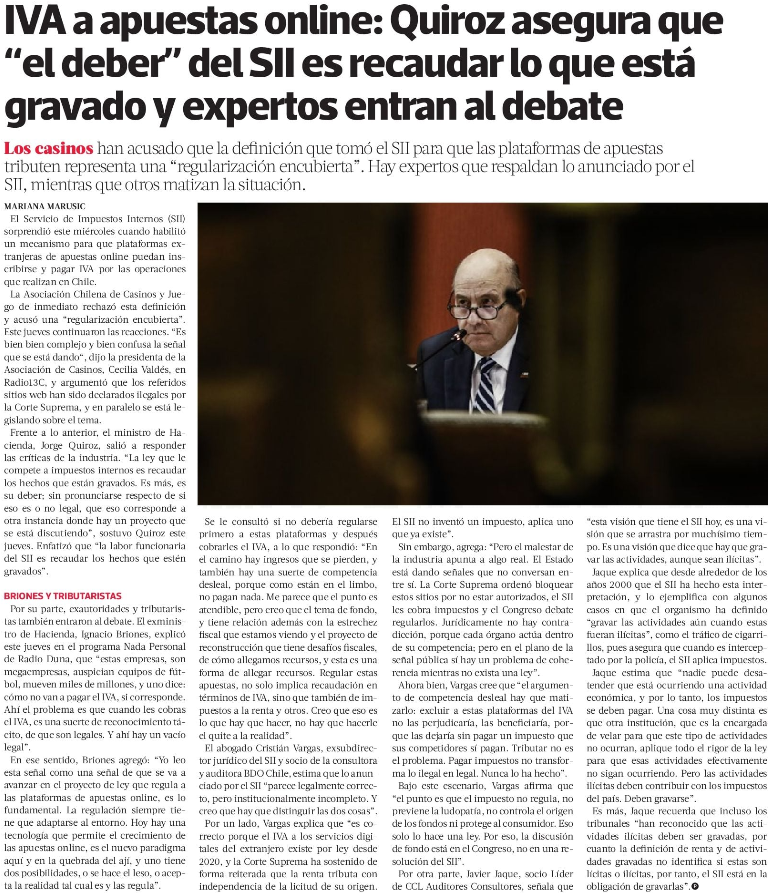
In response, Minister of Finance Jorge Quiroz addressed the industry’s criticism. “The responsibility of the Internal Revenue Service is to collect taxes on taxable activities. In fact, it is its duty to do so, without making any determination as to whether such activities are legal or illegal, since that is a matter for another forum where a bill is currently under discussion,” Quiroz stated on Thursday. He emphasized that “the SII’s institutional role is to collect taxes on taxable activities.”
Briones and Tax Experts
Former authorities and tax specialists also joined the debate. Former Finance Minister Ignacio Briones explained on Thursday during Radio Duna’s program Nada Personal that “these companies are huge businesses, they sponsor football teams, they move billions of dollars, and one naturally asks: how can they not be paying VAT if they are supposed to? The problem is that once you charge them VAT, it becomes a sort of tacit recognition that they are legal. That is where the legal vacuum lies.”
Briones added: “I interpret this move as a signal that progress will be made on the bill regulating online betting platforms, which is the key issue. Regulation must always adapt to the environment. Today, technology allows the expansion of online betting; this is the new paradigm, both here and everywhere else. We have two options: either ignore reality or accept it as it is and regulate it.”
When asked whether these platforms should first be regulated and only then required to pay VAT, Briones replied: “In the meantime, revenue is being lost, and there is also a form of unfair competition because, operating in a legal gray area, they pay nothing. The point is valid, but the fundamental issue relates to the fiscal constraints we are currently facing and the reconstruction bill, which presents fiscal challenges regarding how to raise resources. This is one way to generate revenue. Regulating online betting would not only increase VAT collection but also income tax and other tax revenues. That is what needs to be done; we should not avoid confronting reality.”
Attorney Cristián Vargas, former Legal Deputy Director of the SII and partner at consulting and audit firm BDO Chile, believes that what the SII announced “appears legally correct but institutionally incomplete. It is important to distinguish between those two things.”
On the one hand, Vargas explains that “it is correct because VAT on foreign digital services has existed by law since 2020, and the Supreme Court has repeatedly held that income is taxable regardless of the legality of its source. The SII did not create a new tax; it is simply applying an existing one.”
However, he adds: “The industry’s discomfort points to something real. The State is sending signals that are not aligned. The Supreme Court ordered these websites to be blocked because they are unauthorized, the SII is charging them taxes, and Congress is debating their regulation. Legally there is no contradiction because each institution acts within its own authority, but from the perspective of public policy messaging there is a coherence problem as long as there is no law.”
Vargas also argues that “the unfair competition argument should be qualified: excluding these platforms from VAT would not harm them—it would benefit them, because they would avoid paying a tax that their competitors do pay. Taxation is not the problem. Paying taxes does not transform something illegal into something legal. It never has.”
Under these circumstances, Vargas concludes that “the real issue is that taxation does not regulate, prevent gambling addiction, control the origin of funds, or protect consumers. Only legislation can do that. Therefore, the substantive debate belongs in Congress, not in an administrative resolution issued by the SII.”
Javier Jaque’s View
Javier Jaque, Managing Partner of CCL Auditores Consultores, points out that “the SII’s current position is one that has existed for a very long time. It is based on the principle that activities should be taxed even if they are illegal.”
Jaque explains that the SII has maintained this interpretation since approximately the early 2000s, citing examples where the agency has chosen to “tax activities even when they are unlawful,” such as cigarette smuggling. According to him, when such activities are intercepted by law enforcement authorities, the SII still assesses taxes on them.
Jaque believes that “no one can ignore the fact that an economic activity is taking place, and therefore taxes must be paid. A completely separate matter is that another institution, whose role is to ensure that such activities do not occur, should apply the full force of the law to prevent them from continuing. However, illegal activities must also contribute through taxation. They should be taxed.”
Furthermore, Jaque notes that the courts themselves “have recognized that illegal activities must be taxed, since the legal definition of income and taxable activities does not distinguish between lawful and unlawful activities. Consequently, the SII has an obligation to tax them.”