
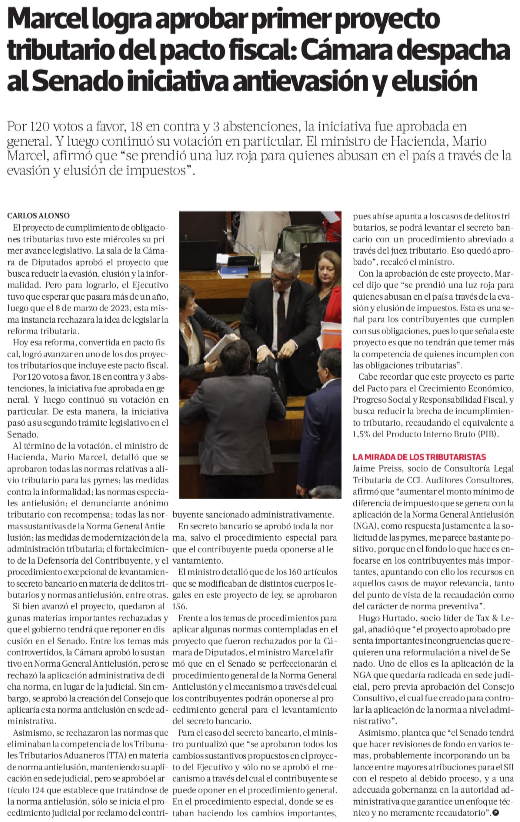
With 120 votes in favor, 18 against, and 3 abstentions, the initiative was approved in general and then moved on to its particular discussion. The Minister of Finance, Mario Marcel, stated that “a red light has been turned on for those who abuse the system in the country through tax evasion and avoidance.”
Read the article in La Tercera-Pulso.
The Tax Compliance Bill took its first legislative step this Wednesday. The Chamber of Deputies approved the bill aimed at reducing tax evasion, avoidance, and informality. However, for this to happen, the Executive had to wait more than a year after the same chamber rejected the broader tax reform proposal on March 8, 2023.
That reform, now reframed as part of a fiscal pact, has advanced through one of the two tax bills included in the agreement.
With 120 votes in favor, 18 against, and 3 abstentions, the initiative was approved in general and continued to its particular discussion. As a result, the bill moved to its second legislative stage in the Senate. :contentReference[oaicite:0]{index=0}
At the end of the vote, Finance Minister Mario Marcel detailed that all provisions related to tax relief for SMEs, anti-informality measures, specific anti-avoidance rules, the anonymous tax whistleblower mechanism with rewards, substantive provisions of the General Anti-Avoidance Rule, modernization of tax administration, strengthening of the Taxpayer Defense Office, and the exceptional procedure for lifting bank secrecy in tax crime cases were approved, among others.
Although the bill advanced, some important provisions were rejected and will need to be reintroduced during Senate discussions. Among the most controversial issues, the Chamber approved the substantive aspects of the General Anti-Avoidance Rule but rejected its administrative application, favoring instead a judicial approach. However, the creation of a council to apply the rule administratively was approved.
Additionally, provisions that would have removed the jurisdiction of Tax and Customs Courts (TTA) in anti-avoidance matters were rejected, maintaining their role in judicial proceedings. However, Article 124 was approved, establishing that judicial proceedings under the anti-avoidance rule will only begin upon a claim by the taxpayer sanctioned administratively.
Regarding bank secrecy, all provisions were approved except for the mechanism allowing taxpayers to oppose its lifting.
The minister noted that of the 160 articles amending various legal bodies in the bill, 156 were approved.
On the rejected procedural aspects, Marcel stated that improvements will be made in the Senate to both the General Anti-Avoidance Rule procedures and the mechanism through which taxpayers may oppose the lifting of bank secrecy.
Regarding bank secrecy, the minister emphasized that “all substantive changes proposed by the Executive were approved, except for the mechanism allowing taxpayer opposition in the general procedure. In the special procedure—focused on tax crime cases—bank secrecy may be lifted through an expedited process before a tax judge, which was approved.”
With the approval of this bill, Marcel stated that “a red light has been turned on for those who abuse the system through tax evasion and avoidance. This sends a signal to compliant taxpayers that they no longer have to compete with those who fail to meet their tax obligations.”
It is worth noting that this bill is part of the Pact for Economic Growth, Social Progress, and Fiscal Responsibility, and aims to reduce the tax compliance gap, raising revenue equivalent to 1.5% of GDP.
Expert perspective
Jaime Preiss, Partner in Tax Legal Consulting at CCL Auditores Consultores, stated that “increasing the minimum tax difference threshold for applying the General Anti-Avoidance Rule, in response to SME concerns, is quite positive, as it focuses enforcement resources on the most significant taxpayers, both in terms of revenue impact and preventive effect.”