
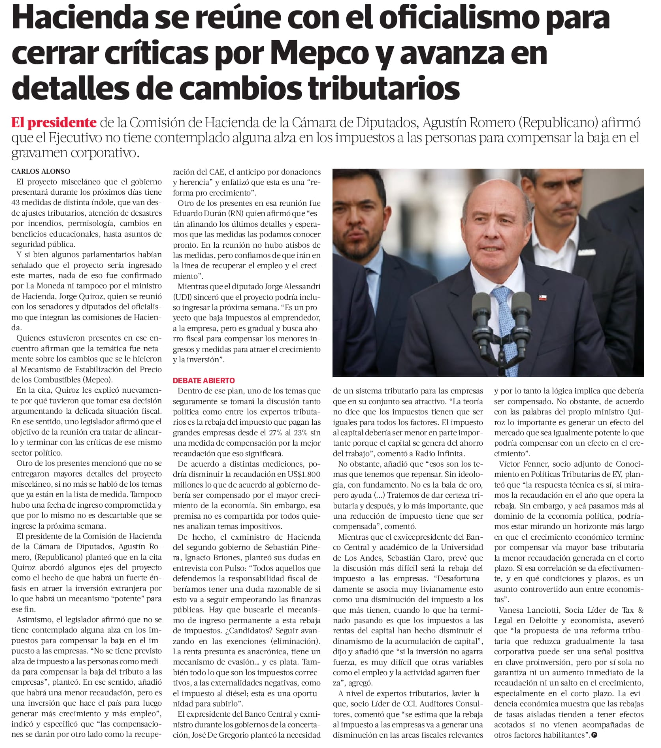
The president of the Finance Committee of the Chamber of Deputies, Agustín Romero (Republican Party), stated that the Executive does not plan to increase personal taxes to offset the reduction in the corporate tax rate.
The omnibus bill that the government is expected to present in the coming days includes 43 measures of various kinds, ranging from tax adjustments, wildfire disaster response, regulatory permitting, changes to education benefits, and public security matters.
Although some lawmakers had indicated that the bill would be submitted this Tuesday, this was not confirmed by the presidential office nor by the Minister of Finance, Jorge Quiroz, who met with ruling coalition senators and deputies who are members of the Finance Committees.
Those present at the meeting stated that the discussion focused exclusively on the changes made to the Fuel Price Stabilization Mechanism (Mepco). During the meeting, Quiroz once again explained the reasons behind the decision, citing the country’s delicate fiscal situation. One legislator noted that the objective of the meeting was to align the coalition and put an end to criticism from within the same political sector.
Another attendee mentioned that no further details were provided regarding the omnibus bill, and that the discussion focused only on measures already included in the proposal. No specific submission date was confirmed, and it is not ruled out that the bill could be introduced next week.
Romero added that Quiroz addressed key aspects of the proposal, including a strong emphasis on attracting foreign investment, for which a “powerful” mechanism will be implemented.
The lawmaker also stated that no tax increases on individuals are being considered to compensate for the reduction in corporate taxes. “There are no plans to raise personal taxes as a measure to offset the reduction in corporate taxation,” he said. In that sense, he acknowledged that there would be lower tax revenue, but described it as an investment aimed at generating greater economic growth and employment. He added that compensation measures would come from other sources, such as the recovery of the CAE (student loan system), advances on donations, and inheritance-related mechanisms, emphasizing that this is a “pro-growth reform.”
Another participant in the meeting, Eduardo Durán (National Renewal), said that “final details are being fine-tuned and we expect to learn about the measures soon. No specific measures were disclosed in the meeting, but we trust they will aim to recover employment and growth.”
Meanwhile, Deputy Jorge Alessandri (UDI) acknowledged that the bill could be introduced as early as next week. “It is a project that reduces taxes for entrepreneurs and companies, but it does so gradually and seeks fiscal savings to offset lower revenues, along with measures to attract growth and investment.”
Open debate
Within this plan, one of the issues that will likely dominate both political and technical discussions is the reduction of the corporate tax rate from 27% to 23%, without a clear compensatory mechanism for the resulting loss in revenue.
According to various estimates, this could reduce tax revenues by around US$1.8 billion, which the government expects to be offset by stronger economic growth. However, this assumption is not shared by all tax experts.
Former Finance Minister Ignacio Briones raised concerns in an interview with Pulso:
“Those of us who defend fiscal responsibility should reasonably question whether this will further deteriorate public finances. A permanent revenue mechanism must be found to support this tax cut. Possible options? Continuing to eliminate tax exemptions. Presumptive income is outdated, enables tax avoidance, and represents lost revenue. Additionally, corrective taxes on negative externalities—such as diesel taxes—could be increased.”
José De Gregorio, former Central Bank president and former minister, highlighted the need for an overall attractive corporate tax system:
“Economic theory does not say taxes must be equal for all factors. Capital taxation should be lower in part because capital is generated from labor savings,” he told Radio Infinita.
However, he added:
“These are issues we must rethink—without ideology, and with solid grounding. It’s not a silver bullet, but it helps. We should aim for tax certainty, and most importantly, any tax reduction must be compensated.”
Sebastián Claro, former Central Bank vice president and academic, anticipates that the most difficult discussion will be the corporate tax cut:
“Unfortunately, this is too easily framed as a tax cut for the wealthy, when in reality taxes on capital income have reduced the dynamism of capital accumulation. If investment does not pick up, it is very difficult for employment and economic activity to gain momentum.”
From a tax expert perspective, Javier Jaque, Managing Partner at CCL Auditores Consultores, stated:
“It is estimated that reducing corporate taxes will significantly impact fiscal revenues, so logically it should be compensated. However, according to Minister Quiroz, the key is to generate a strong market effect that could offset this through economic growth.”
Víctor Fenner, Associate Partner at EY, noted:
“The technical answer is yes, if we look at revenue in the year the tax cut is implemented. However, from a political economy perspective, we may be looking at a longer-term horizon where economic growth compensates through a broader tax base. Whether this actually occurs—and under what conditions and timeframes—remains a matter of debate among economists.”
Vanesa Lanciotti, Tax & Legal Leader at Deloitte, added:
“A tax reform that gradually reduces the corporate rate can send a positive pro-investment signal, but on its own it does not guarantee an immediate increase in revenue or a boost in growth, especially in the short term. Economic evidence shows that isolated tax cuts tend to have limited effects unless accompanied by other enabling factors.”
Lorem ipsum dolor sit amet, consectetur adipiscing elit. Ut elit tellus, luctus nec ullamcorper mattis, pulvinar dapibus leo.