
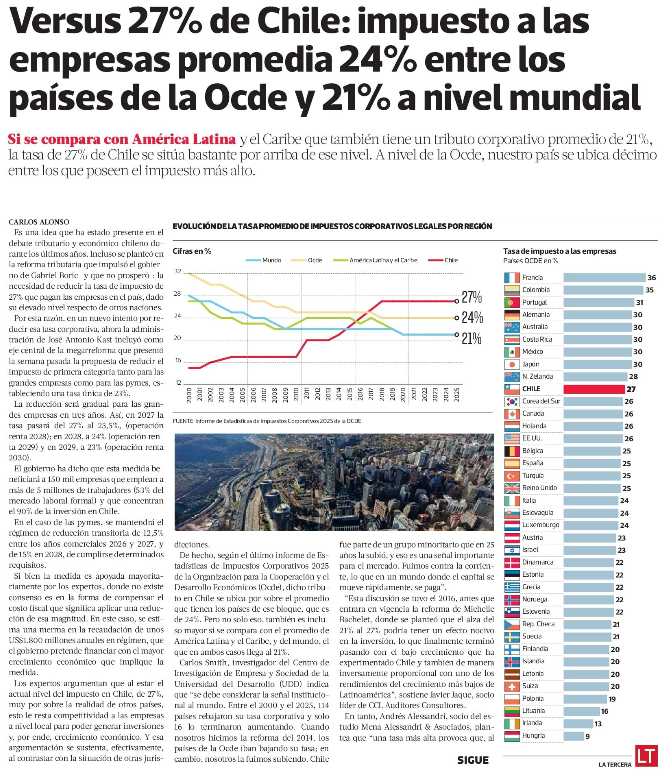
When compared to Latin America and the Caribbean—where the average corporate tax rate is also 21%—Chile’s 27% rate stands significantly above that level. Within the OECD, the country ranks tenth among those with the highest corporate tax rates.
This idea has been present in Chile’s tax and economic debate in recent years. It was even raised during the tax reform proposed by Gabriel Boric’s administration—which ultimately did not pass—highlighting the need to reduce the 27% corporate tax rate due to its relatively high level compared to other countries.
For this reason, in a renewed effort to lower the corporate tax burden, the current administration of José Antonio Kast has placed this issue at the center of the comprehensive reform presented last week. The proposal includes reducing the first-category tax rate for both large companies and SMEs, establishing a unified rate of 23%.
For large companies, the reduction will be gradual over three years. In 2027, the rate will decrease from 27% to 25.5% (for the 2028 tax filing); in 2028, it will drop to 24% (2029 tax filing); and in 2029, it will reach 23% (2030 tax filing).
The government has stated that this measure will benefit 150,000 companies employing more than 5 million workers—representing 53% of the formal labor market—and accounting for 90% of investment in Chile.
For SMEs, the temporary reduced tax regime will remain in place, with rates of 12.5% for fiscal years 2026 and 2027, and 15% in 2028, subject to certain conditions.
While the measure has broad support among experts, there is no consensus on how to offset the fiscal cost of such a reduction. It is estimated that the measure would result in an annual revenue loss of approximately US$1.8 billion once fully implemented, which the government expects to finance through higher economic growth.
Experts argue that Chile’s current 27% corporate tax rate—well above that of other countries—reduces the competitiveness of local companies, limiting their ability to attract investment and drive economic growth. This argument is supported when compared with other jurisdictions.
According to the OECD’s latest Corporate Tax Statistics 2025 report, Chile’s corporate tax rate is above the OECD average of 24%. Moreover, it is also higher than the average in Latin America and the Caribbean, as well as the global average, both of which stand at 21%.
Carlos Smith, researcher at the Business and Society Research Center at Universidad del Desarrollo, notes that “the institutional signal sent to the world must be considered. Between 2000 and 2025, 114 countries reduced their corporate tax rates, while only 16 increased them. When Chile implemented its 2014 reform, OECD countries were lowering their rates, while we were raising ours. Chile was part of a minority group that increased rates over 25 years, which sends a strong signal to the market. We went against the trend, and in a world where capital moves quickly, that has consequences.”
“This discussion already took place in 2016, before Michelle Bachelet’s tax reform came into effect, when it was argued that increasing the rate from 21% to 27% could have a negative impact on investment. Ultimately, this concern materialized, as reflected in Chile’s low growth and comparatively weak performance within Latin America,” says Javier Jaque, Lead Partner at CCL Auditores Consultores.
Meanwhile, Andrés Alessandri, partner at Mena Alessandri & Asociados, points out that “a higher tax rate can discourage investment when comparing projects. This is due to the higher cost relative to investing in other countries, whether OECD members or within Latin America.”
However, Alessandri also notes that “the tax rate alone does not provide the full picture. The tax system must be assessed as a whole.”
The local context
In line with economists and tax experts, Chile has experienced a steady increase in its corporate tax rate over the past decade, in contrast to trends in many other countries.
While Chile’s corporate tax rate was 17% in 2010, it reached 27% by 2018—a level that has remained unchanged. By comparison, the OECD average declined from 25% in 2010 to 24% today, while the average in Latin America and the Caribbean decreased from 23% to 21% over the same period.
Among the 38 OECD member countries, Chile ranks within the top 10 with the highest corporate tax rates. The list is led by France (36%), followed by Colombia (35%) and Portugal (31%). Germany, Australia, Costa Rica, Mexico, and Japan follow with rates of 30%, while New Zealand stands at 28% and Chile at 27%.
At the other end of the spectrum, countries with the lowest corporate tax rates include Hungary (9%), Ireland (13%), Lithuania (16%), and Poland (19%).
A boost to the economy?
Another key debate concerns whether lowering the corporate tax rate necessarily leads to increased investment and economic growth—and to what extent. Experts hold differing views, emphasizing that investment dynamics are multifactorial.
“In general, foreign investors in Chile operate from countries with tax treaties. They can use the corporate tax as a credit, meaning the final tax burden of the project remains at 35%. Therefore, while lowering the corporate tax helps, it must be evaluated in greater detail,” explains Alessandri.
Smith adds that “one would expect that lowering this tax would increase the profitability of investment projects, thereby generating growth and employment. However, this must be accompanied by other factors. To boost employment, lowering taxes alone is not enough—we need clear rules and greater confidence.”
Jaque agrees, noting that “the impact will depend on multiple factors—not just the corporate tax rate, but also reducing bureaucratic barriers and regulatory burdens”.