
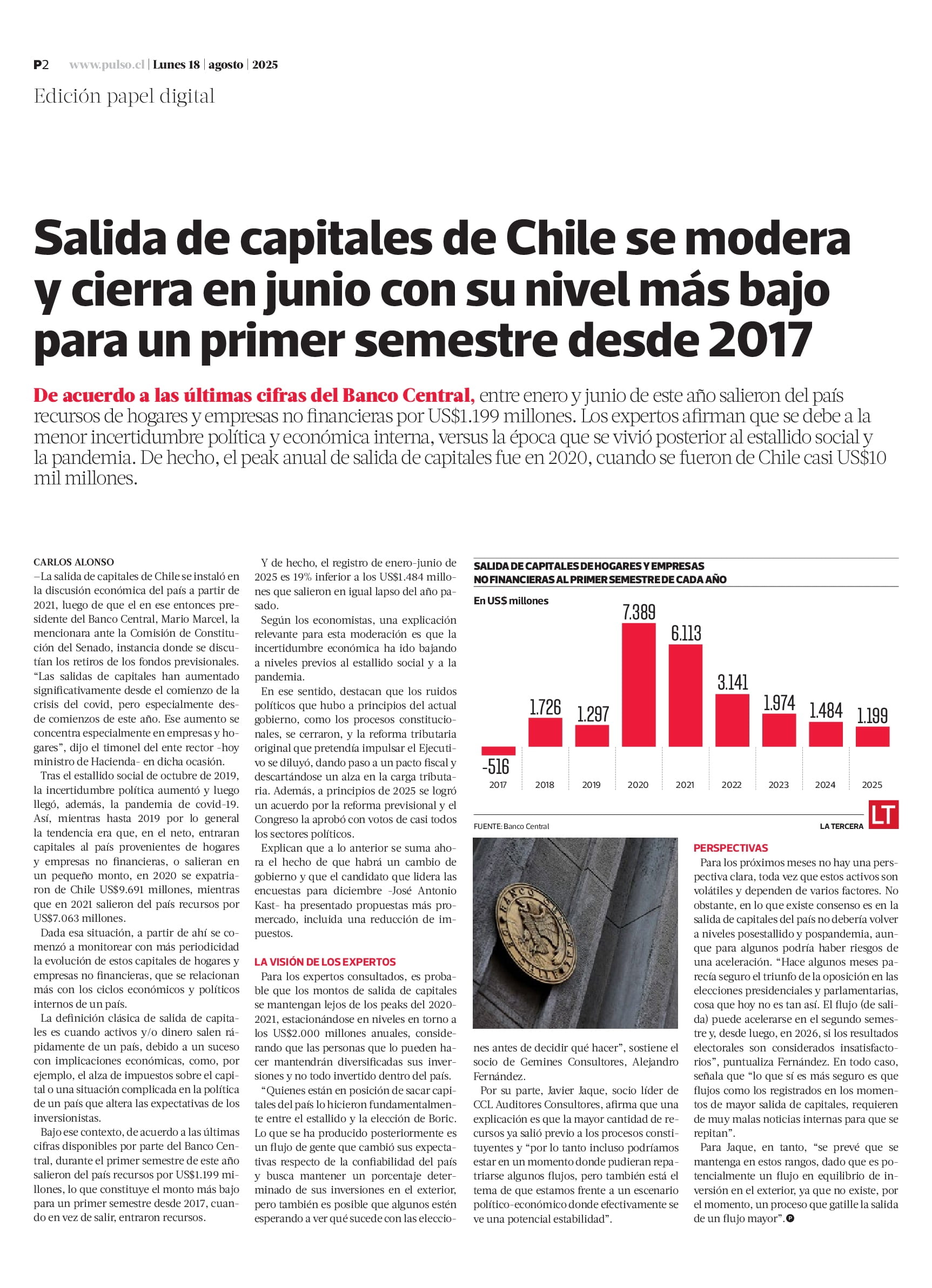
According to the latest figures from the Central Bank, between January and June of this year, resources totaling US$1.199 billion left the country from households and non-financial companies. Experts state that this is due to lower internal political and economic uncertainty compared to the period following the social unrest and the pandemic. In fact, the annual peak of capital outflows was in 2020, when nearly US$10 billion left Chile.
Read the article in La Tercera-Pulso.
Capital outflows from Chile became part of the country’s economic debate starting in 2021, after then Central Bank President Mario Marcel mentioned them before the Senate’s Constitution Committee, during discussions on pension fund withdrawals. “Capital outflows have increased significantly since the beginning of the COVID crisis, but especially since the start of this year. This increase is particularly concentrated among companies and households,” stated the head of the central bank—now Minister of Finance—at that time.
Following the social unrest of October 2019, political uncertainty increased, and the COVID-19 pandemic followed shortly after. As a result, while up until 2019 the general trend was that, on a net basis, capital flowed into the country from households and non-financial companies—or left in small amounts—in 2020 Chile saw US$9.691 billion in capital outflows, followed by US$7.063 billion in 2021.
Given this situation, the evolution of these capital flows from households and non-financial companies—closely linked to domestic economic and political cycles—began to be monitored more frequently.
The classic definition of capital outflow refers to assets and/or money leaving a country rapidly due to an event with economic implications, such as an increase in taxes on capital or a complex political situation that alters investor expectations.
In this context, according to the latest data from the Central Bank, during the first half of this year, capital outflows totaled US$1.199 billion, marking the lowest level for a first half since 2017, when instead there were net inflows.
In fact, the January–June 2025 figure is 19% lower than the US$1.484 billion that left the country during the same period last year.
According to economists, a key explanation for this moderation is that economic uncertainty has declined to levels seen prior to the social unrest and the pandemic.
In this regard, they highlight that early political tensions during the current administration—such as constitutional processes—have concluded, and the original tax reform proposed by the government was set aside in favor of a fiscal pact, ruling out an increase in the overall tax burden. Additionally, at the beginning of 2025, an agreement on pension reform was reached and approved by Congress with support from nearly all political sectors.
They also point out that an upcoming change of government is expected, and that the leading candidate in the polls for December—José Antonio Kast—has presented more market-friendly proposals, including tax reductions.
Experts’ views
For the experts consulted, it is likely that capital outflows will remain well below the peaks of 2020–2021, stabilizing at levels around US$2 billion annually, considering that individuals capable of moving capital will continue to diversify their investments rather than keeping everything invested domestically.
“Those who were in a position to move capital abroad largely did so between the social unrest and Boric’s election. What has happened since then is a shift in expectations regarding the country’s reliability, leading investors to maintain a portion of their assets abroad. It is also possible that some are waiting to see the election outcomes before making further decisions,” says Alejandro Fernández, partner at Gemines Consultores.
For his part, Javier Jaque, Managing Partner of CCL Auditores Consultores, states that one explanation is that a large share of capital had already left prior to the constitutional processes, and “therefore, we could even be entering a phase where some flows may be repatriated. At the same time, we are in a political-economic scenario where a degree of stability is becoming visible.”
Outlook
Looking ahead, there is no clear outlook, as these assets are volatile and depend on multiple factors. However, there is consensus that capital outflows are unlikely to return to post-social unrest and post-pandemic levels, although some risks of acceleration remain. “A few months ago, an opposition victory in presidential and parliamentary elections seemed certain, which is no longer the case. Outflows could accelerate in the second half of the year and into 2026 if election results are perceived as unfavorable,” Fernández notes. In any case, he adds that “flows like those seen during peak outflow periods would require very negative domestic developments to occur again.”
For Jaque, meanwhile, “it is expected that flows will remain within these ranges, as this likely reflects a balanced level of foreign investment, given that there is currently no trigger for a larger outflow.”