
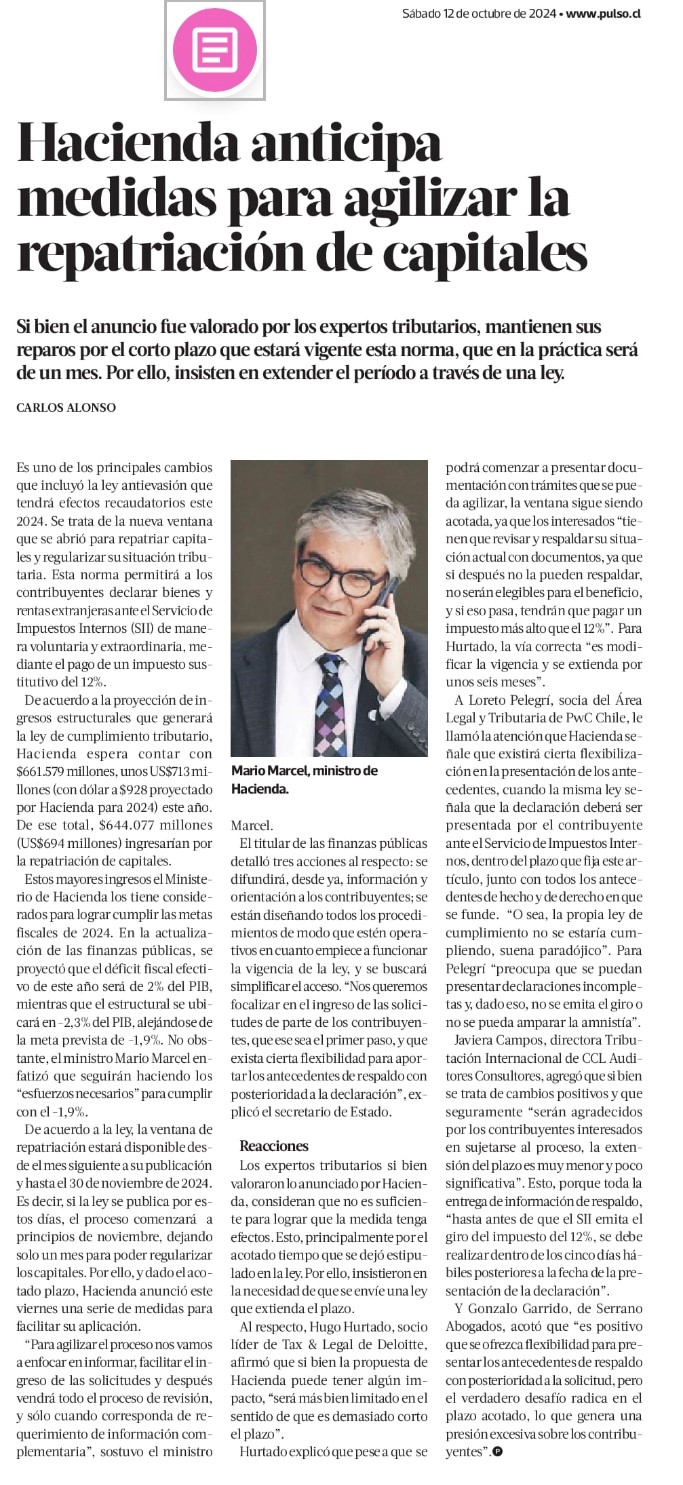
Although the announcement was welcomed by tax experts, they maintain their concerns regarding the short duration of this measure, which in practice will be only one month. For this reason, they insist on extending the period through legislation.
Read the article in La Tercera-Pulso.
This is one of the main changes introduced by the anti-evasion law that will have revenue effects in 2024. It involves the new window opened to repatriate capital and regularize its tax status. This regulation will allow taxpayers to voluntarily and exceptionally declare foreign assets and income before the Internal Revenue Service (SII), through the payment of a 12% substitute tax.
According to the structural revenue projections generated by the Tax Compliance Law, the Treasury expects to receive $661,579 million, approximately US$713 million (based on an exchange rate of $928 projected by the Treasury for 2024) this year. Of that total, $644,077 million (US$694 million) would come from capital repatriation.
These additional revenues are considered by the Ministry of Finance to meet the fiscal targets for 2024. In the public finance update, it was projected that the effective fiscal deficit for this year will be 2% of GDP, while the structural deficit will stand at -2.3% of GDP, moving away from the target of -1.9%. However, Minister Mario Marcel emphasized that they will continue making the “necessary efforts” to meet the -1.9% target.
According to the law, the repatriation window will be available from the month following its publication until November 30, 2024. That is, if the law is published in the coming days, the process will begin in early November, leaving only one month to regularize capital. Therefore, given the limited timeframe, the Treasury announced this Friday a series of measures to facilitate its implementation.
“To streamline the process, we will focus on providing information, facilitating the submission of applications, and then carrying out the review process, and only when necessary requesting additional information,” stated Minister of Finance Mario Marcel.
The head of public finances detailed three actions in this regard: information and guidance for taxpayers will be provided immediately; all procedures are being designed so they are operational as soon as the law comes into effect; and efforts will be made to simplify access. “We want to focus on the submission of applications by taxpayers as the first step, allowing some flexibility in providing supporting documentation after the declaration,” explained the minister.
Reactions
While tax experts welcomed the measures announced by the Treasury, they believe they are insufficient to ensure the effectiveness of the initiative. This is mainly due to the limited timeframe established in the law. Therefore, they insist on the need to pass legislation to extend the deadline.
In this regard, Hugo Hurtado, Lead Partner of Tax & Legal at Deloitte, stated that although the Treasury’s proposal may have some impact, “it will be rather limited, given that the timeframe is too short.”
Hurtado explained that although documentation submission processes may be expedited, the window remains limited, as interested parties “must review and support their current situation with documentation. If they cannot substantiate it afterward, they will not be eligible for the benefit, and in that case, they will have to pay a higher tax than 12%.” For Hurtado, the correct approach “is to modify the validity period and extend it by approximately six months.”
Loreto Pelegrí, partner in the Legal and Tax Area at PwC Chile, noted that it is striking that the Treasury suggests there will be some flexibility in submitting supporting documentation, when the law itself states that the declaration must be submitted to the Internal Revenue Service within the established timeframe, along with all factual and legal background supporting it. “In other words, the compliance law itself would not be fully complied with, which sounds paradoxical.” For Pelegrí, “there is concern that incomplete declarations may be submitted and, as a result, the tax assessment may not be issued or the amnesty benefit may not apply.”
Javiera Campos, Director of International Taxation at CCL Auditores Consultores, added that although these are positive changes and will likely be appreciated by taxpayers interested in participating in the process, “the extension of the deadline is very minor and not significant.” This is because all supporting documentation must be submitted “within five business days after the declaration is filed, before the SII issues the tax assessment for the 12% tax.”
Meanwhile, Gonzalo Garrido, from Serrano Abogados, noted that “it is positive to offer flexibility in submitting supporting documentation after the application, but the real challenge lies in the limited timeframe, which places excessive pressure on taxpayers.”
And Alberto Cuevas, Tax & Legal Partner – Tax Consulting at KPMG, pointed out that “this may help facilitate submissions by interested parties within such a limited timeframe. However, it will always be necessary to wait for information from entities such as the Financial Analysis Unit to ensure that individuals linked to serious crimes such as drug trafficking or organized crime do not improperly benefit from this system.”
For Cuevas, “it must be kept in mind that any flexibility in the procedure must safeguard two essential aspects. First, that accelerating the process does not result in vulnerable systems that compromise the confidentiality of individuals submitting declarations, and second, that individuals who do not meet the legal requirements are not allowed to participate, as this could have a very negative impact when reviewed by authorities responsible for the integrity of the financial system.”