
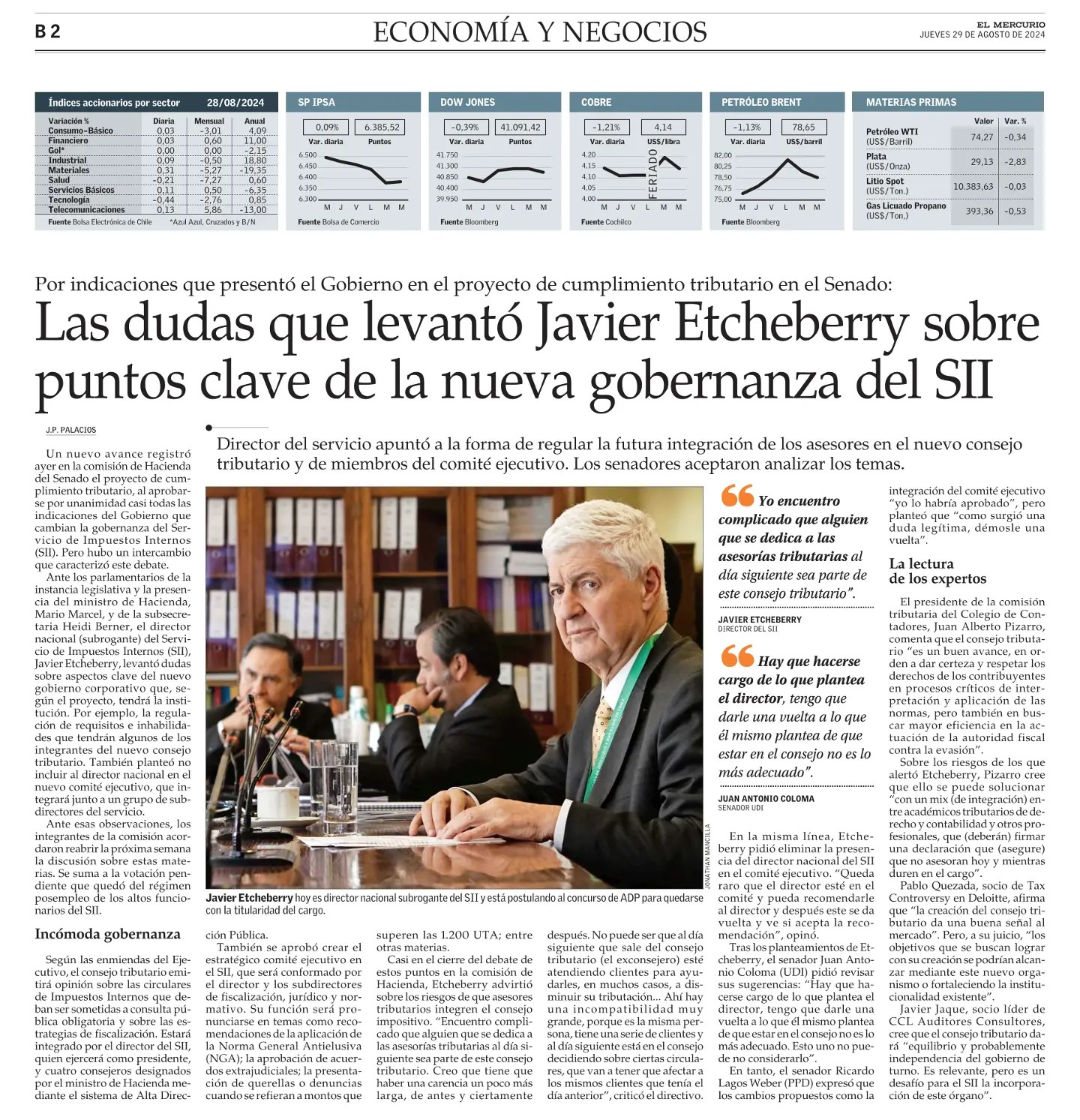
The head of the service pointed to how the future integration of advisors into the new Tax Council and members of the executive committee should be regulated. Senators agreed to review these issues.
Read the article in El Mercurio.
The tax compliance bill made new progress yesterday in the Senate Finance Committee, as almost all government amendments modifying the governance of the Internal Revenue Service (SII) were unanimously approved. However, a key exchange characterized the debate.
Before lawmakers, in the presence of Finance Minister Mario Marcel and Undersecretary Heidi Berner, the acting National Director of the Internal Revenue Service (SII), Javier Etcheberry, raised concerns about key aspects of the institution’s new corporate governance under the bill. For example, he questioned how the requirements and incompatibilities for members of the new Tax Council would be regulated. He also suggested excluding the National Director from the new executive committee, which he would otherwise join along with a group of SII deputy directors.
In response to these observations, committee members agreed to reopen the discussion on these matters the following week. This adds to the pending vote on the post-employment regime for senior SII officials.
Uncomfortable governance
According to the Executive’s amendments, the Tax Council will issue opinions on SII circulars subject to mandatory public consultation and on audit strategies. It will be composed of the SII Director, who will serve as chair, and four members appointed by the Minister of Finance through the Senior Public Management system.
The creation of a strategic executive committee within the SII was also approved. It will be made up of the Director and the Deputy Directors of Audit, Legal, and Regulatory areas. Its role will include providing recommendations on the application of the General Anti-Avoidance Rule (GAAR), approving out-of-court settlements, and deciding on the filing of complaints or lawsuits involving amounts exceeding 1,200 UTA, among other matters.
Toward the end of the debate, Etcheberry warned about the risks of allowing tax advisors to be part of the Tax Council: “I find it problematic that someone engaged in tax advisory work could the next day be part of this Tax Council. There should be a longer cooling-off period, both before and certainly after. It cannot be that someone leaves the Tax Council one day and the next is advising clients—often helping them reduce their tax burden… There is a major incompatibility, because it is the same person, with a client portfolio, and the next day is participating in decisions on circulars that will affect those same clients,” he argued.
In the same vein, Etcheberry proposed removing the SII Director from the executive committee: “It seems odd for the Director to be part of the committee, make recommendations to himself, and then decide whether to accept them,” he stated.
Following these remarks, Senator Juan Antonio Coloma (UDI) called for a review of the concerns: “We must take into account what the Director is raising. I need to reflect on his point that being part of the council may not be the most appropriate. This cannot be ignored.”
Meanwhile, Senator Ricardo Lagos Weber (PPD) noted that he would have approved the proposed changes, such as the integration of the executive committee, but added that “since a legitimate concern has been raised, let’s take another look.”
Expert perspectives
Juan Alberto Pizarro, president of the Tax Committee of the College of Accountants, stated that the Tax Council “is a positive step toward providing certainty and protecting taxpayers’ rights in critical processes of interpreting and applying tax rules, while also improving the efficiency of the tax authority in combating evasion.”
Regarding the risks highlighted by Etcheberry, Pizarro believes they could be addressed “with a mix of members, including tax law and accounting academics and other professionals, who should sign a declaration confirming that they do not provide advisory services during their tenure.”
Pablo Quezada, partner in Tax Controversy at Deloitte, stated that “the creation of the Tax Council sends a positive signal to the market.” However, in his view, “the objectives could also be achieved either through this new body or by strengthening existing institutional frameworks.”
Javier Jaque, Lead Partner at CCL Auditores Consultores, believes that the Tax Council will provide “balance and likely independence from the government in power. It is significant, but it also represents a challenge for the SII in incorporating this new body.”