
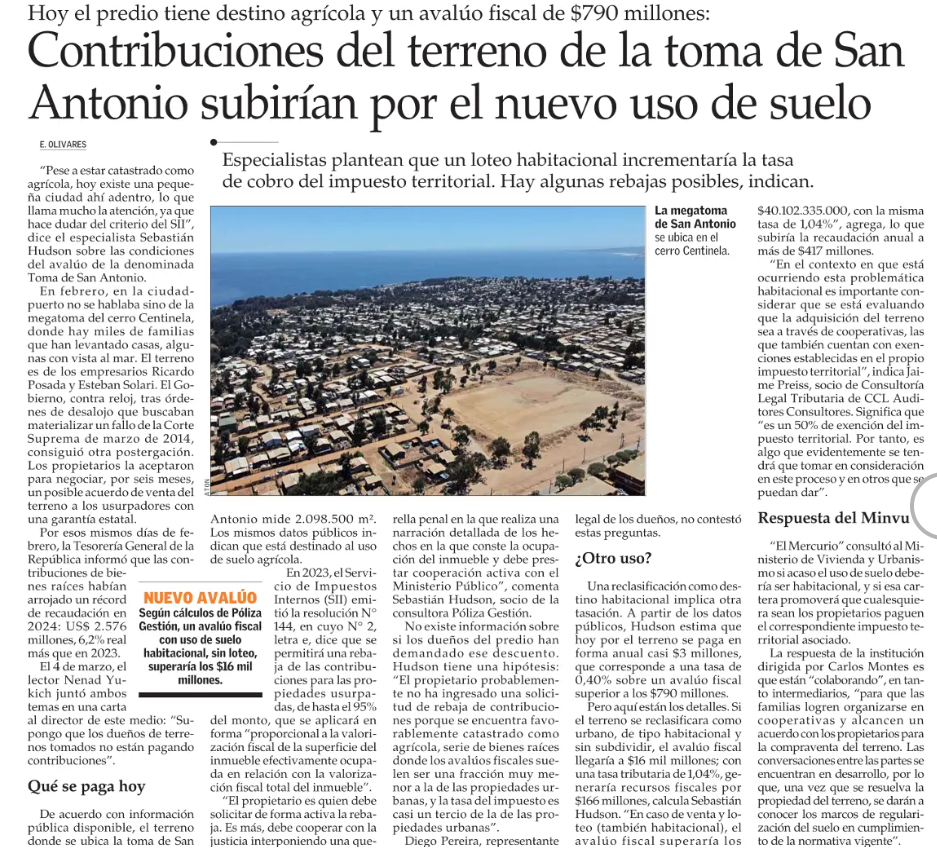
Specialists suggest that a residential subdivision would increase the property tax rate. Some reductions may still apply, they note.
Read the article in El Mercurio.
“Despite being classified as agricultural, today there is practically a small city within it, which raises doubts about the SII’s assessment criteria,” says specialist Sebastián Hudson regarding the valuation conditions of the so-called San Antonio settlement.
In February, in the port city, all the attention was focused on the large informal settlement on Cerro Centinela, where thousands of families have built homes, some with ocean views. The land belongs to businessmen Ricardo Posada and Esteban Solari. The government, under time pressure and following eviction orders tied to a Supreme Court ruling from March 2014, secured another postponement. The owners accepted it to negotiate, for six months, a potential agreement to sell the land to the occupants with a state guarantee.
During those same days in February, the General Treasury of the Republic reported that property tax revenues reached a record in 2024: US$2.576 billion, a real increase of 6.2% compared to 2023. On March 4, a reader, Nenad Yukich, connected both issues in a letter to the editor: “I assume that the owners of occupied land are not paying property taxes.”
What is currently paid
According to publicly available information, the land where the San Antonio settlement is located measures 2,098,500 m². The same sources indicate that it is designated for agricultural use.
In 2023, the Internal Revenue Service (SII) issued Resolution No. 144, which allows a reduction in property taxes for occupied properties of up to 95% of the amount, applied “proportionally to the fiscal valuation of the occupied portion of the property relative to the total valuation.”
“The owner must actively request the reduction. Moreover, they must cooperate with the justice system by filing a criminal complaint that details the occupation of the property and must provide active cooperation with the Public Prosecutor’s Office,” explains Sebastián Hudson, partner at consulting firm Póliza Gestión.
There is no information on whether the owners of the property have requested this discount. Hudson has a hypothesis: “The owner has likely not applied for the tax reduction because the land is favorably classified as agricultural, a category where fiscal valuations are typically much lower than urban properties, and the tax rate is roughly one-third of that applied to urban properties.”
Diego Pereira, legal representative of the owners, did not respond to these questions.
Different land use?
A reclassification to residential use would imply a new valuation. Based on public data, Hudson estimates that the land currently generates around $3 million annually, corresponding to a 0.40% rate on a fiscal valuation exceeding $790 million.
However, the details are significant. If the land were reclassified as urban residential land without subdivision, its fiscal valuation would reach approximately $16 billion. With a 1.04% tax rate, this would generate around $166 million in annual tax revenue, according to Hudson. “If the land is sold and subdivided (also for residential use), the fiscal valuation would exceed $40.1 billion, with the same 1.04% rate,” he adds, raising annual tax revenue to over $417 million.
“Given the context of this housing issue, it is important to consider that the acquisition of the land is being evaluated through cooperatives, which also benefit from exemptions under property tax law,” notes Jaime Preiss, Partner of Legal Tax Consulting at CCL Auditores Consultores. This means “a 50% exemption from property tax, which will certainly need to be taken into account in this and similar processes.”
Response from the Ministry of Housing
“El Mercurio” asked the Ministry of Housing and Urban Development whether the land use should be classified as residential, and whether the ministry would promote ensuring that whoever owns the land pays the corresponding property tax.
The ministry, led by Carlos Montes, responded that it is “collaborating” as an intermediary “to help families organize into cooperatives and reach an agreement with the owners for the purchase of the land. Discussions between the parties are ongoing, and once ownership is resolved, the framework for land regularization in compliance with current regulations will be disclosed.”
New valuation
According to estimates from Póliza Gestión, a fiscal valuation with residential land use, without subdivision, would exceed $16 billion.