
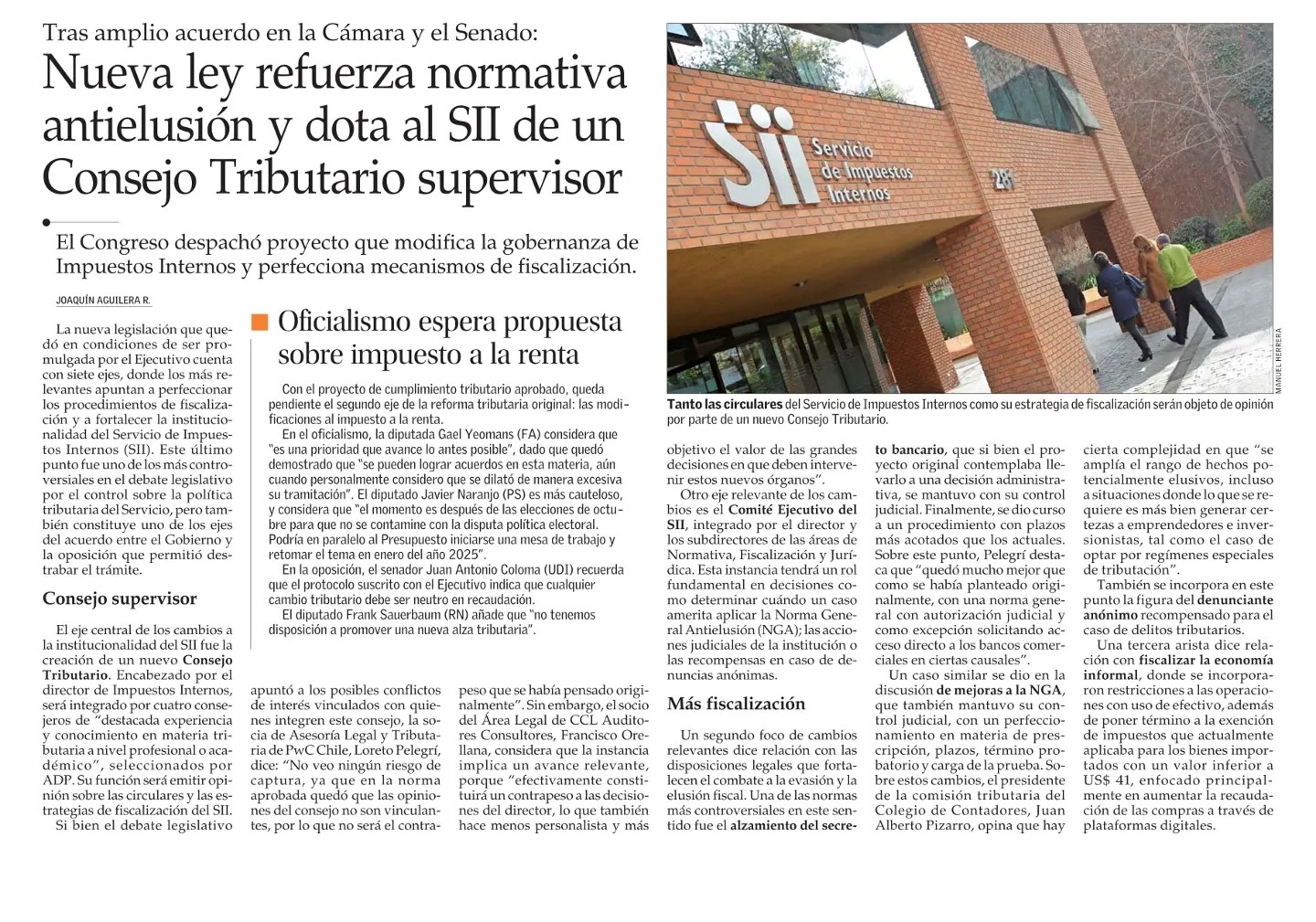
Congress passed a bill that modifies the governance of the Internal Revenue Service and improves audit mechanisms.
Read the article in El Mercurio.
The new legislation, now ready to be enacted by the Executive, is structured around seven pillars, with the most relevant focused on improving audit procedures and strengthening the institutional framework of the Internal Revenue Service (SII). This latter point was one of the most controversial aspects in the legislative debate regarding control over the Service’s tax policy, but it also became a key element of the agreement between the Government and the opposition that allowed the bill to move forward.
Supervisory Council
The central element of the institutional changes to the SII is the creation of a new Tax Council. Chaired by the Director of the Internal Revenue Service, it will be composed of four members with “recognized experience and expertise in tax matters at a professional or academic level,” selected through the Senior Public Management System (ADP). Its role will be to issue opinions on SII circulars and audit strategies.
While the legislative debate focused on potential conflicts of interest involving council members, Loreto Pelegrí, partner in Legal and Tax Advisory at PwC Chile, stated: “I do not see any risk of capture, since the approved rule establishes that the council’s opinions are not binding, so it will not serve as the counterbalance originally envisioned.” However, Francisco Orellana, Partner of the Legal Area at CCL Auditores Consultores, considers that the body represents a significant step forward, as “it will effectively act as a counterbalance to the director’s decisions, making major decisions less personal and more objective when these new bodies are involved.”
Another relevant aspect of the changes is the SII Executive Committee, composed of the Director and the Deputy Directors of the Regulatory, Audit, and Legal areas. This body will play a key role in decisions such as determining when a case warrants the application of the General Anti-Avoidance Rule (GAAR), the institution’s legal actions, or rewards in cases of anonymous reporting.
Increased oversight
A second major focus of the changes relates to legal provisions that strengthen the fight against tax evasion and avoidance. One of the most controversial measures in this regard was the lifting of bank secrecy. While the original bill proposed making this an administrative decision, judicial oversight was ultimately maintained. A procedure with shorter timelines than the current one was approved. On this point, Pelegrí highlights that “it turned out much better than originally proposed, with a general rule requiring judicial authorization and, as an exception, allowing direct access to commercial banks under certain conditions.”
A similar situation occurred in the discussion on improvements to the GAAR, which also retained judicial oversight, with enhancements related to statutes of limitation, deadlines, evidentiary periods, and the burden of proof. Regarding these changes, Juan Alberto Pizarro, president of the Tax Committee of the College of Accountants, notes that there is some complexity in that “the range of potentially avoidant conduct is expanded, even in situations where greater certainty is needed for entrepreneurs and investors, such as when opting for special tax regimes.”
Additionally, the figure of a rewarded anonymous whistleblower for tax crimes is introduced.
A third dimension relates to monitoring the informal economy, where restrictions on cash transactions were introduced, along with the elimination of the tax exemption previously applied to imported goods valued below US$41, primarily aimed at increasing revenue from purchases made through digital platforms.