
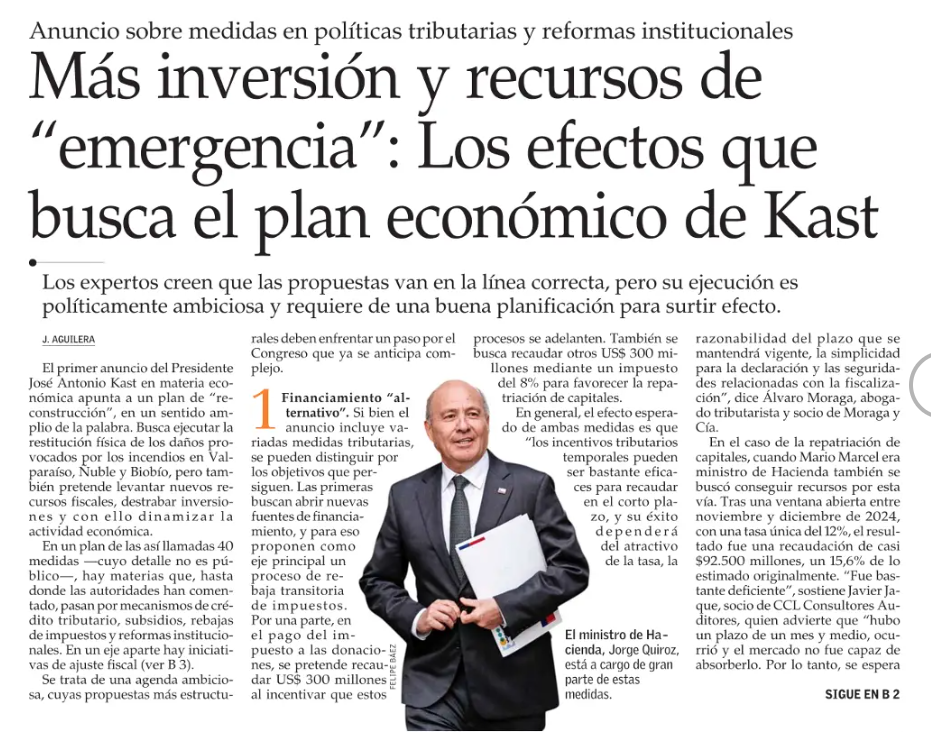
Experts believe that the proposals are moving in the right direction, but their execution is politically ambitious and requires good planning to be effective.
Read the full article at El Mercurio.
The first announcement by President José Antonio Kast in economic matters points to a “reconstruction” plan, in a broad sense of the word. It seeks to carry out the physical restoration of the damage caused by the wildfires in Valparaíso, Ñuble, and Biobío, but also aims to generate new fiscal resources, unlock investments, and thereby stimulate economic activity.
It is a plan of the so-called 40 measures—whose details are not public—and includes areas that, according to what authorities have mentioned so far, involve mechanisms such as tax credits, subsidies, tax reductions, and institutional reforms. In a separate axis, there are fiscal adjustment initiatives.
This is an ambitious agenda, whose more structural proposals must go through Congress, a process that is already expected to be complex.
- “Alternative” financing: In the case of capital repatriation, when Mario Marcel was Minister of Finance, efforts were also made to obtain resources through this route. After a window opened between November and December 2024, with a flat rate of 12%, the result was a collection of nearly $92.5 billion, about 15.6% of what was originally estimated. “It was quite deficient,” says Javier Jaque, Leading Partner at CCL Auditores Consultores, who warns that “there was a one-and-a-half-month period; it happened, and the market was not able to absorb it. Therefore, it is expected that a reasonable amount of time to analyze, submit documentation, gather background information, etc., could have a greater impact.”
- “Rebuilding” the economy
- The “permit-related” challenge