
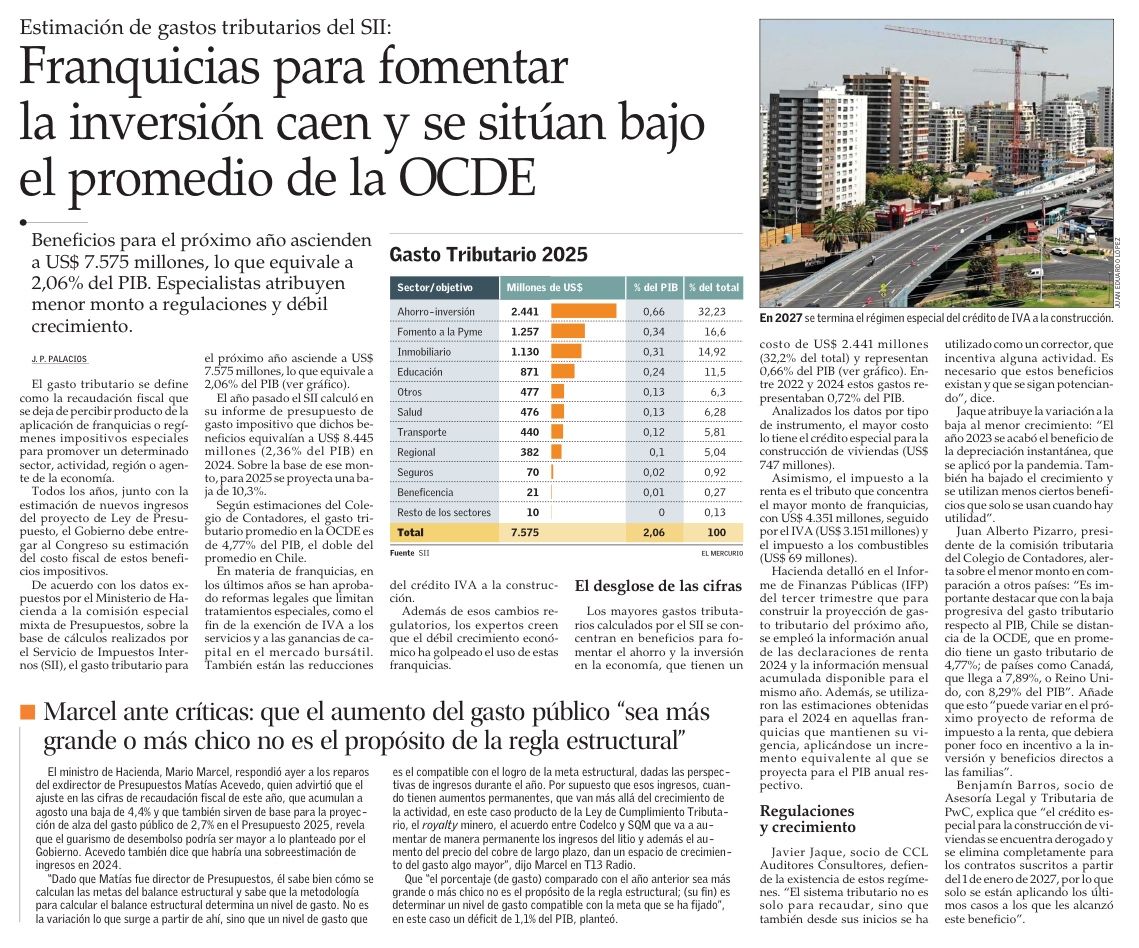
Benefits for next year amount to US$7.575 billion, equivalent to 2.06% of GDP. Specialists attribute the lower figure to regulations and weak economic growth.
Read the full article in El Mercurio.
Tax expenditure is defined as the fiscal revenue that is not collected due to the application of tax incentives or special tax regimes aimed at promoting a specific sector, activity, region, or economic agent.
Each year, together with the estimate of new revenues in the Budget Bill, the Government must present to Congress its estimate of the fiscal cost of these tax benefits.
According to data presented by the Ministry of Finance to the Joint Special Budget Committee, based on calculations carried out by the Internal Revenue Service (SII), tax expenditure for next year amounts to US$7.575 billion, equivalent to 2.06% of GDP.
Breakdown of the figures
The largest tax expenditures calculated by the SII are concentrated in benefits aimed at promoting savings and investment in the economy, which amount to US$2.441 billion (32.2% of the total) and represent 0.66% of GDP. Between 2022 and 2024, these expenditures represented 0.72% of GDP.
Regulations and growth
Javier Jaque, Lead Partner at CCL Auditores Consultores, defends the existence of these regimes: “The tax system is not only designed to collect revenue, but has also historically been used as a corrective tool to encourage certain activities. It is necessary for these benefits to exist and continue to be strengthened,” he says.
Jaque attributes the decline to slower growth: “In 2023, the benefit of immediate depreciation, which was implemented during the pandemic, came to an end. Economic growth has also slowed, and certain benefits are used less frequently, as they are typically applied only when there are profits.”