
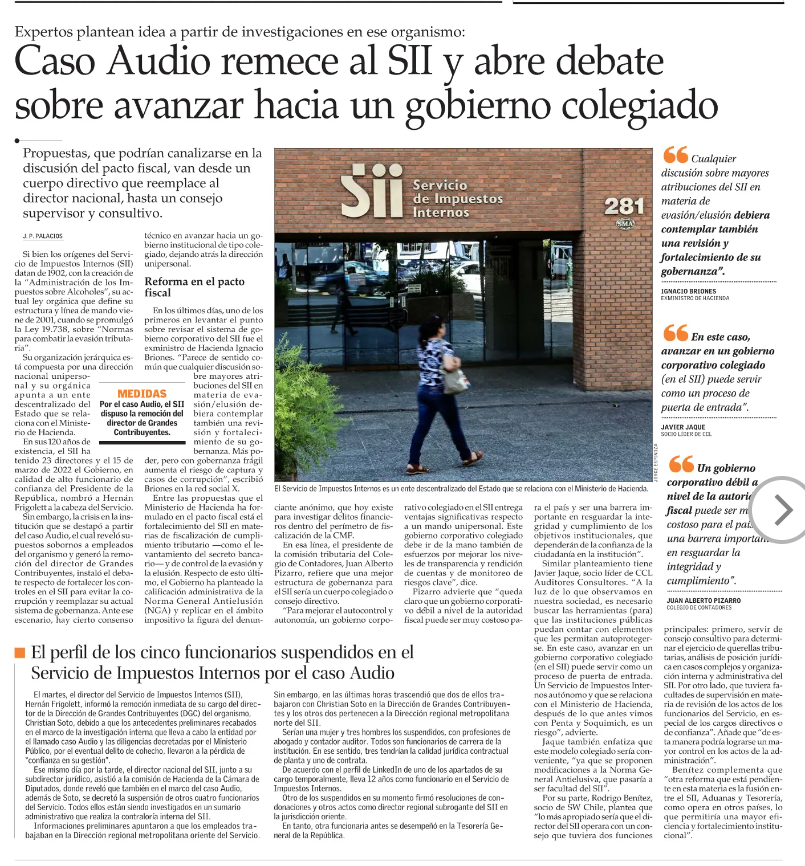
Proposals, which could be channeled into the discussion of the fiscal pact, range from an executive body to replace the national director, to a supervisory and advisory council.
Read the article in El Mercurio here.
(…) In recent days, one of the first to raise the issue of reviewing the SII’s corporate governance system was former Finance Minister Ignacio Briones. “It seems common sense that any discussion about greater powers for the SII regarding tax evasion/avoidance should also include a review and strengthening of its governance. More power but with fragile governance increases the risk of capture and corruption cases,” Briones wrote on the social media platform X.
Among the proposals that the Ministry of Finance has put forward in the fiscal pact is the strengthening of the SII in matters of tax compliance oversight – such as lifting banking secrecy – and control of evasion and avoidance (…).
“In light of what we observe in our society, it is necessary to seek tools that allow public institutions to have mechanisms to self-protect. In this case, advancing towards a collegiate corporate governance (within the SII) can serve as an entry point process. An autonomous Internal Revenue Service that interacts with the Ministry of Finance, after what we saw previously with Penta and Soquimich, is a risk,” warns Javier Jaque, the Lead Partner at CCL Auditores Consultores.
Jaque also emphasizes that this collegiate model would be advisable, “since modifications are being proposed to the General Anti-Avoidance Rule, which would become a power of the SII.”