
Dipres Public Finance Report warns that the regulation has yielded less revenue than expected
At the end of 2024, when Mario Marcel was Minister of Finance under Gabriel Boric’s administration, the Tax Compliance Law (LCT), also known as the anti-evasion law, was approved. Marcel promoted the debate following the rejection of the tax reform in 2023, making this initiative — together with the mining royalty — the only proposals from his ambitious original plan that the administration managed to pass through Congress.
The purpose of the LCT was to strengthen tax compliance through measures aimed at improving oversight, reducing tax evasion and avoidance, and modernizing the tax administration. In general terms, its revenue effects depend on the operational capacity of the tax authority and taxpayers’ responses.
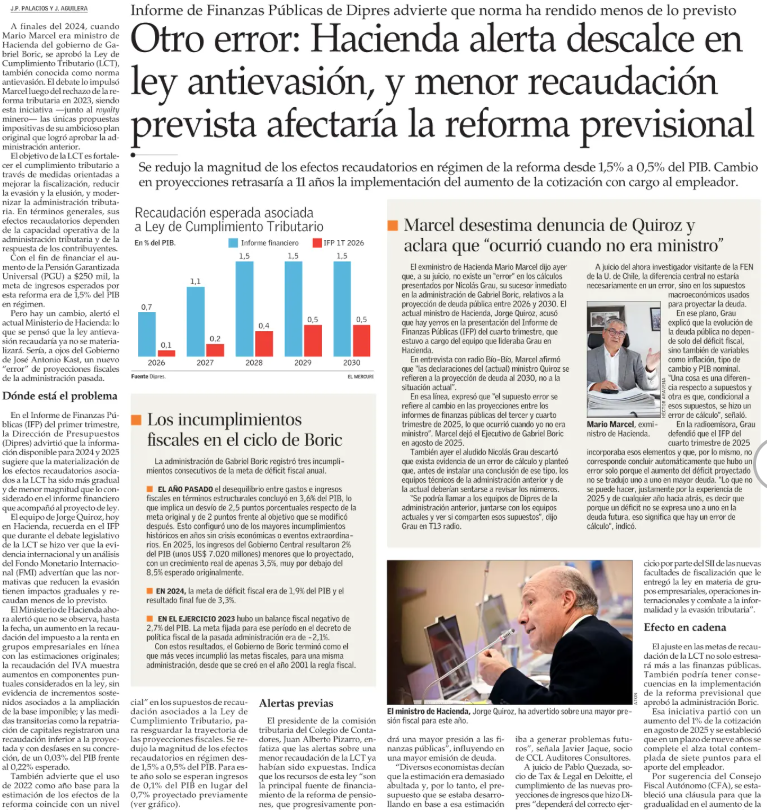
To finance the increase of the Guaranteed Universal Pension (PGU) to CLP 250,000, the expected revenue target from this reform was 1.5% of GDP in steady state.
However, there has been a change, the current Ministry of Finance warned: what had been expected from the anti-evasion law is no longer materializing. According to José Antonio Kast’s government, this represents another “error” in the previous administration’s fiscal projections.
Where is the problem?
In the first-quarter Public Finance Report (IFP), the Budget Office (Dipres) stated that the information available for 2024 and 2025 suggests that the realization of the revenue effects associated with the LCT has been more gradual and of a lower magnitude than originally contemplated in the financial report accompanying the bill.
Jorge Quiroz’s team, now at the Ministry of Finance, recalled in the IFP that during the legislative debate on the LCT, international evidence and an analysis by the International Monetary Fund (IMF) had already shown that regulations aimed at reducing tax evasion produce gradual impacts and require months of implementation.
The Ministry of Finance noted that, to date, no increase has been observed in income tax collection from business groups in line with the original estimates; VAT collection shows increases in specific components considered in the law, but without evidence of sustained increases associated with the expansion of the tax base; and temporary measures such as capital repatriation generated lower-than-expected revenue and delays in implementation.
The chart reveals that the use of 2022 as the baseline year for estimating the reform’s effects coincided with an “abnormally high” level of tax collection associated with the Tax Compliance Law, “in order to safeguard the trajectory of fiscal projections.” The magnitude of the steady-state revenue effects was reduced from 1.5% to 0.5% of GDP, in addition to delaying by three years the implementation of the additional 0.5% of GDP instead of the previously projected 0.7%.
Fiscal non-compliance during Boric’s administration
Gabriel Boric’s administration recorded three consecutive failures to meet the annual fiscal deficit target.
- Last year, the imbalance between structural revenues and expenditures reached 3.6% of GDP, implying a deviation of 2.5 percentage points from the original target and 2 points from the revised objective. This became one of the largest fiscal target breaches in recent years.
- In 2025, Central Government revenues will be 2% of GDP (around USD 7.02 billion) lower than projected. Revenues grew 3.5% in the first quarter, well below expectations.
- In 2024, the fiscal deficit target was 1.9% of GDP, but the final result reached 3.3%.
- In 2023, the fiscal balance recorded a deficit of 2.7% of GDP. The target established in the fiscal policy decree for that period had been 1.2%.
As a result, the government posted one of the weakest fiscal performances for a single administration since the fiscal rule was established in 2001.
Previous warnings
The chairman of the Tax Committee of the Chilean Association of Accountants, Juan Alberto Pizarro, emphasized that warnings regarding lower revenue collection from the LCT had already been raised. He noted that the resources from this law “are the main source of financing for the pension reform, which will progressively place pressure on public finances,” influencing higher debt issuance.
“Various economists questioned whether the estimate was excessively optimistic and, therefore, whether the budget designed on the basis of that estimate would create future problems,” said Javier Jaque, partner at CCL Auditores Consultores.
According to Pablo Correa, former Director of Studies at Dipres and current economist, the success of the new revenue projections “will depend on the proper execution by the Internal Revenue Service (SII) of the new oversight powers granted by the law regarding business groups, international operations, and the fight against informality and tax evasion.”
Chain effect
The adjustment in the LCT revenue targets will not only further tighten public finances. It could also have consequences for the implementation of the pension reform approved under Boric’s administration.
That initiative began with a 1% increase in employer pension contributions in August 2025, with a plan to gradually complete the total seven-percentage-point increase over nine years.
At the suggestion of the Autonomous Fiscal Council (CFA), a clause was established so that the pace of the employer contribution increase would automatically adjust according to the actual revenue collected through the anti-evasion law.
“Marcel dismisses Quiroz’s allegations and claims calculation error by the new minister”
Former Finance Minister Mario Marcel stated yesterday that, in his opinion, there is no “error” in the calculations presented by Nicolás Grau, his immediate successor in Gabriel Boric’s administration, regarding public debt projections between 2026 and 2030. Current Finance Minister Jorge Quiroz claimed there were mistakes in the presentation of the fourth-quarter Public Finance Report (IFP), which the Ministry attributed to Grau’s former team.
In an interview with Radio Bio-Bío, Marcel said that “the statements made by current Minister Quiroz refer to debt projections for 2030, not the current situation.”
In that regard, he explained that “the alleged error concerns changes in projections between the third- and fourth-quarter public finance reports of 2025, which occurred when I was minister.” Marcel left the Boric administration in August 2025.
Also yesterday, Nicolás Grau dismissed the existence of evidence of a calculation error and argued that, before drawing such conclusions, the technical teams from both the previous and current administrations should sit down and review the figures together.
“One could bring together the Dipres teams from the previous administration with the current teams and see whether they share those assumptions,” Grau said on T13 Radio.
Mario Marcel compared those elements and argued that “it is not appropriate to automatically conclude that there was an error simply because the projected increase in the deficit did not translate year by year into greater debt. What cannot be done, precisely because of the experience of 2025 and previous years, is to say that because a deficit is not expressed one-to-one in future debt, there must therefore be a calculation error,” he stated.