
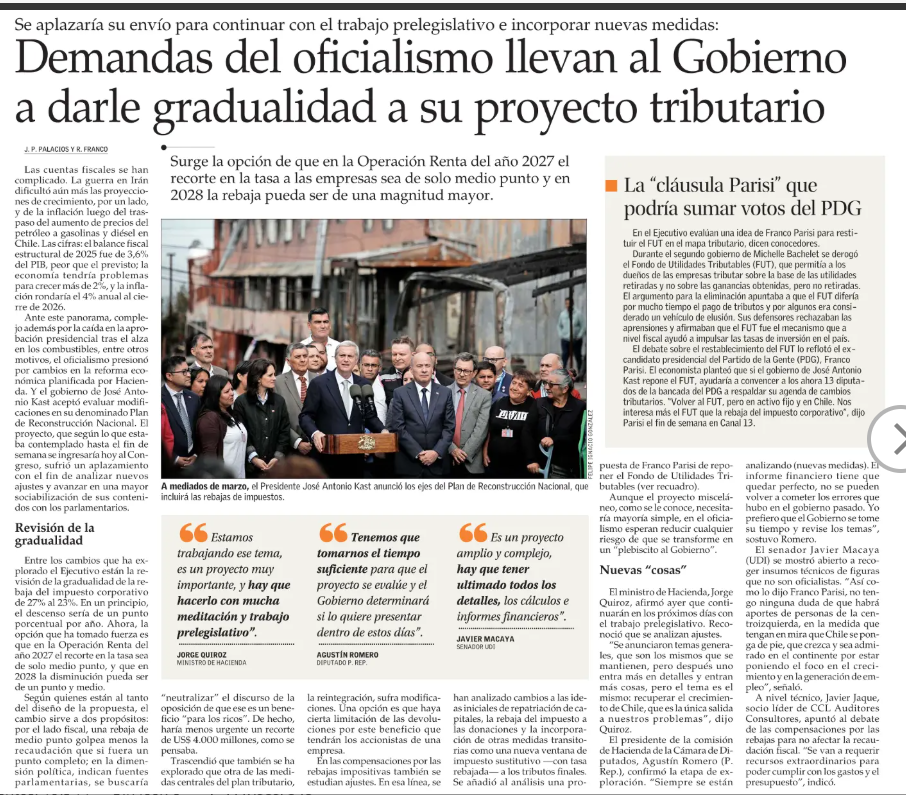
An option has emerged whereby, in the 2027 Tax Filing Season, the corporate tax rate cut would be only half a percentage point, with a larger reduction potentially taking place in 2028.
Public finances have become strained. The war in Iran has further complicated growth projections, as well as inflation forecasts due to the pass-through of rising oil prices to gasoline and diesel in Chile. The figures show that the structural fiscal balance for 2025 reached 3.6% of GDP, worse than expected; the economy is likely to struggle to grow beyond 2%; and inflation is projected to hover around 4% annually by the end of 2026.
Amid this scenario—also marked by declining presidential approval following rising fuel prices, among other factors—the ruling coalition pushed for changes to the economic reform planned by the Ministry of Finance. The government of José Antonio Kast agreed to evaluate modifications to its so-called National Reconstruction Plan. The bill, which was expected to be submitted to Congress, has been postponed in order to assess adjustments and further socialize its content with lawmakers.
Review of gradual implementation
Among the changes being considered by the Executive is a revision of the gradual reduction of the corporate tax rate from 27% to 23%. Initially, the decrease was planned at one percentage point per year. Now, the option gaining traction is a reduction of only half a point in the 2027 Tax Filing Season, followed by a 1.5-point decrease in 2028.
According to those familiar with the proposal’s design, this change serves two purposes. From a fiscal perspective, a half-point reduction has a smaller impact on revenue than a full point. Politically, parliamentary sources indicate it may help “neutralize” opposition claims that the measure primarily benefits the wealthy. In fact, it would make a US$4 billion spending cut less urgent than previously anticipated.
It has also emerged that another key component of the tax plan—re-integration—could be modified. One option under consideration is to introduce limitations on the refunds shareholders would receive under this benefit.
Adjustments to compensation measures for tax cuts are also being analyzed. These include revising initial proposals on capital repatriation, reducing the tax on donations, and introducing additional temporary measures such as a new window for substitute taxation—at a reduced rate—on final taxes. A proposal by Franco Parisi to reinstate the Taxable Profits Fund (FUT) has also been added to the discussion.
Although the omnibus bill would require only a simple majority, the ruling coalition aims to minimize any risk of it becoming a “referendum on the Government.”
New elements
Finance Minister Jorge Quiroz stated that pre-legislative work will continue in the coming days and acknowledged that adjustments are being considered.
“General topics were announced and remain the same, but as discussions move into more detail, additional elements emerge. The core issue remains: restoring Chile’s economic growth, which is the only solution to our challenges,” Quiroz said.
Agustín Romero, chairman of the Lower House Finance Committee, confirmed that the proposal is still under review. “New measures are always being analyzed. The financial report must be flawless—we cannot repeat the mistakes of the previous government. I prefer that the Government take its time and review the issues thoroughly,” he stated.
Senator Javier Macaya expressed openness to incorporating technical input from non-government figures. “As Franco Parisi mentioned, I have no doubt there will be contributions from center-left figures as well, provided they are focused on helping Chile recover, grow, and become a leading example in the region,” he said.
From a technical standpoint, Javier Jaque, Managing Partner at CCL Auditores Consultores, emphasized the importance of compensation measures to avoid harming fiscal revenues. “Extraordinary resources will be required to meet spending needs and budget commitments,” he noted.