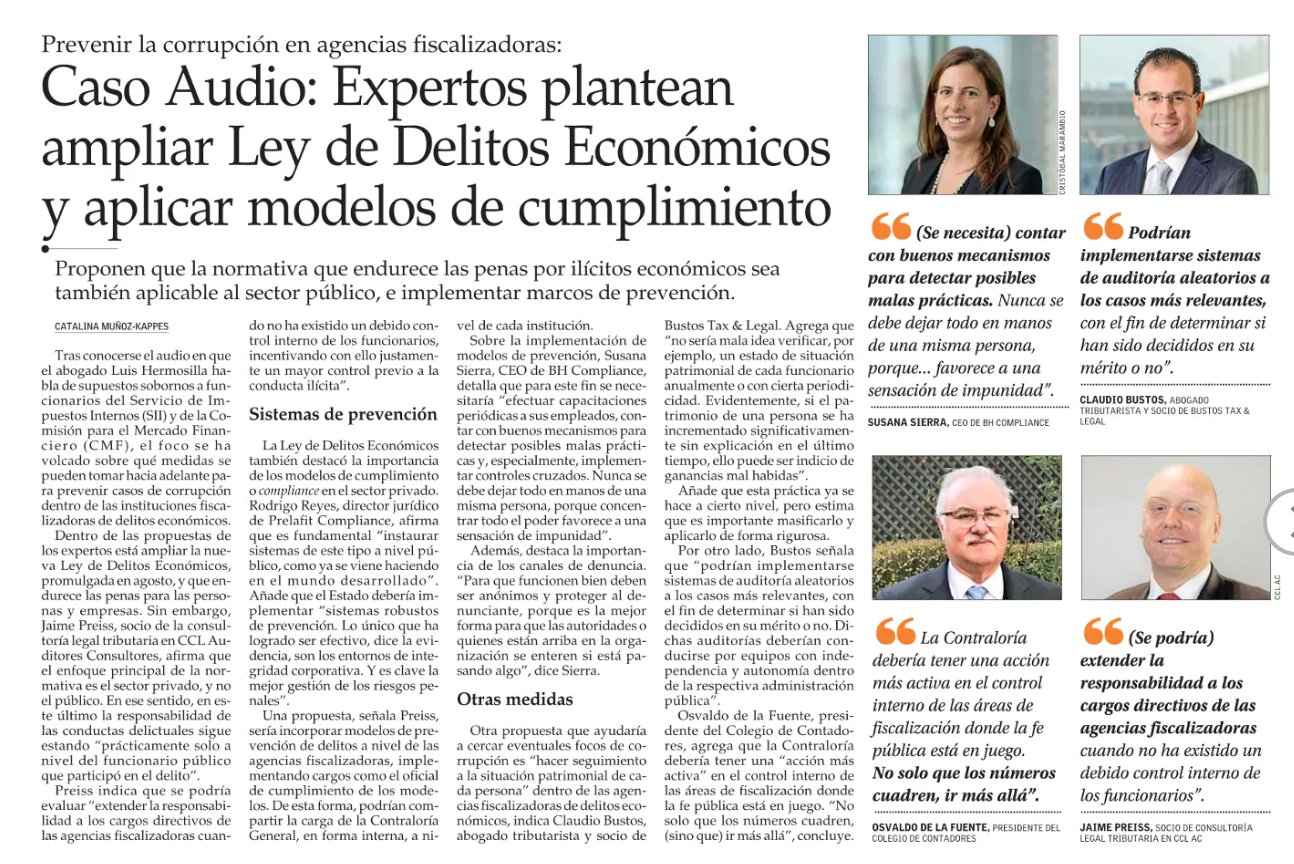
They propose that the regulation that strengthens penalties for economic crimes should also apply to the public sector, and to implement prevention frameworks.
Read the full article in El Mercurio.
Following the release of an audio recording in which lawyer Luis Hermosilla speaks about alleged bribes to officials of the Internal Revenue Service (SII) and the Financial Market Commission (CMF), the focus has shifted to what measures can be taken going forward to prevent corruption within institutions that oversee economic crimes.
Among the experts’ proposals is to expand the new Economic Crimes Law, enacted in August, which strengthens penalties for individuals and companies. However, according to Jaime Preiss, partner in Legal Tax Consulting at CCL Auditores Consultores, the main focus of the regulation is the private sector, not the public sector. In this regard, in the latter, responsibility for criminal conduct remains “practically only at the level of the public official who participated in the crime.”
Preiss indicates that it could be considered to “extend liability to senior management positions within supervisory agencies when there has been a lack of proper internal control over officials, thereby encouraging greater oversight prior to any unlawful conduct.”
Prevention systems
One proposal, Preiss notes, would be to incorporate crime prevention models within supervisory agencies, implementing roles such as compliance officers responsible for these models. In this way, they could share the burden of the Office of the Comptroller General internally at the level of each institution.