
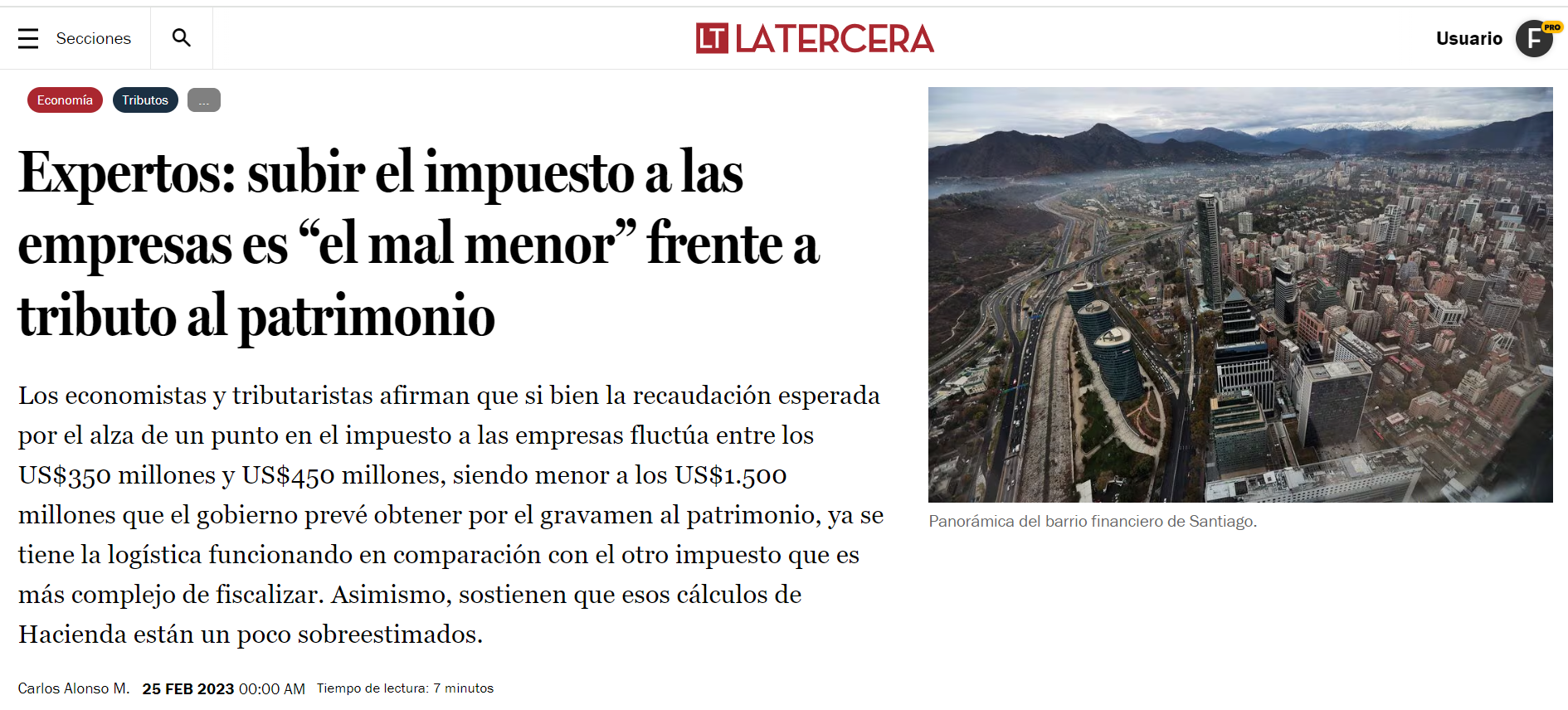
Economists and tax experts state that while the expected revenue from a one-percentage-point increase in corporate tax ranges between US$350 million and US$450 million—lower than the US$1.5 billion the government expects to raise from the wealth tax—the administrative and enforcement framework is already in place, unlike the wealth tax, which is more complex to oversee. They also argue that the Treasury’s estimates are somewhat overstated.
Read the full article in La Tercera-Pulso.
March is approaching, and the tax debate will once again take center stage in the legislative discussion. On the 7th and 8th of next month, the Chamber of Deputies will vote on the tax reform bill, after which the discussion will continue in the Senate Finance Committee during its second legislative stage.
One of the issues that has drawn the most criticism from the opposition and the business sector is the wealth tax, as they believe it will negatively impact investment and savings by taxing accumulated assets. In response, the Minister of Finance, Mario Marcel, stated that “if the opposition believes this tax has several issues, then it should propose an alternative that maintains the goals of revenue collection and progressivity,” as he noted in an interview with Pulso at the end of January.
Although the opposition has not yet presented a formal proposal to replace the tax, the business sector has begun to develop alternative options that will be presented when invited to the Senate Finance Committee.
It was precisely the president of the Confederation of Production and Commerce (CPC), Ricardo Mewes, who proposed that one of the alternatives under consideration is replacing the wealth tax with a one-percentage-point increase in the tax paid by large corporations. While he indicated that this idea has already been informally discussed with Minister Marcel, further calculations are still needed to determine the expected revenue before formally presenting it to the Treasury.
For the business sector, the priority is to modify the wealth tax because it affects the stock of assets, which in turn impacts investment and savings. Therefore, alternative proposals are focused on mechanisms that tax income flows, such as corporate taxes.
Currently, the first-category tax paid by large companies under the semi-integrated system is 27%. Shareholders or partners are entitled to a 65% credit, meaning they can deduct 65% of the 27% corporate tax from their personal income tax. This rate is already considered high by several experts when compared to the OECD (Organisation for Economic Co-operation and Development) average of 23.7%.
Less harmful option
For this reason, the CPC’s proposal immediately sparked debate among tax experts and economists, who, while not fully agreeing that it is the ideal solution, consider it a “lesser evil” compared to the implementation of a wealth tax.
Tax experts
Javier Jaque, Tax Consulting Partner at CCL Auditores Consultores, states that “wealth taxes have proven to be inefficient in various parts of the world. Therefore, compared to income tax—which, while not ideal, is more widely accepted by the industry—it is more feasible to generate revenue through corporate taxes than through a wealth tax.”