
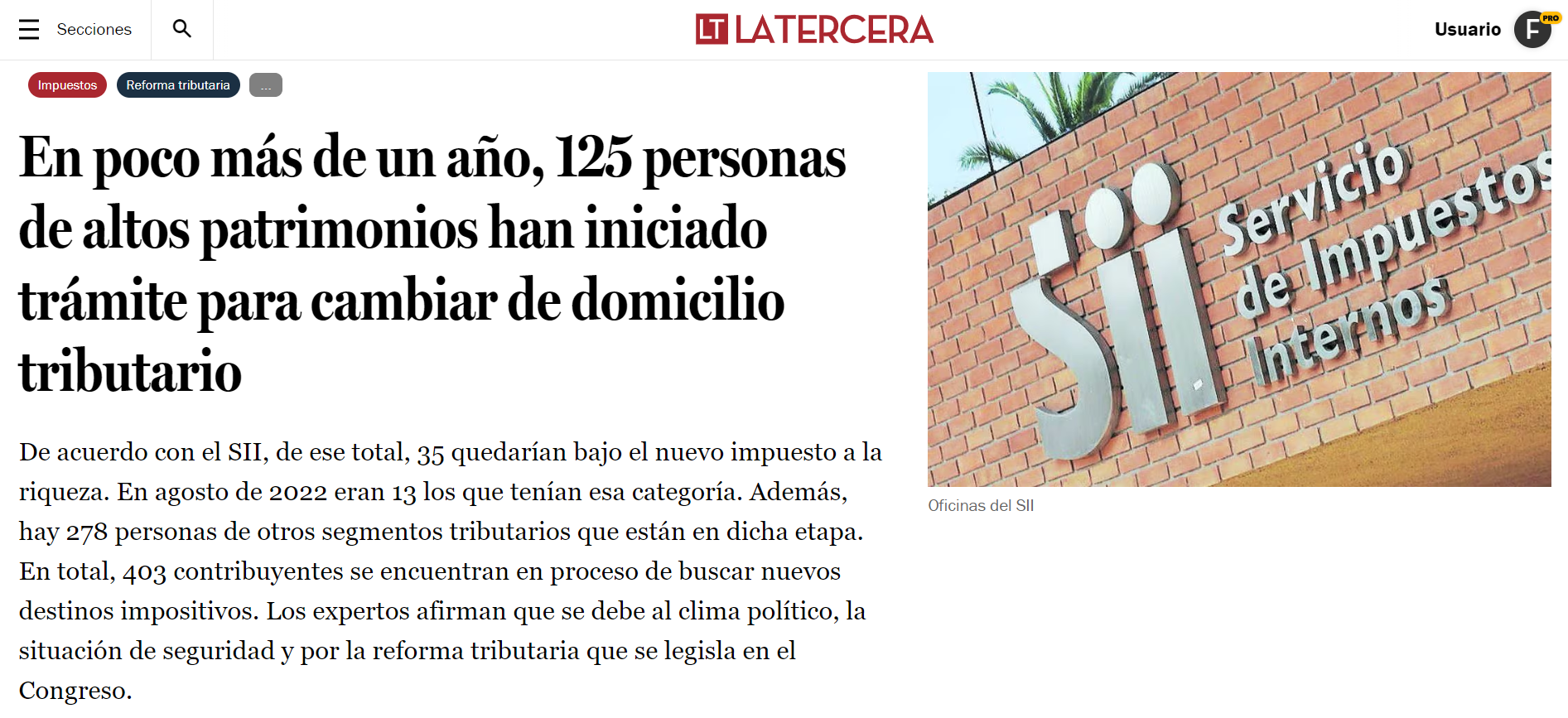
According to the Internal Revenue Service (SII), of that total, 35 would fall under the new wealth tax. In August 2022, there were 13 in that category. Additionally, there are 278 individuals from other tax segments in the same stage. In total, 403 taxpayers are in the process of seeking new tax destinations. Experts state that this is due to the political climate, security concerns, and the tax reform currently being legislated in Congress.
Read the full article in La Tercera-Pulso.
The tax reform passed an important milestone this week. The Finance Committee of the Chamber of Deputies approved it and sent it to the floor. The initiative, which will be voted on March 6 and 7 in the chamber, includes an article that concerns both the opposition and most experts: the wealth tax. This is because they argue it will not generate the projected revenue and presents challenges in its implementation and enforcement.
This new tax will apply to individuals domiciled or resident in Chile, based on their total wealth—both domestic and abroad—exceeding 6,000 UTA, equivalent to approximately US$5 million. The structure includes a tiered system with marginal rates: between US$4.9 million and US$14.7 million, a 1% rate will apply, and above US$14.7 million, a 1.8% rate will apply.
During the legislative debate, the government introduced several amendments. Among them, the exit tax for taxpayers losing domicile was eliminated, although the obligation to report remains in order to be exempt from the tax. The wording was also refined to establish simpler rules without compromising accurate wealth determination. Additionally, a cap on the tax burden of 50% of income was proposed, considering effective income tax and wealth tax rates. As a result, approximately 6,300 individuals will be subject to this tax.
However, these changes did not ease the criticism. One of the main concerns raised by experts is that, with this type of tax, high-net-worth individuals may begin to consider changing their tax domicile. Tax attorneys also point out that the growing number of taxpayers seeking to relocate is influenced by the political climate and the perceived lack of citizen and legal security in Chile.
If between November 2021 and August 2022, 158 taxpayers had informed the Internal Revenue Service (SII) that they would begin the process of changing their tax domicile, now, between November 2022 and January 23 of this year, that number has risen to 403, representing a 155% increase from August to January. Breaking down this figure, the SII reports that 125 of them are high-net-worth taxpayers, of which 35 would be subject to the new wealth tax. In August, there were 13 in that category. Currently, the high-net-worth list prepared by the SII includes 92,226 taxpayers.
However, not only high-net-worth individuals have initiated this procedure; there are also 278 individuals from other tax segments in the same process. This has been tracked since November 2021, when the procedure for notifying a change of domicile was formally regulated and came into force.
Javier Jaque, Tax Partner at CCL AC, believes that the progress of the wealth tax “undoubtedly raises concerns.” He adds that “there has been increased demand for advice on what needs to be done to change domicile.”