
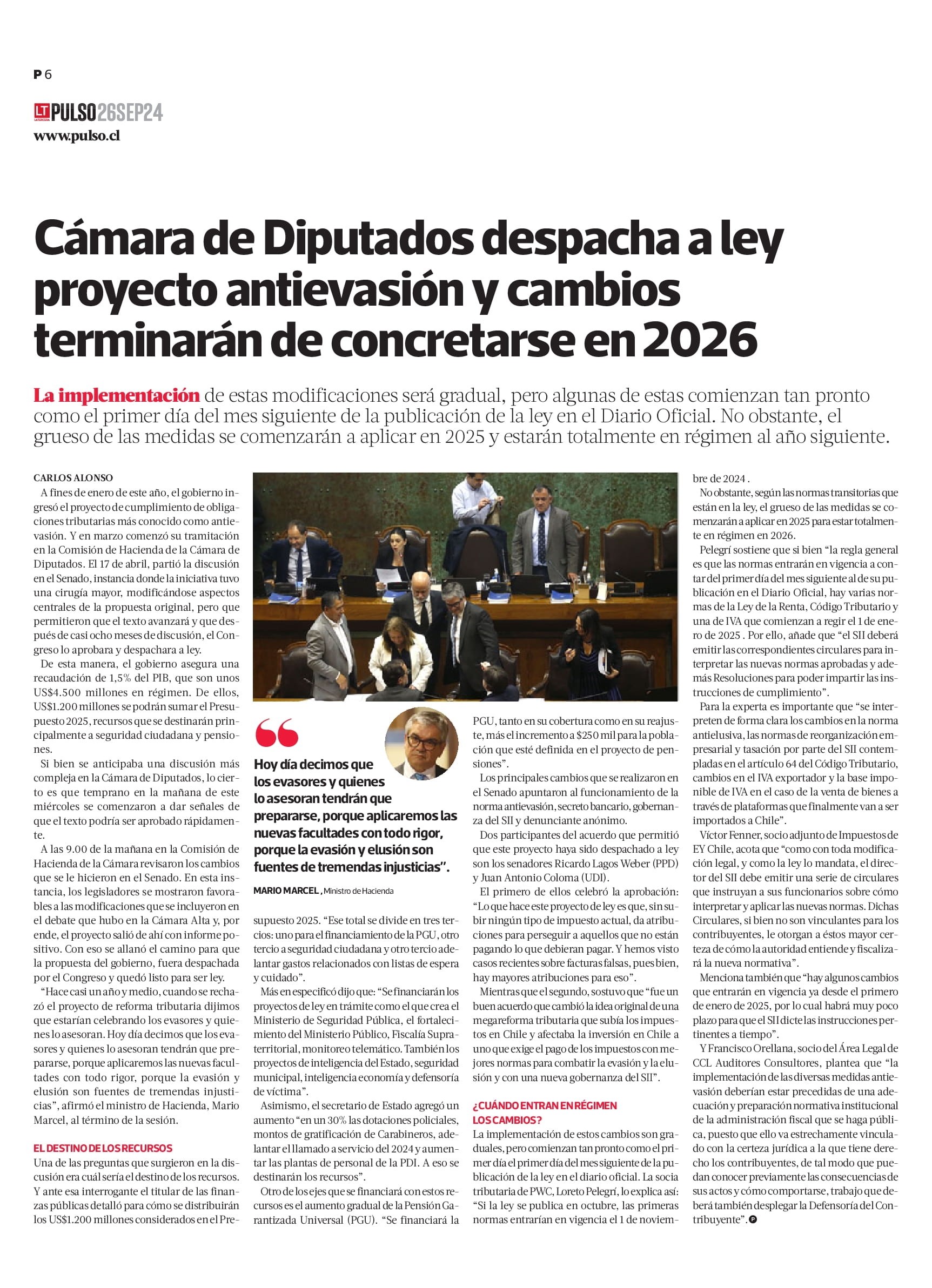
The implementation of these changes will be gradual, although some will take effect as early as the first day of the month following the law’s publication in the Official Gazette. However, most measures will begin to be applied in 2025 and will be fully in force by the following year.
Read the article in La Tercera-Pulso.
At the end of January this year, the government introduced the tax compliance bill, better known as the anti-evasion bill. In March, it began its review in the Finance Committee of the Chamber of Deputies. On April 17, discussion began in the Senate, where the initiative underwent major revisions, modifying key aspects of the original proposal, which ultimately allowed the bill to advance and, after nearly eight months of debate, be approved by Congress and passed into law.
In this way, the government secures revenue equivalent to 1.5% of GDP, approximately US$4.5 billion in steady state. Of this amount, US$1.2 billion can be incorporated into the 2025 Budget, mainly allocated to public security and pensions.
Although a more complex discussion was anticipated in the Chamber of Deputies, early signals on Wednesday morning suggested that the bill could be approved quickly.
At 9:00 a.m., the Chamber’s Finance Committee reviewed the changes introduced by the Senate. In this instance, lawmakers expressed support for the modifications incorporated during the Senate debate, and the bill was approved with a favorable report. This paved the way for the government’s proposal to be passed by Congress, making it ready to become law.
“Almost a year and a half ago, when the tax reform bill was rejected, we said that tax evaders and their advisors would be celebrating. Today, we say that tax evaders and their advisors must prepare themselves, because we will apply the new powers with full rigor, as evasion and avoidance are sources of significant injustice,” stated Finance Minister Mario Marcel at the end of the session.
One of the questions raised during the discussion concerned the destination of the resources. In response, the head of public finances explained how the US$1.2 billion included in the 2025 Budget will be distributed: “That total is divided into three parts: one for financing the PGU, another for public security, and the remaining third to address healthcare waiting lists and caregiving.”
More specifically, he stated: “Projects such as the creation of the Ministry of Public Security, strengthening the Public Prosecutor’s Office, supraterritorial prosecution, electronic monitoring, as well as state intelligence projects, municipal security, economic intelligence, and victim support services will be financed.”
Additionally, the minister noted an increase of “30% in police staffing, improvements in Carabineros’ compensation, advancing the 2024 service call, and expanding the personnel capacity of the PDI. These resources will be allocated to those purposes.”
Another key area to be financed with these resources is the gradual increase in the Universal Guaranteed Pension (PGU). “The PGU will be financed both in terms of coverage and adjustment, including the increase to $250,000 for the population defined in the pension reform bill.”
The main changes introduced in the Senate focused on the operation of the anti-evasion rules, bank secrecy, governance of the SII, and the anonymous whistleblower mechanism.
Two key participants in the agreement that allowed this bill to be passed into law were Senators Ricardo Lagos Weber (PPD) and Juan Antonio Coloma (UDI).
The former celebrated the approval: “What this bill does is, without increasing any current taxes, grant powers to pursue those who are not paying what they should. We have seen recent cases involving false invoices; now there are greater powers to address that.”
Meanwhile, the latter stated that “it was a good agreement that shifted from the original idea of a major tax reform that would have increased taxes in Chile and affected investment, to one that enforces tax compliance with better tools to combat evasion and avoidance, along with improved governance of the SII.”
The implementation of these changes will be gradual, but will begin as early as the first day of the month following publication in the Official Gazette. PwC tax partner Loreto Pelegrí explains: “If the law is published in October, the first provisions would come into force on November 1, 2024.”
However, according to the transitional provisions included in the law, most measures will begin to be applied in 2025 and will be fully implemented by 2026.
Pelegrí adds that although “the general rule is that provisions will enter into force on the first day of the month following publication in the Official Gazette, there are several provisions of the Income Tax Law, the Tax Code, and one related to VAT that will come into force on January 1, 2025.” Therefore, she notes that “the SII must issue the corresponding circulars to interpret the new rules and resolutions to provide compliance instructions.”
For the expert, it is important that “the changes to the anti-avoidance rule, corporate reorganization rules, and valuation provisions under Article 64 of the Tax Code, as well as changes in export VAT and the VAT tax base for goods sold through platforms that are ultimately imported into Chile, are interpreted clearly.”
Víctor Fenner, associate tax partner at EY Chile, adds that “as with any legal reform, and as mandated by the law, the Director of the SII must issue a series of circulars instructing officials on how to interpret and apply the new rules. Although these circulars are not binding on taxpayers, they provide greater certainty as to how the authority will interpret and enforce the new regulations.”
He also notes that “some changes will come into force as early as January 1, 2025, leaving very little time for the SII to issue the necessary guidance in a timely manner.”
And Francisco Orellana, Partner of the Legal Area at CCL Auditores Consultores, states that “the implementation of the various anti-evasion measures should be preceded by institutional regulatory adjustments and preparation by the tax administration, made public, as this is closely linked to the legal certainty to which taxpayers are entitled. This would allow them to understand in advance the consequences of their actions and how to behave, a task that must also be carried out by the Taxpayer Defense Office.”